Saudi project clears 971 explosive devices in Yemen

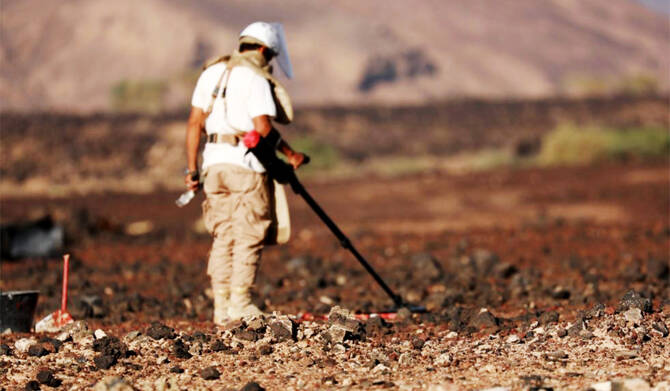
The project trains local demining engineers and provides them with modern equipment. (Supplied)
Short Url
Updated 20 July 2025
Follow

Saudi project clears 971 explosive devices in Yemen

  • The demining operations took place in Marib, Aden, Jouf, Shabwa, Taiz, Hodeidah, Lahij, Sanaa, Al-Bayda, Al-Dhale and Saada

RIYADH: Members of Saudi Arabia’s Project Masam removed 971 explosive devices from various regions of Yemen last week.

The total included 891 unexploded ordnance, 78 anti-tank mines, one anti-personnel mine and one improvised explosive device, according to a recent report.

Ousama Al-Gosaibi, the initiative’s managing director, said that 506,437 mines have been cleared since the project began in 2018.

The explosives were planted indiscriminately and posed a threat to civilians, including children, women and the elderly.

The demining operations took place in Marib, Aden, Jouf, Shabwa, Taiz, Hodeidah, Lahij, Sanaa, Al-Bayda, Al-Dhale and Saada.

Project Masam trains local demining engineers and provides them with modern equipment. It also offers support to Yemenis injured by the devices.

Teams are tasked with clearing villages, roads and schools to facilitate the safe movement of civilians and the delivery of humanitarian aid.


Pioneering electric bus service takes to the road in Makkah

Updated 19 December 2025
Follow

Pioneering electric bus service takes to the road in Makkah

  • The bus rapid transit project, a system designed to have higher capacity and reliability than conventional bus services, is said to be the first of its kind in the Kingdom
  • The vehicles operate in dedicated bus lanes within a network that includes two main bus stations and 11 stops along the route connecting them

MAKKAH: A pioneering electric bus service took to the road in Makkah this week.

Electromin, the developer and operator of the service in partnership with Umm Al-Qura for Development and Construction, said it is expected to serve more than 125 million passengers over the next 15 years, while cutting carbon dioxide emissions by more than 31,500 tonnes compared with traditional vehicles.

The bus rapid transit project, a system designed to have higher capacity and reliability than conventional bus services, is said to be one of the first of its kind in the Kingdom. It was inaugurated on Wednesday by Amr Al-Dabbagh, chairperson of Al-Dabbagh Group; Samir Nawar, managing director of Petromin; and Yasser Abu Ateeq, CEO of Umm Al-Qura.

The bus rapid transit project is designed to have higher capacity and reliability than conventional bus services. (Supplied)

Electromin, a subsidiary of Petromin specializing in energy and mobility solutions, said the new service, which forms part of the Masar Destination mixed-use real estate development project in Makkah, is one the first transport networks of its kind in the country, and represents a significant shift toward a cleaner, more efficient urban transport model.

It operates in dedicated bus lanes, connecting key hubs within Masar and providing safe, reliable and environmentally friendly transportation for residents and visitors, the company added. The network includes two main bus stations and 11 stops along the route connecting them. It has been designed to serve more than 5 million visitors and pilgrims annually, and to be easily accessible to all users.

Operators say the service is designed as a foundation for Makkah’s future transportation system, through its integration with the broader Masar project, which includes pedestrian walkways, more than 5,000 parking spaces, metro services and other urban infrastructure.