MAKKAH: The Custodian of the Two Holy Mosques Institute for Hajj and Umrah Research continues to provide academic studies in the transportation system and smart applications fields, essential for pilgrims during the Hajj.
“The Institute constitutes a beacon of knowledge and a main tributary in Hajj studies, as it always seeks to find accurate studies to improve and accelerate the pace of service delivery in the Hajj system,” said the dean of the institute, Dr. Adnan Al-Shahrani, in an interview with Arab News.
According to Al-Shahrani, members of the institute, located at Umm Al-Qura University, have contributed to keeping abreast of developments in various fields including engineering, urban, environmental, health, and media, in addition to the humanitarian, administrative, informatics, and technology fields, and many others related to facilitating pilgrims’ Hajj and Umrah rituals.
“Research projects related to transportation in Makkah, Madinah, and holy sites, are among the institute’s top priorities handled in the Urban and Engineering Research Department. There are specialized professors continuously working on evaluating and developing the current situation through exchanging thoughts, studies, and programs designed to develop the transportation system and delivering it to the relevant authorities,” said Al-Shahrani.
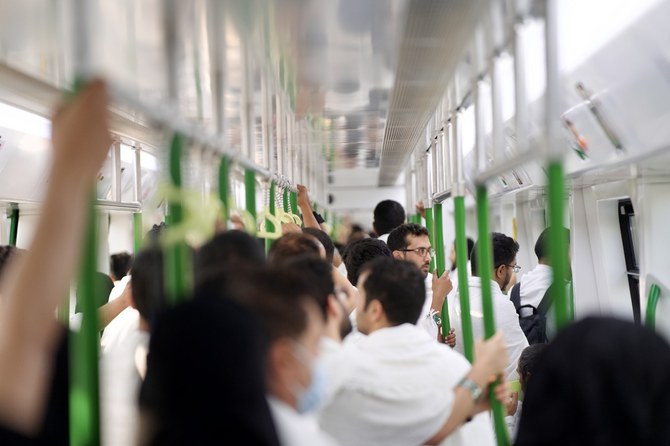
These projects include the shuffle transportation project in the holy sites, in addition to Al-Mashaaer Al-Mugaddassah Metro Line, which serves all categories of Hajj and Umrah pilgrims.
Dr. Khalid Osra, a professor of transportation and traffic engineering at the institute, has been studying the challenges of transportation during the Hajj since 1995, when the first phase of the shuttle-bus transportation system was implemented between the holy sites. The benefits came from separating pedestrian movement from vehicles without interference, which improves traffic safety and reduces the transit times.
“The time required for transit, which used to take hours, was reduced to only 20 minutes,” Osra said.
“One of the most important advantages of this system is reducing the number of buses used in the fleet by reusing each bus on multiple different trips. Therefore, the bus is not dedicated to transporting a specific group of pilgrims, but rather it transports the largest possible number of pilgrims between the holy sites by reusing the same bus. This results in saving at least 25 percent of the operational fleet,” he said.
Osra highlighted that this caused the congestion level on roads to decrease, reduced noise levels and emissions from fuel, and improved air quality.
“The institute evaluates the transportation plan annually by measuring the transit times between the holy sites, as well as passenger loading times at loading stations and providing recommendations to enhance the positives and address any challenges,” he added.
The institute conducted another evaluation of an existing plan through its studies in 2011. This plan aimed to unify the direction of traffic movement from Mina to the Grand Mosque in Makkah on some roads on 12 Dhu Al-Hijjah, as approximately 70 percent of pilgrims leave Mina on this day every year.
“The direction of some roads was changed from Mina toward the Holy Mosque in Makkah because the traffic density on these roads in the opposite direction (entering Makkah) is low. Several years prior, the institute recommended prohibiting the entry of low-capacity vehicles into the holy sites. The institute also implemented an annual program to count the number of vehicles of various types on the roads connecting the holy sites. During Ramadan, the institute played a collaborative role by keeping the cars of pilgrims in parking lots outside the central area and using buses to enter the central area, thereby reducing traffic congestion caused by the high number of small vehicles in the holy capital,” he said.
Al-Shahrani stated the institute accords great importance to using computerized and digital technologies to develop the Hajj system, in line with the Kingdom’s Vision 2030 as one of the main digital transformation and artificial intelligence enablers.
“The institute’s research studies rely on digitization and artificial intelligence in transportation, subsistence, health, and future predictions of risks and disease outbreaks fields, as our researchers use these technologies to monitor the pilgrim’s health condition, for instance, improve the crowd movement management, and monitor and evaluate the quality of catering services in cooperation with government entities and charitable organizations,” he said.
Al-Shahrani mentioned the institute has carried out several studies requiring the use of AI, including a study concerned with analyzing the pilgrims’ feelings.
He highlighted that results from recent research was presented during the 22nd Scientific Forum for Hajj, Umrah, and Visit Research, including on smart applications, such as crowd simulation apps, and the simulation of pilgrims going to Muzdalifah.


![]()
![]()

Institute of Hajj and Umrah Research lists Makkah transportation challenges among its top priorities

Short Url
https://arab.news/b66x9
Institute of Hajj and Umrah Research lists Makkah transportation challenges among its top priorities
- “The Institute constitutes a beacon of knowledge and a main tributary in Hajj studies,” said the dean of the institute, Dr. Adnan Al-Shahrani
- According to Al-Shahrani, members of the institute, located at Umm Al-Qura University, have contributed to keeping abreast of developments in various fields


Latest updates


© 2026 SAUDI RESEARCH & PUBLISHING COMPANY, All Rights Reserved And subject to Terms of Use Agreement.