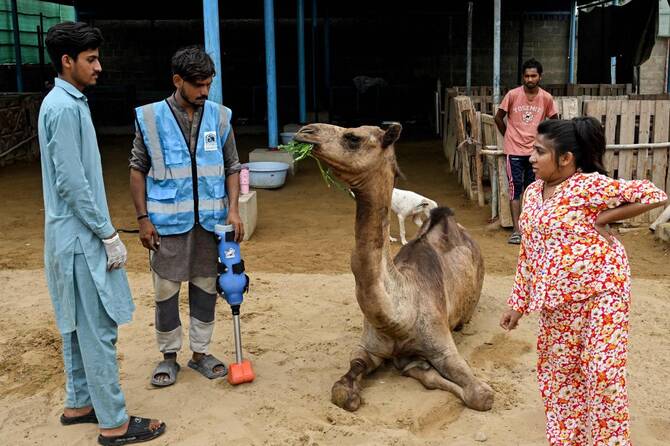
Pakistani camel relearns to walk with prosthetic leg

This photograph shows Sheema Khan (R), manager of the CDRS Benji animal welfare project standing beside a healthcare provider holding a prosthetic leg tailored for Cammie, an amputee camel at the shelter house in Karachi. (AFP)
Short Url
Updated 21 July 2025
Follow

Pakistani camel relearns to walk with prosthetic leg

  • Cammie’s leg was allegedly severed by a landlord in June 2024 as punishment for entering his field in search of fodder

KARACHI: Cammie, a young camel whose front leg was chopped off by a landlord in Pakistan’s southern province of Sindh, left her caregivers emotional as she walked for the first time on a prosthetic leg.
“I started weeping when I saw her walking with the prosthetic leg. It was a dream come true,” Sheema Khan, the manager of an animal shelter in Karachi told AFP on Saturday.
Veterinarian Babar Hussain said it was the first time a large animal in Pakistan had received a prosthetic leg.
Cammie’s leg was allegedly severed by a landlord in June 2024 as punishment for entering his field in search of fodder.
A video of the wounded camel that circulated on social media prompted swift government action.
According to the deputy commissioner of Sanghar, she was transported the very next day to Karachi, over 250 kilometers (155 miles) away, and has been living in a shelter there ever since.
“She was terrified when she first arrived from Sanghar. We witnessed her heart-wrenching cries. She was afraid of men,” Khan told AFP.
One of the biggest challenges the caregivers faced was gaining her trust.
“I cannot put her condition into words,” Khan added.
To aid her recovery, the caregivers introduced another young camel named Callie. Her presence brought comfort to the injured Cammie, who tried standing on her three legs for the first time after seeing her new companion.
“Cammie had been confined to her enclosure for almost four to five months before Callie arrived,” Khan added.
After treating the wound and completing initial rehabilitation, the shelter — Comprehensive Disaster Response Services (CDRS) Benji Project — arranged a prosthetic leg from a US-based firm so she could walk on all fours again.
“We don’t force her to walk. After attaching the prosthetic leg, we wait about 15 to 20 minutes. Then she stands up on her own and walks slowly,” veterinarian Hussain told AFP.
He said that it would take another 15 to 20 days for her to fully adjust to the new limb.
The caregivers said Cammie will remain at the shelter permanently.


Thai coffee chains cut default sugar content in coffee and tea drinks in a new health push

Updated 11 February 2026
Follow

Thai coffee chains cut default sugar content in coffee and tea drinks in a new health push

  • The Health Department says Thais consume 21 teaspoons of sugar daily, far exceeding the World Health Organization’s recommended six teaspoons
  • Officials warn this increases obesity and diabetes risks. A survey found iced coffee and bubble tea contain high sugar levels

BANGKOK: For many Thais, a meal doesn’t feel complete without an iced coffee or tea so sugary it could pass for dessert. The government, concerned about the health consequences, wants them to dial it back.
Starting Wednesday, nine major coffee chains across the country have pledged to cut the default sugar content in some of their drinks by half in a government initiative aimed at tackling excessive sugar consumption.
According to the Health Department, Thais consume an average of 21 teaspoons of sugar per day, more than three times the World Health Organization’s recommended limit of six teaspoons. Health officials warn that such high intake increases the risk of obesity, diabetes and other diseases.
The initiative is the first significant step to change consumers’ sugar consumption behavior, said Amporn Benjaponpitak, the director general of the department.
Pakorn Tungkasereerak, the department’s deputy, said 2025 data show that about 45 percent of Thais aged 15 and older are obese, while 10 percent of the population has diabetes.
A survey by the Bureau of Nutrition found that a 22-ounce (650-milliliter) iced coffee contains an average of nine teaspoons of sugar, while a 10-ounce (300-milliliter) serving of bubble milk tea — an iced milk tea with tapioca pearls known as boba — can contain as much as 12 teaspoons.
Sirinya Kuiklang, an office worker, said she approves of the changes. She already orders her drinks at just 25 percent of the standard sugar level, but she is aware that many others consume too much sugar.
“It’s good for Thai people,” she said.
Another office worker, Porwares Tantikanpanit, said he has enjoyed his non-coffee beverages at their current sugar levels but is willing to adjust if shops reduce the sweetness.
However, putting the policy into practice may prove challenging. Officials have said each brand can apply the initiative as they see fit.
Some customers have expressed confusion in response to social media posts promoting the initiative, asking how to order drinks with the level of sweetness that they prefer. Several brands said that the reduction applies only to certain menu items.