

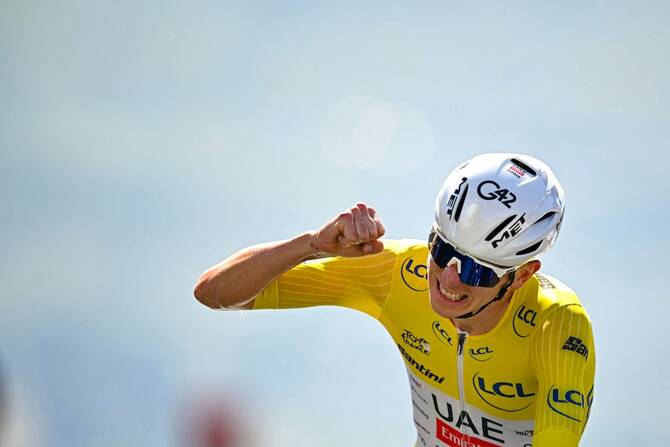
Pogacar extends Tour de France lead with dominant time-trial win

Tadej Pogacar powered to victory in an uphill time trial on stage 13 of the Tour de France on Friday to stretch his lead in the race to more than four minutes. (AFP)
Short Url
Updated 19 July 2025
Follow

Pogacar extends Tour de France lead with dominant time-trial win

  • Pogacar was last down the start ramp of the 171 riders setting off and stunned rivals by using a road bike instead of one typically used for time trials
  • Saturday’s stage 14 is another punishing affair with around 50km of climbing but it will likely be raced in rain

PEYRAGUDES, France: Tadej Pogacar powered to victory in an uphill time trial on stage 13 of the Tour de France on Friday to stretch his lead in the race to more than four minutes.

Jonas Vingegard and Remco Evenepoel clung on to their places in the overall top three, but this 10.9km time-trial triumph was defending champion Pogacar’s second crushing win in two days.

Pogacar was last down the start ramp of the 171 riders setting off and stunned rivals by using a road bike instead of one typically used for time trials.

“It’s more comfortable and I ride that 95 percent of the year,” he explained. “I went without a radio too, there are time clocks along the way so I just looked at them.”

Decked out in his overall leader’s yellow kit, the 26-year-old Team UAE rider was faster from the off, despite his exertions from the previous day, when he finished over two minutes ahead of main rival Vingegaard.

“I was feeling good all day, from when I got up. I was planning to go all in from start to finish and that’s what I did,” said Pogacar, who won the Tour de France in 2020, 2021 and 2024.

Pogacar had a sticker of the Hulk comic book superhero on his bike but said after the stage his hero was Spider-Man.

“Hulk though, he’s the one you don’t want to make angry,” said Pogacar.

By the time he finished stage 13 at the Peyragudes Altiport where the opening scene of the James Bond movie “Tomorrow Never Dies” was shot, Pogacar was 36 seconds faster than Vingegaard, while Primoz Roglic was third at 1min 20sec.

Evenepoel was overtaken close to the line by Vingegaard, but said he was too tired to care.

“I was drained,” he said, slumped in a chair. “I didn’t give a damn when Jonas went past.”

“I just wanted to finish. To be honest I’m relieved it’s over,” said the double Olympic champion.

Most riders warmed up for the time trial wearing ice jackets to combat the sizzling 30C temperature at the foot of the climb.

Australian champion Luke Plapp set the early pace and sat in the hot seat all day before suddenly packing his case and vacating it on seeing Vingegaard storm up the mountain.

Pogacar was even faster.

At 1580m altitude the ride remained beneath the clouds and below the treeline, but even atop the hill it was punishingly hot.

American Quinn Simmons gave hundreds of high-fives on the home straight as one of the rare riders appearing to enjoy the climb.

Saturday’s stage 14 is another punishing affair with around 50km of climbing but it will likely be raced in rain.

It starts with the famous Col de Tourmalet and ends at the Luchon-Superbagneres ski resort.

Stage 15 is a hilly run to the walled city of Carcassonne but for Pogacar there remains the specter of three more massive mountain stages in the final week.

There is also the prospect of potential chaos in Paris with three ascents of Montmartre’s old cobbled lanes on the final day.


Africa Cup of Nations moved to every four years

Updated 59 min 18 sec ago
Follow

Africa Cup of Nations moved to every four years

  • The tournament, which brings in an estimated 80 percent of CAF’s revenue, has traditionally been held every two years since its inception in 1957

RABAT: The Africa Cup of Nations will in future be held every four years instead of every two years, the Confederation ​of African Football said on Saturday.
The surprise decision was made at the body’s executive committee meeting in the Moroccan capital and announced at a press conference by CAF President Patrice Motsepe.
The tournament, which brings in an estimated 80 percent of CAF’s revenue, has traditionally been held every two years since its inception in 1957.
Sunday marks the start of the ‌35th edition, ‌hosted in Morocco with the home ‌team ⁠taking ​on ‌Comoros.
Motsepe said the next Cup of Nations finals, scheduled for 2027 in Kenya, Tanzania and Uganda, will go ahead and then another tournament would be held in 2028 but after that it will be hosted every four years.
Motsepe announced the launch of an African Nations League annually from 2029 to fill the ⁠gap, following the example of Europe which holds its championship every four years.
“Historically ‌the Nations Cup was the prime ‍resource for us but now ‍we will get financial resources every year,” he said.
“It ‍is an exciting new structure which will contribute to sustainable financial independence and ensure more synchronization with the FIFA calendar.”
Holding the Cup of Nations every four years had been previously proposed by FIFA ​President Gianni Infantino but this had been rebuffed by CAF because of their reliance on the revenues ⁠that the tournament generates.
The timing of AFCON has long courted controversy because it has usually been hosted in the middle of the European season, forcing clubs to release their African players.
This tug of loyalty was supposed to be solved by moving the Cup of Nations to mid-year from 2019 but later tournaments in Cameroon in 2022 and Ivory Coast in 2024 were again hosted at the start of the year.
This year’s tournament in Morocco was moved back six months when FIFA introduced ‌a new-look Club World Cup, which was hosted in the US in June and July.