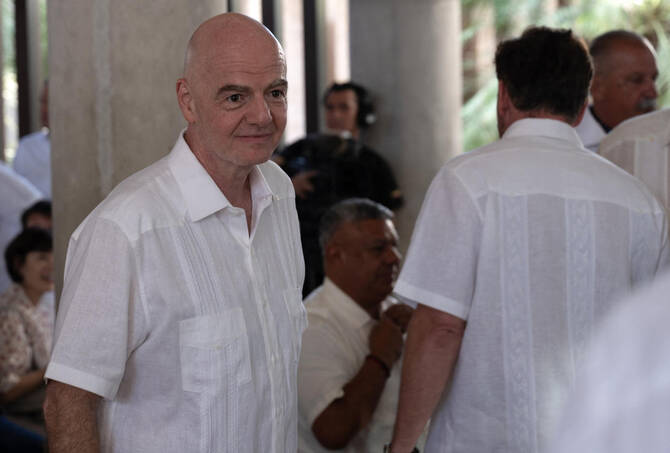
BARRANQUILLA: FIFA boss Gianni Infantino told AFP on Tuesday he was “very reassured” about Mexico’s hosting of games in the football World Cup, in his first comments on the violence triggered by the killing of a drug cartel leader.
“Very reassured, everything’s good. It’s going to be spectacular,” Infantino said in the Colombian city of Barranquilla, two days after cartel members went on a rampage — including in host city Guadalajara — over the army’s killing of their leader Nemesio “El Mencho” Oseguera.
Mexico is one of the three host countries for the June 11-July 19 World Cup, along with the United States and Canada.
The country as a whole, but particularly Guadalajara, was shaken by the violence that followed the killing of the leader of the powerful Jalisco New Generation Cartel (CJNG).
At least 74 people were killed during the operation to capture him at a ranch near Guadalajara and subsequent clashes between the security forces and suspected cartel members.
Only one was a civilian, according to the government, but residents and tourists alike were left scurrying for cover as cartel gunmen blocked roads in 20 of Mexico’s 32 states and torched vehicles and businesses.
- ‘No risk’ to football fans -
“It feels like we’re in a war zone,” Javier Perez, a 41-year-old engineer, told AFP on Tuesday in the parking lot of a grocery store replete with burnt-out cars in the Jalisco tourist resort of Puerto Vallarta.
The images of anarchy and violence were beamed around the world less than four months before the start of the World Cup, while FIFA on Monday refused to comment.
Infantino spoke to AFP at a Colombian Football Federation event.
However, Infantino’s optimism was not reflected by the Portuguese Football Federation, who cast doubt on whether their team would play a friendly on March 29 in Mexico City.
The federation said it was “closely monitoring the delicate situation currently unfolding in Mexico.”
It added that the safety of players, coaches and supporters was a top priority and security considerations would be the deciding factor.
Mexico national team coach Javier Aguirre was more upbeat, declaring: “All is going ahead as planned.”
Earlier, Mexican President Claudia Sheinbaum assured that there was “no risk” to World Cup fans and said the situation was “gradually returning to normal.”
Guadalajara, the capital of Jalisco state, will host four group-stage matches.
Mexico City and the northeastern city of Monterrey will also host games. Both cities were spared by the recent unrest.
In addition to the four matches, including one of the most anticipated of the first round between Uruguay and Spain, Guadalajara will co-host with Monterrey the playoff tournament that will determine the last two teams to qualify for the World Cup at the end of March.
Jalisco Governor Pablo Lemus ruled out the prospect of Guadalajara being dropped from the tournament over security concerns, saying there was “absolutely no risk” of a change in the line-up.
All eyes will be on the central state of Queretaro on Wednesday, when Mexico meets Iceland for a friendly.
A first-division game was suspended on Sunday in Queretaro over the violence.
- Car manufacturing affected -
Oseguera was one of the most-wanted men in the United States and Mexico. He had a $15 million US bounty on his head.
Oseguera was a founding member of CJNG, which was formed in 2009 and grew into one of the biggest, most violent drug cartels in Mexico, overtaking the Sinaloa cartel of jailed kingpin Joaquin “El Chapo” Guzman.
Mexico confirmed that he was captured with the help of “complementary information” from US authorities, but insists no US forces took part in the raid.
As the fallout from the violence continued to reverberate nationwide, Japanese car manufacturer Honda announced that it had suspended activities at its assembly plant in Guadalajara.
“As a precautionary measure, our operations in our installations in Guadalajara were temporarily suspended on Monday, February 23,” Daniela Sanchez, a spokesperson for the car factory, told AFP, explaining that the automotive giant was currently “assessing the (security) situation.”
Mexico is a major automotive hub with several major manufacturers, including Ford, General Motors, BMW, and Audi, assembling vehicles in the country for the North American and European markets.

FIFA boss ‘very reassured’ about World Cup in Mexico despite violence
https://arab.news/vj3yk
FIFA boss ‘very reassured’ about World Cup in Mexico despite violence
- Mexico is one of the three host countries for the June 11-July 19 World Cup, along with the United States and Canada
In Lahore’s historic Walled City, Ramadan fills the rows at Mughal-era Sunehri Mosque
- Experts call for restoration of the 18th-century mosque amid encroachments and structural strain
- Generations of traders shift their work schedules in Ramadan to gather for iftar and nightly prayers
LAHORE, Pakistan: In Old Lahore’s Kashmiri Bazaar, Ramadan changes the rhythm of trade.
By late afternoon, shop shutters begin to drop halfway and traders step away from their counters. Within minutes, the courtyard of Sunehri Mosque begins to fill.
On most days, the 18th-century mosque holds just a few rows of worshippers. In Ramadan, that number more than doubles.
“It has been 27 years since I have been leading the prayers here,” Qari Mohammed Hanif, the 47-year-old imam at the mosque, told Arab News. “On normal days, there are four to five rows. But in Ramadan, the mosque fills completely. People stand till the lower end.”
The congregation is largely drawn from the surrounding market — shopkeepers, traders and workers who close their businesses and walk directly into prayer.
For many, the mosque is inseparable from livelihood.
“I have a shop at Sunehri Masjid,” said Nasir Mehmood, 46, who runs a yarn business steps away. “This is our third generation running the shop. First it was my grandfather, then my father and now us. The shop is 50 years old.”
He said that at the beginning of Ramadan, he breaks his fast at home with his family. As the month progresses, the routine shifts.
“We start breaking our fast here at the shop, together with our friends and fellow shopkeepers. We also offer Taraweeh prayers here,” he continued, referring to the special Ramadan prayer performed after the obligatory Isha prayer at night.
Working hours extend as well.
“For the first three to four fasts, we come at 12 p.m. and leave after Asar prayers,” said Sheikh Mohammed Saleem, 50, who runs a clothing shop nearby. “After that, our routine changes. We open at 11 a.m. and stay until 12 a.m. at night, continuing this schedule until the last fast of Ramadan.
“Some food is brought from home, and some we buy from the market,” he added. “All of us gather together to break our fast.”
Others return year after year for spiritual reasons.
“I have been coming here for 11 years,” said Mohammed Rafique, 45. “Whenever I am in this area, I always come to this mosque. I find peace here, peace in my heart. There is something from Allah. I cannot explain it. Whenever I come here, I try to break my fast here.”
Even younger traders feel a strong attachment to the space. Abdullah, 25, who gave only one name, said the mosque has become part of his working life.
“I have a shop in Lahore’s Rang Mehal, in Kasera Bazaar, under Sunehri Masjid,” he said. “I have been here for three years. The environment here is very good, the people are good.”
GILDED DOMES
The building that fills so quickly during Ramadan was constructed in 1753 during the later Mughal period by Nawab Bhikari Khan, a deputy governor of Lahore. Its three gilded domes gave it the name “Sunehri,” meaning golden.
Unlike imperial Mughal mosques built in expansive courtyards, Sunehri Mosque was embedded within a functioning marketplace. It rose not in isolation but among shops, a structure woven into commercial life rather than set apart from it.
“The Sunehri Mosque is small in scale because it was built during the decline of the Mughal Empire, a time when political power had weakened and resources were limited,” cultural heritage expert Saad Zahid told Arab News. “Its modest size and comparatively simple detailing reflect this period of reduced imperial strength.
“Unlike earlier Mughal monuments, it does not display the same richness or refinement, making it an important example of late Mughal architecture in Lahore,” he added.
Lahore, once a major administrative and cultural center of the Mughal Empire, saw numerous mosques constructed at the height of imperial power. Like most of them, Sunehri Mosque’s courtyard also featured a central pond, a hallmark of Mughal mosque design, though visitors usually find it dry these days.
Sunehri Masjid
While the mosque remains active and crowded during Ramadan, aspects of its physical condition raise concern.
The historic shops built beneath the mosque are now heavily encroached upon, obscuring parts of the mosque’s facade. Piles of wooden ladders and used boxes are stacked along sections of the structure. Tangled electricity wires hang across and above the building, cutting through the visual line of its domes. In some areas, residents hang washed clothes along its outer walls to dry.
B
Behind the mosque lies Baoli Bagh, once associated with an important Sikh-era gurdwara site, which Zahid said also deserves conservation.
He also argued that, like the Badshahi and Wazir Khan mosques, Sunehri Mosque should remain open to visitors beyond prayer times and be more actively promoted as part of Lahore’s historic landscape.
“The frescoes inside the mosque today appear overly bright and artificial. The original Mughal paintings were likely more subtle in tone, suggesting that later interventions have altered its authentic appearance,” he said, emphasizing the urgency of the building’s careful restoration to protect original design, materials and architectural identity rather than replace them with new construction.