

France faces another tough wheat export year despite better crop

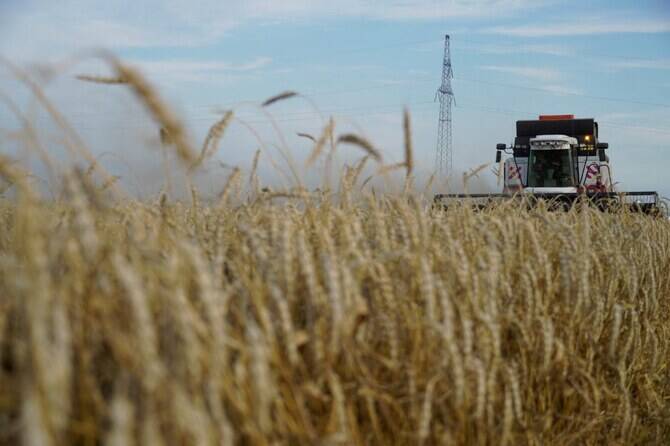
France could struggle to sell a much bigger wheat crop expected this year as export options for the European Union's top wheat producer have narrowed due to less demand from Algeria and China as well as strong competition from cheaper Black Sea grain. (AFP/File)
Short Url
Updated 18 July 2025
Follow

France faces another tough wheat export year despite better crop

  • Sales to Algeria and China, among France’s biggest wheat buyers in recent years, stalled last season due to a diplomatic fallout between Paris and Algiers
  • A smaller than normal 2024 French crop meant steady demand from Morocco and West Africa, plus sporadic sales to Egypt and Thailand

PARIS/HAMBURG: France could struggle to sell a much bigger wheat crop expected this year as export options for the European Union’s top wheat producer have narrowed due to less demand from Algeria and China as well as strong competition from cheaper Black Sea grain.

Sparse overseas demand could lead France to stock hefty amounts of wheat or offload more crop in livestock feed markets. Either outcome could keep prices below production costs, a trend that has fueled farmer protests in the past year.

Farm office FranceAgriMer on Wednesday projected French soft wheat exports outside the EU in 2025/26 at a relatively modest 7.5 million metric tons, contributing to a forecast 21-year high for end-of-season stocks.

Sales to Algeria and China, among France’s biggest wheat buyers in recent years, stalled last season due to a diplomatic fallout between Paris and Algiers and a general drop in Chinese imports amid hefty domestic supply.

A smaller than normal 2024 French crop meant steady demand from Morocco and West Africa, plus sporadic sales to Egypt and Thailand, absorbed last season’s surplus. But that may no longer be enough.

“The harsh reality is that France has a huge challenge to reach a 7.5 million ton export program,” Rory Deverell, owner of Black Silo Commodity Consulting, said.

A price rise in Russia amid tight availability in the world’s biggest wheat supplier may offer only brief respite, with Russian and other Black Sea region producers expected to sweep up near-term demand, as shown by this week’s 1 million ton purchase by Algeria.

“Russia, Ukraine, Romania and Bulgaria are likely to dominate wheat exports in coming months,” a German trader said. “The west EU faces the threat of being only a niche wheat exporter.”

Like France, Germany and Poland may struggle too, with overall EU exports again set to be bolstered by Black Sea neighbors Romania and Bulgaria.

A rally in the euro against the dollar this year, a repercussion of US President Donald Trump’s policies, represents another export headwind.

Lower-priced feed markets may provide opportunities for western European wheat, especially if the harvest struggles to meet milling specifications, with traders reporting talk of some low protein levels plus the risk that this week’s rain might damage the quality of unharvested wheat.

That could mean exports to distant destinations in southeast Asia, or shipments within the EU, with the return of EU quotas on Ukrainian wheat reducing competition for feed wheat inside the bloc.

But traders say a bumper harvest in Spain will also curb demand from the traditionally major EU buyer, while wheat will face feed competition from maize as well. FranceAgriMer anticipates stable French intra-EU exports versus last season.

“It is hard to see where west EU wheat could be sold,” another German trader said.


UN peacekeepers defy South Sudan military’s order to leave opposition-held town

Updated 5 sec ago
Follow

UN peacekeepers defy South Sudan military’s order to leave opposition-held town

JUBA, South Sudan: The United Nations Mission in South Sudan said Monday that it would not comply with a government order to shut down its base in Akobo, an opposition stronghold near the Ethiopian border where tens of thousands of refugees have fled.
On Friday, the South Sudanese army ordered UN peacekeepers as well as NGOs and civilians to vacate the town ahead of a planned assault.
But the mission refused to leave and said it would provide “a protective presence for civilians” in the town, adding that the safety and security of its personnel “must be fully respected at all times.”
The UN Mission said it was engaging “intensively with national, state and local stakeholders” regarding this order. “Any military operations in and around Akobo gravely endanger the safety and security of civilians,” said mission chief Anita Kiki Gbeho.
The South Sudanese government has been fighting opposition forces since a 2018 peace deal broke down about a year ago.
A dramatic escalation took place in December 2025, when opposition forces seized several government outposts in northern Jonglei. A government counter-offensive repelled their forces a month later and displaced over 280,000 people. Tens of thousands have sought refuge in Akobo, where a small contingent of UN peacekeepers is stationed.
Fearing the looming government assault on Akobo, humanitarian workers were evacuated over the weekend, and a mass exodus of the population has also begun.
Local officials contacted by the The Associated Press said fleeing civilians faced danger and widespread shortages of essential supplies. Dual Diew, the Akobo County health director, who has fled to Ethiopia, said there were 84 wounded patients at the hospital. “We have most of them with us here now,” he said, adding that they lack medicine and basic nursing equipment.
Christophe Garnier, the leader of Doctors Without Borders in South Sudan said the organization had to evacuate its staff from Akobo on Saturday and learned of the subsequent looting of its hospital and the ransacking of its office.
“People in Akobo must now either flee without protection or remain at risk of being killed, while losing access to health care and other essential services,” he said.
The three Western governments that have played a major role in the peace process — the U.S, UK, and Norway — sent a letter to President Kiir on Monday urging that the army’s evacuation order be revoked and warning of “further deaths, displacement and suffering for the South Sudanese people” if the offensive on Akobo is implemented.