

From Antarctica to Brussels, hunting climate clues in old ice

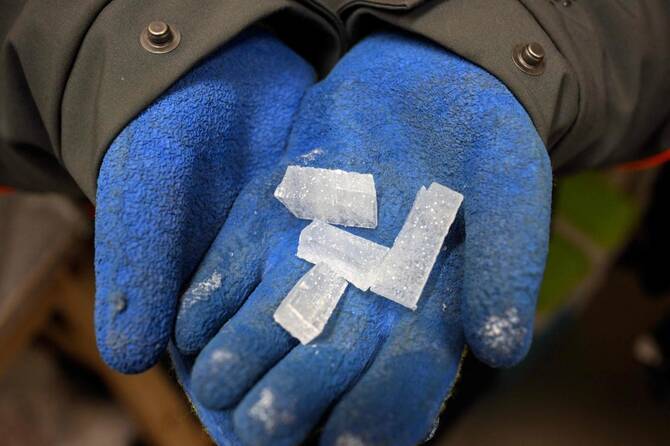
In a small, refrigerated room at a Brussels university, parka-wearing scientists chop up Antarctic ice cores tens of thousands of years old in search of clues to our planet’s changing climate. (AFP)
Short Url
Updated 18 July 2025
Follow

From Antarctica to Brussels, hunting climate clues in old ice

  • In a small, refrigerated room at a Brussels university, parka-wearing scientists chop up Antarctic ice cores tens of thousands of years old in search of clues to our planet’s changing climate

BRUSSELS: In a small, refrigerated room at a Brussels university, parka-wearing scientists chop up Antarctic ice cores tens of thousands of years old in search of clues to our planet’s changing climate.
Trapped inside the cylindrical icicles are tiny air bubbles that can provide a snapshot of what the earth’s atmosphere looked like back then.
“We want to know a lot about the climates of the past because we can use it as an analogy for what can happen in the future,” said Harry Zekollari, a glaciologist at Vrije Universiteit Brussel (VUB).
Zekollari was part of a team of four that headed to the white continent in November on a mission to find some of the world’s oldest ice — without breaking the bank.
Ice dating back millions of years can be found deep inside Antarctica, close to the South Pole, buried under kilometers of fresher ice and snow.
But that’s hard to reach and expeditions to drill it out are expensive.
A recent EU-funded mission that brought back some 1.2-million-year-old samples came with a total price tag of around 11 million euros (around $12.8 million).
To cut costs, the team from VUB and the nearby Universite Libre de Bruxelles (ULB) used satellite data and other clues to find areas where ancient ice might be more accessible.

Just like the water it is made of, ice flows toward the coast — albeit slowly, explained Maaike Izeboud, a remote sensing specialist at VUB.
And when the flow hits an obstacle, say a ridge or mountain, bottom layers can be pushed up closer to the surface.
In a few rare spots, weather conditions like heavy winds prevent the formation of snow cover — leaving thick layers of ice exposed.
Named after their coloration, which contrasts with the whiteness of the rest of the continent, these account for only about one percent of Antarctica territory.
“Blue ice areas are very special,” said Izeboud.
Her team zeroed in on a blue ice stretch lying about 2,300 meters (7,500 feet) above sea level, around 60 kilometers (37 miles) from Belgium’s Princess Elisabeth Antarctica Research Station.
Some old meteorites had been previously found there — a hint that the surrounding ice is also old, the researchers explained.
A container camp was set up and after a few weeks of measurements, drilling, and frozen meals, in January the team came back with 15 ice cores totalling about 60 meters in length.
These were then shipped from South Africa to Belgium, where they arrived in late June.
Inside a stocky cement ULB building in the Belgian capital, they are now being cut into smaller pieces to then be shipped to specialized labs in France and China for dating.
Zekollari said the team hopes some of the samples, which were taken at shallow depths of about 10 meters, will be confirmed to be about 100,000 years old.
This would allow them to go back and dig a few hundred meters deeper in the same spot for the big prize.
“It’s like a treasure hunt,” Zekollari, 36, said, comparing their work to drawing a map for “Indiana Jones.”
“We’re trying to cross the good spot on the map... and in one and a half years, we’ll go back and we’ll drill there,” he said.
“We’re dreaming a bit, but we hope to get maybe three, four, five-million-year-old ice.”
Such ice could provide crucial input to climatologists studying the effects of global warming.
Climate projections and models are calibrated using existing data on past temperatures and greenhouse gases in the atmosphere — but the puzzle has some missing pieces.
By the end of the century temperatures could reach levels similar to those the planet last experienced between 2.6 and 3.3 million years ago, said Etienne Legrain, 29, a paleo-climatologist at ULB.
But currently there is little data on what CO2 levels were back then — a key metric to understand how much further warming we could expect.
“We don’t know the link between CO2 concentration and temperature in a climate warmer than that of today,” Legrain said.
His team hopes to find it trapped inside some very old ice. “The air bubbles are the atmosphere of the past,” he said. “It’s really like magic when you feel it.”


Italian cooking and its rituals get UN designation as world heritage

Updated 10 December 2025
Follow

Italian cooking and its rituals get UN designation as world heritage

  • UNESCO added the rituals surrounding Italian food preparation and consumption to its list of the world’s traditional practices and expressions

ROME: Italian food is known and loved around the world for its fresh ingredients and palate-pleasing tastes, but on Wednesday, the UN’s cultural agency gave foodies another reason to celebrate their pizza, pasta and tiramisu by listing Italian cooking as part of the world’s “intangible” cultural heritage.
UNESCO added the rituals surrounding Italian food preparation and consumption to its list of the world’s traditional practices and expressions. It’s a designation celebrated alongside the more well-known UNESCO list of world heritage sites, on which Italy is well represented with locations like the Rome’s Colosseum and the ancient city of Pompeii.
The citation didn’t mention specific dishes, recipes or regional specialties, but highlighted the cultural importance Italians place on the rituals of cooking and eating: the Sunday family lunch, the tradition of grandmothers teaching grandchildren how to fold tortellini dough just so, even the act of coming together to share a meal.
“Cooking is a gesture of love, a way in which we tell something about ourselves to others and how we take care of others,” said Pier Luigi Petrillo, a member of the Italian UNESCO campaign and professor of comparative law at Rome’s La Sapienza University.
“This tradition of being at the table, of stopping for a while at lunch, a bit longer at dinner, and even longer for big occasions, it’s not very common around the world,” he said.
Premier Giorgia Meloni celebrated the designation, which she said honored Italians and their national identity.
“Because for us Italians, cuisine is not just food or a collection of recipes. It is much more: it is culture, tradition, work, wealth,” she said in a statement.
It’s by no means the first time a country’s cuisine has been recognized as a cultural expression: In 2010, UNESCO listed the “gastrnomic meal of the French” as part of the world’s intangible heritage, highlighting the French custom of celebrating important moments with food.
Other national cuisines and cultural practices surrounding them have also been added in recent years: the “cider culture” of Spain’s Asturian region, the Ceebu Jen culinary tradition of Senegal, the traditional way of making cheese in Minas Gerais, Brazil.
UNESCO meets every year to consider adding new cultural practices or expressions onto its lists of so-called “intangible heritage.” There are three types: One is a representative list, another is a list of practices that are in “urgent” need of safeguarding and the third is a list of good safeguarding practices.
This year, the committee meeting in New Delhi considered 53 nominations for the representative list, which already had 788 items. Other nominees included the Swiss yodelling, the handloom weaving technique used to make Bangladesh’s Tangail sarees, and Chile’s family circuses.
In its submission, Italy emphasized the “sustainability and biocultural diversity” of its food. Its campaign noted how Italy’s simple cuisine valued seasonality, fresh produce and limiting waste, while its variety highlighted its regional culinary differences and influences from migrants and others.
“For me, Italian cuisine is the best, top of the range. Number one. Nothing comes close,” said Francesco Lenzi, a pasta maker at Rome’s Osteria da Fortunata restaurant, near the Piazza Navona. “There are people who say ‘No, spaghetti comes from China.’ Okay, fine, but here we have turned noodles into a global phenomenon. Today, wherever you go in the world, everyone knows the word spaghetti. Everyone knows pizza.”
Lenzi credited his passion to his grandmother, the “queen of this big house by the sea” in Camogli, a small village on the Ligurian coast where he grew up. “I remember that on Sundays she would make ravioli with a rolling pin.”
“This stayed with me for many years,” he said in the restaurant’s kitchen.
Mirella Pozzoli, a tourist visiting Rome’s Pantheon from the Lombardy region in northern Italy, said the mere act of dining together was special to Italians:
“Sitting at the table with family or friends is something that we Italians cherish and care about deeply. It’s a tradition of conviviality that you won’t find anywhere else in the world.”
Italy already has 13 other cultural items on the UNESCO intangible list, including Sicilian puppet theater, Cremona’s violin craftsmanship and the practice moving of livestock along seasonal migratory routes known as transhumance.
Italy appeared in two previous food-related listings: a 2013 citation for the “Mediterranean diet” that included Italy and half a dozen other countries, and the 2017 recognition of Naples’ pizza makers.
Petrillo, the Italian campaign member, said after 2017, the number of accredited schools to train Neapolitan pizza makers increased by more than 400 percent.
“After the UNESCO recognition, there were significant economic effects, both on tourism and and the sales of products and on education and training,” he said.