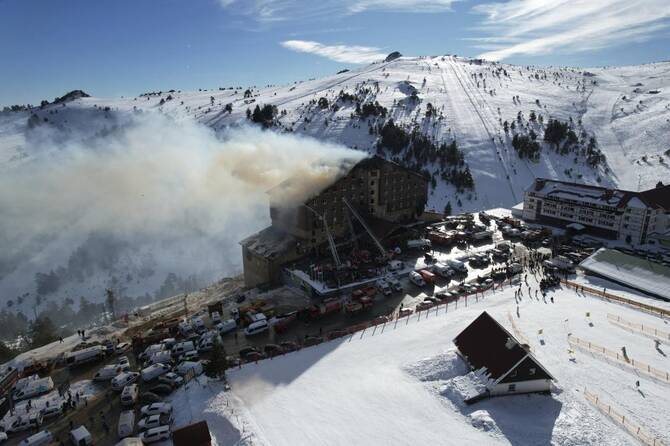
Turkish court postpones hearing over hotel fire

A Turkish court on Thursday adjourned the trial of 32 people over a fire January at a luxury ski resort hotel that killed 78 people, after 10 days of harrowing testimony. (AP/File)
Short Url
Updated 17 July 2025
Follow

Turkish court postpones hearing over hotel fire

  • The court is considering allegations that poor safety measures at the hotel contributed to the disaster
  • The different organizations under scrutiny denied responsibility

ISTANBUL: A Turkish court on Thursday adjourned the trial of 32 people over a fire January at a luxury ski resort hotel that killed 78 people, after 10 days of harrowing testimony.

Since the trial opened on July 7, survivors, many of them in tears, have told the court how they escaped the deadly blaze, whose victims included 36 children.

The fire swept through the Grand Kartal Hotel in the northern mountain resort of Kartalkaya on January 21.

As well as the 78 people killed in the fire, another 130 people were injured.

The court is considering allegations that poor safety measures at the hotel contributed to the disaster.

Among the defendants facing manslaughter charges are the hotel’s owner, managers, the deputy mayor of Bolu city and two fire department officials.

“Everyone including the employees and bosses lied in their initial statements,” said Yusuf Yaman, the private DHA news agency reported. Yaman lost his daughter and grand-daughter in the fire.

“We lost 78 lives. They’re all my children. If they (the suspects) had shown courage, if they had confessed everything, they would have had a clearer conscience,” he added.

After the fire, the different organizations under scrutiny denied responsibility, the tourism ministry and the local municipality run by the main opposition CHP party blaming each other.

At the end of the 10-day hearing, the hotel’s director and owner Emir Aras expressed regret. He told the judge he did not want to be released from detention, DHA reported.

The court postponed the hearing to September 22.


Thousands of Gaza children suffer from famine conditions

Updated 7 sec ago
Follow

Thousands of Gaza children suffer from famine conditions

  • “The number of children admitted is five times higher than in February, so we need to see the numbers come down further”

GENEVA: Thousands of children have been admitted for treatment for acute malnutrition in Gaza since an October ceasefire that was supposed to enable a major increase in humanitarian aid, the UN children’s agency said on Tuesday.
UNICEF, the biggest provider of malnutrition treatment in Gaza, said that 9,300 children were treated for severe acute malnutrition in October, when the first phase of an agreement to end the two-year Israel-Hamas war came into effect.

FASTFACTS

• UNICEF, the biggest provider of malnutrition treatment in Gaza, said that 9,300 children were treated for severe acute malnutrition in October. • While this is down from a peak of over 14,000 in August, the number is still significantly higher than during a brief February-March ceasefire.

While this is down from a peak of over 14,000 in August, the number is still significantly higher than during a brief February-March ceasefire and indicates that aid flows remain insufficient, UNICEF spokesperson Tess Ingram told a Geneva press briefing by video link from Gaza.
“It’s still a shockingly high number,” she said.
“The number of children admitted is five times higher than in February, so we need to see the numbers come down further.” Ingram described meeting underweight babies weighing less than 1 kilogram born in hospitals “their tiny chests heaving with the effort of staying alive.”
UNICEF is able to import considerably more aid into the enclave than it was before the October 10 agreement but obstacles remain, she said, citing delays and denials of cargoes at crossings, route closures and ongoing security challenges.
“We have seen some improvement, but we continue to call for all of the available crossings into the Gaza Strip to be open,” she added. There are not enough commercial supplies entering Gaza, she added, saying that meat was still prohibitively expensive at around $20 a kilogram.
“Most families can’t access this, and that’s why we’re still seeing high rates of malnutrition,” she said.
In August, a UN-backed hunger monitor determined that famine conditions were affecting about half a million people — or a quarter of Gaza’s population.
Children were severly affected by hunger as the war progressed, with experts warning that the effects could cause lasting damage.