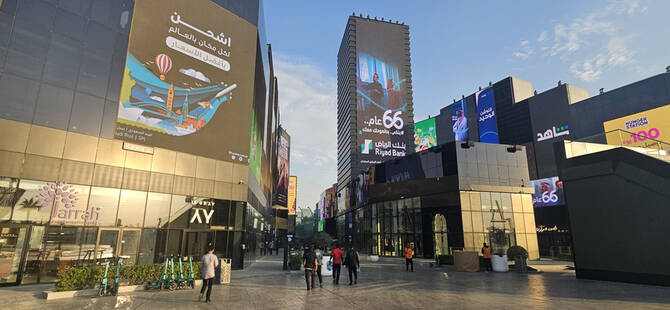

RIYADH: International retail brands attracted by social and economic shifts in Saudi Arabia are set to deliver real estate sector growth to the Kingdom, according to an analysis.
In its latest report, S&P Global stated that the residential real estate sector in the nation also appears strong, with young Saudi families relocating to cities in search of work opportunities.
Strengthening the real estate sector is one of the crucial goals outlined in Vision 2030, as Saudi Arabia continues to diversify its economy away from oil and position itself as a global business and tourist destination.
The Kingdom’s Real Estate General Authority expects the property market to reach $101.62 billion by 2029, with an anticipated compound annual growth rate of 8 percent from 2024.
In its latest report, S&P Global said: “Saudi retail real estate growth prospects are strong. Significant social and economic changes in the Kingdom are making it a major target market for international brands in the fashion, luxury, and food and beverage segments. As a result, demand for premium retail space is increasing.”
In June, global real estate consultancy Knight Frank, also echoed similar views, stating that Saudi Arabia’s commercial real estate sector is witnessing exponential growth, with rents for Grade A office spaces in the Kingdom’s capital reaching SR2,700 ($719.95) per sq. meter by the end of the first quarter, representing a 23 percent rise compared to the same period in the previous year.
In its latest analysis, S&P Global noted that Saudi Arabia’s retail landscape is expected to face several challenges, including oversupply, particularly in the shopping mall sector.
“Saudi retail real estate could face a supply wall. Knight Frank forecasts Riyadh’s supply to grow by 50 percent by 2027 and Jeddah’s to grow 75 percent over the same period. This could lead to rental discounts, revenue-sharing lease models, and other incentives to maintain occupancies,” said S&P Global.
The US-based agency further stated that the Kingdom’s retail real estate sector has strong growth prospects, provided that careful planning and market positioning are implemented, which are expected to help mall owners ensure long-term success.
In a broader context, the report projected that Dubai and Abu Dhabi are experiencing resilient demand and modest rental growth for retail real estate, with prime super-regional malls continuing to dominate the market, which has led to mall owners expanding their offerings.
S&P Global added that Dubai’s commercial real estate sector is booming, as vacancy rates remain at an all-time low of 8.6 percent, and demand for grade-A offices drives up rentals.
“Supportive regulations for businesses, dynamic economic environment, and the low tax regime sustains the city’s attractiveness for global businesses and family offices,” said the report.
S&P Global cautioned that oversupply in the oil market will continue to outweigh slow oil demand growth through 2025 and beyond, and this could negatively impact the growth of real estate sectors in both Saudi Arabia and Dubai.
“Unfavorable tariffs could also lead to economic slowdown and weaker market sentiment. This could have some impact on residential prices and rents as we believe there is good correlation, despite Dubai’s economy being less reliant on oil. Saudi Arabia and its spending on Vision 2030 remain highly dependent on oil prices,” added the report.
According to the analysis, the current ceasefire between Israel and Iran has reduced immediate regional credit stress; however, an escalated, prolonged geopolitical conflict could lead to an expatriate exodus from the region, severely impacting real estate prices and rents.