

Nearly 150 killed as Pakistan’s deadly monsoon season intensifies

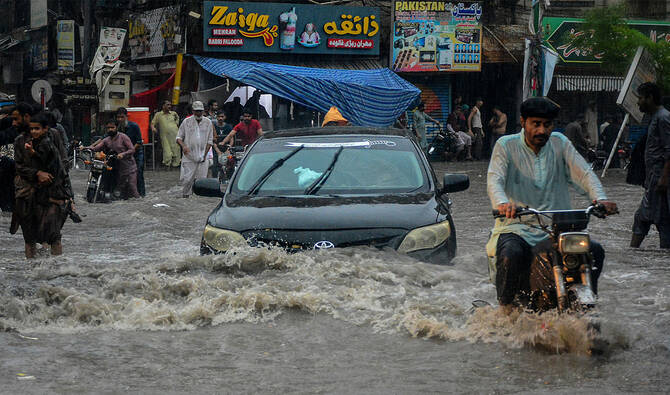
Commuters wade through a flooded street during heavy monsoon rains in Hyderabad, in Sindh province, on July 14, 2025. Monsoon rains in Pakistan have been linked to more than 110 deaths including dozens of children since they arrived in late June, according to government figures released on July 14. (AP)
Short Url
Updated 16 July 2025
Follow

Nearly 150 killed as Pakistan’s deadly monsoon season intensifies

  • At least 77 dead in Punjab as roof collapses drive surge in monsoon fatalities 
  • Officials urge precautions after 27 people killed in 24 hours in Punjab province 

ISLAMABAD: Nearly 150 people in Pakistan have died and hundreds have been injured since late June due to heavy monsoon rains this season, disaster management authorities said on Wednesday.

The monsoon season brings South Asia up to 80 percent of its annual rainfall, arriving in early June in India and late June in Pakistan, and lasting through until September.

The annual rains are vital for agriculture and food security, and the livelihoods of millions of farmers. But they also bring with them flooding and landslides and cause buildings to collapse.

“Due to this year’s monsoon rains, 77 citizens have died and 214 have been injured,” a spokesperson for the Provincial Disaster Management Authority (PDMA) in Punjab, Pakistan’s most populous province, said in a statement. 

In the past 24 hours alone, 27 people had died and 46 more injured across the province, the statement added.

On Monday, the National Disaster Management Authority (NDMA) had warned of another wet spell in the country from July 15 till July 17 and said the death toll from monsoon rains and floods had reached 111 since June 26. With the fresh deaths in Punjab over the last 24 hours, that figure is nearing 150.

“Most deaths have been recorded due to roofs collapsing in dilapidated buildings and old houses,” DG PDMA said, urging citizens to avoid staying in old mud homes and to take extra precautions.

“Citizens are requested to take precautionary measures in view of the rainy season … Citizens are urged not to stay in old mud houses under any circumstances.”

On the instructions of Punjab’s chief minister, the injured are being provided “the best possible medical aid” and families of those killed will receive financial assistance under the provincial government’s policy, the agency added.

Children should be kept away from electric wires, poles, and low-lying flooded areas to prevent further casualties, the PDMA said. 

“By adopting precautionary measures, loss of life and property can be avoided.”

Pakistan, despite contributing less than one percent of global greenhouse gas emissions, is among the countries most vulnerable to the impacts of climate change.

In 2022, unprecedented monsoon flooding submerged a third of the country, affecting over 33 million people and inflicting more than $30 billion in losses, according to government estimates.


Pakistan, global crypto exchange discuss modernizing digital payments, creating job prospects 

Updated 05 December 2025
Follow

Pakistan, global crypto exchange discuss modernizing digital payments, creating job prospects 

  • Pakistani officials, Binance team discuss coordination between Islamabad, local banks and global exchanges
  • Pakistan has attempted to tap into growing crypto market to curb illicit transactions, improve oversight

ISLAMABAD: Pakistan’s finance officials and the team of a global cryptocurrency exchange on Friday held discussions aimed at modernizing the country’s digital payments system and building local talent pipelines to meet rising demand for blockchain and Web3 skills, the finance ministry said.

The development took place during a high-level meeting between Finance Minister Muhammad Aurangzeb, Pakistan Virtual Assets Regulatory Authority (PVARA) Chairman Bilal bin Saqib, domestic bank presidents and a Binance team led by Global CEO Richard Teng. The meeting was held to advance work on Pakistan’s National Digital Asset Framework, a regulatory setup to govern Pakistan’s digital assets.

Pakistan has been moving to regulate its fast-growing crypto and digital assets market by bringing virtual asset service providers (VASPs) under a formal licensing regime. Officials say the push is aimed at curbing illicit transactions, improving oversight, and encouraging innovation in blockchain-based financial services.

“Participants reviewed opportunities to modernize Pakistan’s digital payments landscape, noting that blockchain-based systems could significantly reduce costs from the country’s $38 billion annual remittance flows,” the finance ministry said in a statement. 

“Discussions also emphasized building local talent pipelines to meet rising global demand for blockchain and Web3 skills, creating high-value employment prospects for Pakistani youth.”

Blockchain is a type of digital database that is shared, transparent and tamper-resistant. Instead of being stored on one computer, the data is kept on a distributed network of computers, making it very hard to alter or hack.

Web3 refers to the next generation of the Internet built using blockchain, focusing on giving users more control over their data, identity and digital assets rather than big tech companies controlling it.

Participants of the meeting also discussed sovereign debt tokenization, which is the process of converting a country’s debt such as government bonds, into digital tokens on a blockchain, the ministry said. 

Aurangzeb called for close coordination between the government, domestic banks and global exchanges to modernize Pakistan’s payment landscape.

Participants of the meeting also discussed considering a “time-bound amnesty” to encourage users to move assets onto regulated platforms, stressing the need for stronger verifications and a risk-mitigation system.

Pakistan has attempted in recent months to tap into the country’s growing crypto market, crack down on money laundering and terror financing, and promote responsible innovation — a move analysts say could bring an estimated $25 billion in virtual assets into the tax net.

In September, Islamabad invited international crypto exchanges and other VASPs to apply for licenses to operate in the country, a step aimed at formalizing and regulating its fast-growing digital market.