

Pentagon ends deployment of 2,000 National Guard troops in Los Angeles

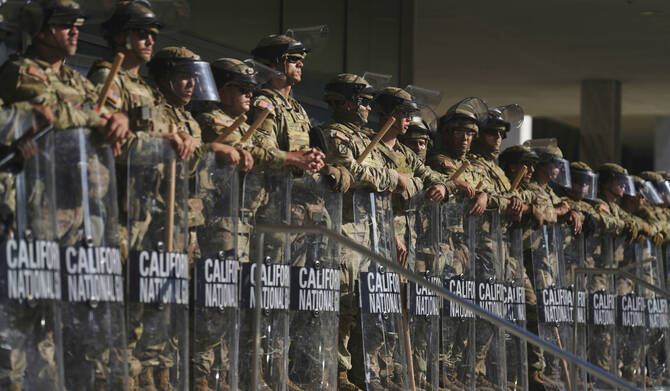
California National Guard are positioned at the Federal Building, June 10, 2025, in downtown Los Angeles. (AP)
Short Url
Updated 16 July 2025
Follow

Pentagon ends deployment of 2,000 National Guard troops in Los Angeles

  • A day later, police officers used flash bangs and shot projectiles as they pushed protesters through Little Tokyo, where bystanders and restaurant workers rushed to get out of their way

LOS ANGELES: The Pentagon said Tuesday it is ending the deployment of 2,000 National Guard troops in Los Angeles, accounting for nearly half of the soldiers sent to the city to deal with protests over the Trump administration’s immigration crackdown.
Roughly 4,000 National Guard soldiers and 700 Marines have been in the city since early June. It wasn’t immediately clear what prompted the 60-day deployment to end suddenly, nor was it immediately clear how long the rest of the troops would stay in the region.
In late June, the top military commander in charge of troops deployed to LA had asked Defense Secretary Pete Hegseth for 200 of them to be returned to wildfire fighting duty amid warnings from Newsom that the Guard was understaffed as California entered peak wildfire season.
The end of the deployment comes a week after federal authorities and National Guard troops arrived at MacArthur Park with guns and horses in an operation that ended abruptly. Although the US Department of Homeland Security wouldn’t explain the purpose of the operation or whether anyone had been arrested, local officials said it seemed designed to sow fear.
“Thanks to our troops who stepped up to answer the call, the lawlessness in Los Angeles is subsiding,” Chief Pentagon spokesman Sean Parnell said in a statement in announcing the decision.
On June 8, thousands of protesters took to the streets in response to Trump’s deployment of the Guard, blocking off a major freeway as law enforcement used tear gas, rubber bullets and flash bangs to control the crowd. Photos captured several Waymo robotaxis set on fire.
A day later, police officers used flash bangs and shot projectiles as they pushed protesters through Little Tokyo, where bystanders and restaurant workers rushed to get out of their way.
Mayor Karen Bass set a curfew in place for about a week that she said had successfully protected businesses and helped restore order. Demonstrations in the city and the region in recent weeks have been largely small impromptu protests around arrests.
Bass applauded the troops’ departure.
“This happened because the people of Los Angeles stood united and stood strong. We organized peaceful protests, we came together at rallies, we took the Trump administration to court — all of this led to today’s retreat,” she said in a statement, adding that “We will not stop making our voices heard until this ends, not just here in LA, but throughout our country.”
On Tuesday afternoon, there was no visible military presence outside the federal complex downtown that had been the center of early protests and where National Guard troops first stood guard before the Marines were assigned to protect federal buildings. Hundreds of the soldiers have been accompanying agents on immigration operations.
President Donald Trump ordered the deployment against the wishes of Gov. Gavin Newsom, who sued to stop it.
Newsom sued to block Trump’s command of the California National Guard, arguing that Trump violated the law when he deployed the troops despite his opposition. He also argued that the National Guard troops were likely violating the Posse Comitatus Act, which prohibits troops from conducting civilian law enforcement on US soil.
Newsom won an early victory in the case after a federal judge ruled the Guard deployment was illegal and exceeded Trump’s authority. But an appeals court tossed that order, and control of the troops remained with the federal government. The federal court is set to hear arguments next month on whether the troops are violating the Posse Comitatus Act.
The deployment of National Guard troops was for 60 days, though Defense Secretary Pete Hegseth had the discretion to shorten or extend it “to flexibly respond to the evolving situation on the ground,” the Trump administration’s lawyers wrote in a June 23 filing in the legal case.
Following the Pentagon’s decision Tuesday, Newsom said in a statement that the National Guard’s deployment to Los Angeles County has pulled troops away from their families and civilian work “to serve as political pawns for the President.”
He added that the remaining troops “continue without a mission, without direction and without any hopes of returning to help their communities.”
“We call on Trump and the Department of Defense to end this theater and send everyone home now,” he said.


UK veterans are ‘ticking time bomb’ after Iraq war chemical exposure

Updated 10 sec ago
Follow

UK veterans are ‘ticking time bomb’ after Iraq war chemical exposure

  • Fifteen former RAF personnel were deployed to the Qarmat Ali water plant in 2003, which was contaminated with sodium dichromate
  • Veterans say they were not screened or protected, and are now living with serious health conditions

LONDON: Fifteen British servicemen who worked on a carcinogen-contaminated water treatment site during the Iraq war say they were not offered biological screening despite official guidance saying they should have been.

The former Royal Air Force members, who have suffered from ailments including cancer, tumors and nosebleeds, told Sky News they were offered no medical assistance or subsequent treatment after having been exposed to toxic sodium dichromate at the Qarmat Ali water treatment plant in 2003.

The channel said it had seen a letter from the RAF’s medical authority stating that senior officers knew of the dangers posed by the substance.

Peter Lewis, 53, was one of 88 personnel deployed to guard the site, which was deemed vital for getting Iraq’s oil industry up and running. He told Sky: “I’ve had eight or nine operations to remove cancer.

“I’ve had so many lumps taken out of my neck, one on my face. This is something I’m literally fighting every year now. It’s constant.”

Qarmat Ali, the former troops say, was covered in ripped bags of bright orange sodium dichromate.

“We were never warned what the bags of chemicals were,” Jon Caunt, another former serviceman, said. “We were breathing this stuff in.”

His former comrade Tony Watters added: “I never thought about what it was. We were told the site is safe.”

Several months after deployment to the site, however, the servicemen were joined by two workers wearing protective gear who placed signs around it reading: “Warning. Chemical hazard. Full protective equipment and chemical respirator required. Sodium dichromate exposure.”

Watters said: “When you left the site, your uniform was contaminated, your webbing was contaminated.

“You went in your sleeping bag, and that was contaminated. And you were contaminating other people with it back at camp.”

Andy Tosh, who has led the group of veterans as they sought answers from the Ministry of Defence, said: “Even with the warning signs going up … they kept us there. They knowingly kept us exposed.”

The RAF gave some of the men a leaflet on their return to the UK, warning of the dangers of the substance, but not all were told.

The letter seen by Sky acknowledging the dangers posed to the veterans made a “strong” link to “increased risk of lung and nose cancer” as well as numerous other issues. It suggested personnel sent to Qarmat Ali should have their medical records altered to mention their exposure to sodium dichromate.

“Offer biological screening. This cannot be detailed until the numbers exposed are confirmed,” the letter also said.

An inquiry into US personnel deployed to Qarmat Ali found that 830 people were “unintentionally exposed” to sodium dichromate, giving them access to support from the US Department of Veterans Affairs. This came after the death of Lt. Col. James Gentry from cancer in 2009, which the US Army determined came “in line of duty for exposure to sodium dichromate.”

There has been no such inquiry by UK authorities despite British personnel being deployed at the site for longer than their American counterparts.

Thirteen of them have suffered from cancer and similar symptoms, including one who developed a brain tumor.

Jim Garth told Sky: “My skin cancer will never go away … It’s treatable, but when the treatment is finished, it comes back, so I’ve got that for life really.”

Lewis added: “I’m actually getting to the point now where I don’t care anymore … sooner or later, it’s going to do me.”

Caunt described his former colleagues’ conditions as a “ticking time bomb.”

He added: “We do not know what’s going to happen in the future."

The MoD insists medical screening was offered to personnel at the time, despite the men stating that it was not. In 2024, several met with Labour MPs about the issue. One, John Healey, who is now the UK defence secretary, said at the time the veterans should have “answers to their important questions.”

In a statement, the MoD said: “We take very seriously the concerns raised by veterans who were deployed to guard the Qarmat Ali Water Treatment Plant in 2003.

“As soon as we were alerted to the possible exposure of Sodium Dichromate, an environmental survey was conducted to evaluate typical exposure at Qarmat Ali. Results showed that the levels at the time were significantly below UK government guidance levels.”

A 2004 letter seen by Sky News suggested, however, that the MoD knew the levels of sodium dichromate were higher.

“Anyone who requires medical treatment can receive it through the Defence Medical Services and other appropriate services,” the MoD said.

“Veterans who believe they have suffered ill health due to service can apply for no-fault compensation under the War Pensions Scheme.”

Watters called on the government to hold an investigation into what happened at Qarmat Ali.

“We are the working class, we are ex-soldiers who have put our lives on the line and you’re turning a blind eye to us,” he said.

Garth added: “We felt let down at Qarmat Ali all those years ago, and we still feel let down now.”