

Saudi Data and Artificial Intelligence Authority, Shareek sign deal to accelerate AI, cloud innovation

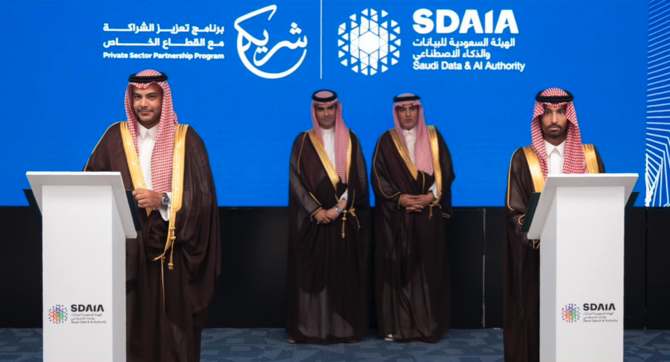
A deal has been signed between the Saudi Data and Artificial Intelligence Authority and the Private Sector Partnership Reinforcement Program, known as Shareek. X/@SDAIA_SA
Short Url
Updated 15 July 2025
Follow

Saudi Data and Artificial Intelligence Authority, Shareek sign deal to accelerate AI, cloud innovation

RIYADH: Saudi Arabia’s private sector is set to gain a boost in AI-driven innovation and data capabilities through a new agreement aimed at accelerating digital transformation across key industries. 

The new deal, signed between the Saudi Data and Artificial Intelligence Authority and the Private Sector Partnership Reinforcement Program, known as Shareek, aims to conduct comprehensive market studies and coordinate with relevant authorities, according to an official statement. 

The memorandum of understanding also includes a mandate to develop AI-aligned business models and provide technical consultation services to private sector entities participating in the Shareek program. 

This comes as the Gulf’s largest economy positions itself as a global AI hub under its Vision 2030 strategy, which targets $135.2 billion in economic value from the technology by the end of the decade. 

The same roadmap aims to raise the private sector’s contribution to gross domestic product to 65 percent by 2030, signaling a shift toward tech-led diversification away from oil dependency. 

In a post on X, SDAIA stated that the MoU also seeks to “develop investment opportunities in cooperation with relevant authorities” and to “develop business models for both parties, in accordance with established procedures.” 

It added that the agreement will also focus on “identifying and prioritizing investment opportunities and providing specialized technical consultations,” as well as “sharing investment opportunities with the sector and relevant authorities to join the Private Sector Partnership Reinforcement Program – Shareek.”

Launched in 2021, Shareek is a flagship public-private partnership program aiming to unlock SR5 trillion ($1.33 trillion) in investments by 2030. It supports large Saudi companies in accelerating growth and driving economic development. Its collaboration with SDAIA highlights its role in advancing large-scale digital transformation.

The development comes as the Kingdom expands its global tech alliances, with SDAIA signing an MoU with Advanced Micro Devices, or AMD, on the sidelines of the Saudi-US Investment Forum in Riyadh in May to strengthen the AI ecosystem. 

The agreement aims to develop specialized AI data centers powered by AMD technologies, supporting the Kingdom’s efforts to build a robust digital infrastructure.

These developments come as Saudi Arabia’s global AI standing continues to rise, with the Kingdom ranking third worldwide in the OECD AI Policy Observatory in December, behind only the US and the UK.


Saudi POS transactions see 20% surge to hit $4bn: SAMA

Updated 05 December 2025
Follow

Saudi POS transactions see 20% surge to hit $4bn: SAMA

RIYADH: Saudi Arabia’s total point-of-sale transactions surged by 20.4 percent in the week ending Nov. 29, to reach SR15.1 billion ($4 billion).

According to the latest data from the Saudi Central Bank, the number of POS transactions represented a 9.1 percent week-on-week increase to 240.25 million compared to 220.15 million the week before.

Most categories saw positive change across the period, with spending on laundry services registering the biggest uptick at 36 percent to SR65.1 million. Recreation followed, with a 35.3 percent increase to SR255.99 million. 

Expenditure on apparel and clothing saw an increase of 34.6 percent, followed by a 27.8 percent increase in spending on telecommunication. Jewelry outlays rose 5.6 percent to SR354.45 million.

Data revealed decreases across only three sectors, led by education, which saw the largest dip at 40.4 percent to reach SR62.26 million. 

Spending on airlines in Saudi Arabia fell by 25.2 percent, coinciding with major global flight disruptions. This followed an urgent Airbus recall of 6,000 A320-family aircraft after solar radiation was linked to potential flight-control data corruption. Saudi carriers moved swiftly to implement the mandatory fixes.

Flyadeal completed all updates and rebooked affected passengers, while flynas updated 20 aircraft with no schedule impact. Their rapid response contained the disruption, allowing operations to return to normal quickly.

Expenditure on food and beverages saw a 28.4 percent increase to SR2.31 billion, claiming the largest share of the POS. Spending on restaurants and cafes followed with an uptick of 22.3 percent to SR1.90 billion.

The Kingdom’s key urban centers mirrored the national decline. Riyadh, which accounted for the largest share of total POS spending, saw a 14.1 percent surge to SR5.08 billion, up from SR4.46 billion the previous week. The number of transactions in the capital reached 75.2 million, up 4.4 percent week-on-week.

In Jeddah, transaction values increased by 18.1 percent to SR2.03 billion, while Dammam reported a 14 percent surge to SR708.08 million.

POS data, tracked weekly by SAMA, provides an indicator of consumer spending trends and the ongoing growth of digital payments in Saudi Arabia. 

The data also highlights the expanding reach of POS infrastructure, extending beyond major retail hubs to smaller cities and service sectors, supporting broader digital inclusion initiatives. 

The growth of digital payment technologies aligns with the Kingdom’s Vision 2030 objectives, promoting electronic transactions and contributing to the nation’s broader digital economy.