

China’s Xi, Pakistan’s Dar pledge unity as SCO faces regional strains

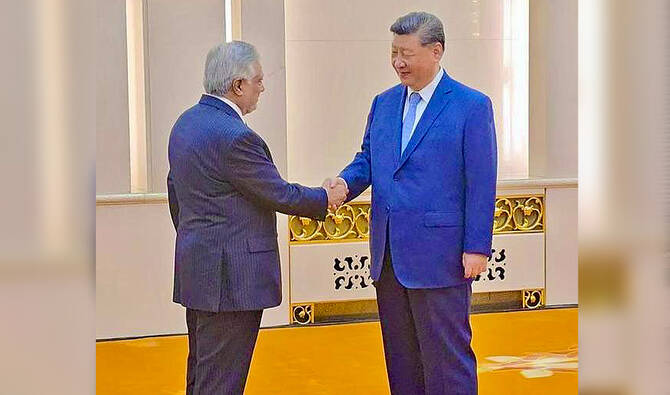
Pakistan's Deputy Prime Minister and Foreign Minister, Ishaq Dar (left) shaking hand with President of China, Xi Jinping, on the sidelines of the SCO Council of Foreign Ministers meeting in China. (@MIshaqDar50/X)
Short Url
Updated 15 July 2025
Follow

China’s Xi, Pakistan’s Dar pledge unity as SCO faces regional strains

  • President Xi Jinping emphasizes importance of the regional cooperation under the SCO framework
  • Dar also meets Russia’s Sergei Lavrov, Iran’s Abbas Araghchi on the sidelines of the conference

ISLAMABAD: Pakistan’s Deputy Prime Minister Ishaq Dar on Tuesday highlighted his country’s commitment to strengthening ties with China and reaffirmed a shared vision for regional peace and development during an interaction with Chinese President Xi Jinping at the joint call of the Shanghai Cooperation Organization (SCO) Foreign Ministers in Beijing.

The interaction took place on the sidelines of the SCO Council of Foreign Ministers (CFM) meeting, a key diplomatic gathering aimed at preparing the groundwork for the upcoming SCO Leaders’ Summit later this year. The CFM convened to review progress on multilateral cooperation and set the agenda for endorsement by heads of state.

“Delighted to meet earlier today with President Xi Jinping at the Great Hall of the People in Beijing,” Dar said in a post on social media platform X. “Conveyed the warm greetings of the leadership, government and people of Pakistan. As iron-clad brothers and All-Weather Strategic Cooperative Partners, we remain committed to deepening Pak-China enduring friendship and advancing shared regional goals.”

Islamabad and Beijing are long-time allies and have been jointly working on multibillion-dollar infrastructure, energy and connectivity initiatives under the China-Pakistan Economic Corridor (CPEC), a flagship project of China’s Belt and Road Initiative. The corridor provides China direct access to the Arabian Sea through Pakistan’s Gwadar port, while enabling Pakistan to modernize its infrastructure and strengthen regional trade links.

The foreign office of Pakistan said in a statement released earlier today that President Xi emphasized the importance of regional cooperation under the SCO framework, an organization spanning the Eurasian landmass and representing a significant portion of the global population.

BILATERAL MEETINGS

On the sidelines of the conference, the Pakistani deputy prime minister also met Russian Foreign Minister Sergei Lavrov.

The two officials expressed satisfaction over the positive trajectory of bilateral ties and agreed to further enhance cooperation in trade, energy, agriculture and defense, according to an official statement.

It added Dar also invited Lavrov to visit Pakistan.

Their meeting came at a time when Pakistan and Russia are seeking to deepen their partnership through plans to build a new steel mill in southern Sindh and launch a pilot cargo train project in August.

The deputy PM also met with Iranian Foreign Minister Seyyed Abbas Araghchi, with the two leaders reviewing bilateral cooperation and discussing the evolving regional situation following Israel’s war against Iran.

Dar reaffirmed Pakistan’s “unwavering solidarity with the people and Government of Iran,” and emphasized that dialogue and diplomacy remain the only viable path to de-escalation and lasting peace, according to the foreign office.

The SCO conference is also being attended by India’s External Affairs Minister Subrahmanyam Jaishankar, though no meeting is scheduled between Pakistani and Indian officials.

The CFM takes place nearly two months after a tense four-day military standoff between Pakistan and India, during which both sides exchanged missiles, drones and artillery fire before agreeing to a US-brokered ceasefire.


Imran Khan not a ‘national security threat,’ ex-PM’s party responds to Pakistan military

Updated 06 December 2025
Follow

Imran Khan not a ‘national security threat,’ ex-PM’s party responds to Pakistan military

  • Pakistan’s military spokesperson on Friday described Khan’s anti-army narrative as a “national security threat”
  • PTI Chairman Gohar Ali Khan says words used by military spokesperson for Khan were “not appropriate”

ISLAMABAD: Former prime minister Imran Khan’s Pakistan Tehreek-e-Insaf (PTI) party on Saturday responded to allegations by Pakistan military spokesperson Lt. Gen. Ahmed Sharif Chaudhry from a day earlier, saying that he was not a “national security threat.”

Chaudhry, who heads the military’s media wing as director general of the Inter-Services Public Relations (ISPR), spoke to journalists on Friday, in which he referred to Khan as a “mentally ill” person several times during the press interaction. Chaudhry described Khan’s anti-army narrative as a “national security threat.”

The military spokesperson was responding to Khan’s social media post this week in which he accused Chief of Defense Forces Field Marshal Asim Munir of being responsible for “the complete collapse of the constitution and rule of law in Pakistan.” 

“The people of Pakistan stand with Imran Khan, they stand with PTI,” the party’s secretary-general, Salman Akram Raja, told reporters during a news conference. 

“Imran Khan is not a national security threat. Imran Khan has kept the people of this country united.”

Raja said there were several narratives in the country, including those that created tensions along ethnic and sectarian lines, but Khan had rejected all of them and stood with one that the people of Pakistan supported. 

PTI Chairman Gohar Ali Khan, flanked by Raja, criticized the military spokesperson as well, saying his press talk on Thursday had “severely disappointed” him. 

“The words that were used [by the military spokesperson] were not appropriate,” Gohar said. “Those words were wrong.”

NATURAL OUTCOME’

Speaking to reporters earlier on Saturday, Pakistan’s Defense Minister Khawaja Asif defended the military spokesperson’s remarks against Khan.

“When this kind of language is used for individuals as well as for institutions, then a reaction is a natural outcome,” he said. 

“The same thing is happening on the Twitter accounts being run in his [Khan’s] name. If the DG ISPR has given any reaction to it, then I believe it was a very measured reaction.”

Khan, who was ousted after a parliamentary vote of confidence in April 2022, blames the country’s powerful military for removing him from power by colluding with his political opponents. Both deny the allegations. 

The former prime minister, who has been in prison since August 2023 on a slew of charges he says are politically motivated, also alleges his party was denied victory by the army and his political rivals in the 2024 general election through rigging. 

The army and the government both deny his allegations.