

Some airlines checking Boeing fuel switches after Air India crash

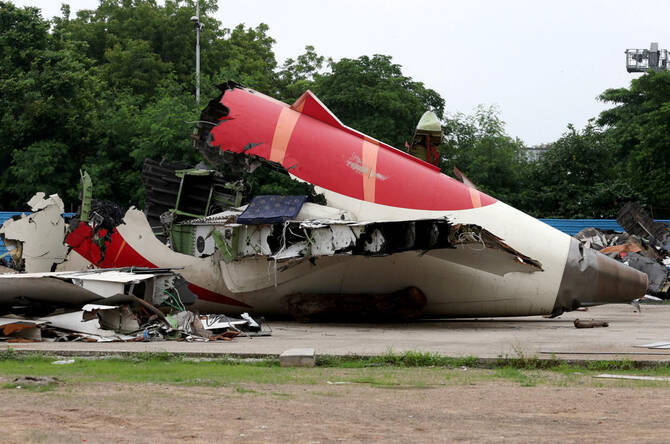
Air India’s Boeing 787-8 Dreamliner plane crashed shortly after take off at Sardar Vallabhbhai Patel International Airport. (Reuters)
Short Url
Updated 15 July 2025
Follow

Some airlines checking Boeing fuel switches after Air India crash

  • Precautionary moves by India, South Korea and some airlines in other countries
  • Some airlines around the world said they had been checking relevant switches since 2018

NEW DELHI: India on Monday ordered its airlines to examine fuel switches on several Boeing models, while South Korea said it would order a similar measure, as scrutiny intensified of fuel switch locks at the center of an investigation into a deadly Air India crash.

The precautionary moves by India, South Korea and some airlines in other countries came despite the planemaker and the US Federal Aviation Administration telling airlines and regulators in recent days that the fuel switch locks on Boeing jets are safe.

The locks have come under scrutiny following last month’s crash of an Air India jet, which killed 260 people.

A preliminary report found that the switches had almost simultaneously flipped from run position to cutoff shortly after takeoff. One pilot was heard on the cockpit voice recorder asking the other why he cut off the fuel. “The other pilot responded that he did not do so,” the report said.

The report noted a 2018 advisory from the US Federal Aviation Administration (FAA), which recommended, but did not mandate, operators of several Boeing models including the 787 to inspect the locking feature of fuel cutoff switches to ensure they could not be moved accidentally.

India’s Directorate General of Civil Aviation said it had issued an order to investigate locks on several Boeing models including 787s and 737s, after several Indian and international airlines began making their own inspections of fuel switches.

The regulator oversees the world’s third-largest and fastest-growing aviation market. Boeing planes are used by three of the country’s four largest airlines.

Precautionary checks

Some airlines around the world said they had been checking relevant switches since 2018 in accordance with the FAA advisory, including Australia’s Qantas Airways and Japan’s ANA.

Others said they had been making additional or new checks since the release of the preliminary report into the Air India crash.

Singapore Airlines said on Tuesday that precautionary checks on the fuel switches of its 787 fleet, including planes used by its low-cost subsidiary Scoot, confirmed all were functioning properly.

A spokesperson for the South Korean transport ministry said checks there would be in line with the 2018 advisory from the FAA, but did not give a timeline for them.

Flag carrier Korean Air Lines said on Tuesday it had proactively begun inspecting fuel control switches and would implement any additional requirements the transport ministry may have.

Japan Airlines said it was conducting inspections in accordance with the 2018 advisory.

Boeing referred Reuters’ questions to the FAA, which did not respond to a request for comment.

Over the weekend, Air India Group started checking the locking mechanism on the fuel switches of its 787 and 737 fleets and has discovered no problems yet, a source familiar with the matter told Reuters on Monday.

About half the group’s 787s have been inspected and nearly all its 737s, the source added, speaking on condition of anonymity. Inspections were set to be completed in the next day or two.

The Air India crash preliminary report said the airline had not carried out the FAA’s suggested inspections as the FAA’s 2018 advisory was not a mandate.

But it also said maintenance records showed that the throttle control module, which includes the fuel switches, was replaced in 2019 and 2023 on the plane involved in the crash.

In an internal memo on Monday, Air India CEO Campbell Wilson said the preliminary report found no mechanical or maintenance faults and that all required maintenance had been carried out.


Women fleeing Mali’s conflict say they were sexually assaulted but silence hides many more

Updated 2 sec ago
Follow

Women fleeing Mali’s conflict say they were sexually assaulted but silence hides many more

DOUANKARA: The girl lay in a makeshift health clinic, her eyes glazed over and her mouth open, flies resting on her lips. Her chest barely moved. Drops of fevered sweat trickled down her forehead as medical workers hurried around her, attaching an IV drip.
It was the last moment to save her life, said Bethsabee Djoman Elidje, the women’s health manager, who led the clinic’s effort as the heart monitor beeped rapidly. The girl had an infection after a sexual assault, Elidje said, and had been in shock, untreated, for days.
Her family said the 14-year-old had been raped by Russian fighters who burst into their tent in Mali two weeks earlier. The Russians were members of Africa Corps, a new military unit under Russia’s defense ministry that replaced the Wagner mercenary group six months ago.
Men, women and children have been sexually assaulted by all sides during Mali’s decade-long conflict, the UN and aid workers say, with reports of gang rape and sexual slavery. But the real toll is hidden by a veil of shame that makes it difficult for women from conservative, patriarchal societies to seek help.
The silence that nearly killed the 14-year-old also hurts efforts to hold perpetrators accountable.
The AP learned of the alleged rape and four other alleged cases of sexual violence blamed on Africa Corps fighters, commonly described by Malians as the “white men,” while interviewing dozens of refugees at the border about other abuses such as beheadings and abductions.
Other combatants in Mali have been blamed for sexual assaults. The head of a women’s health clinic in the Mopti area told the AP it had treated 28 women in the last six months who said they had been assaulted by militants with the Al-Qaeda affiliated JNIM, the most powerful armed group in Mali.
The silence among Malian refugees has been striking.
In eastern Congo, which for decades has faced violence from dozens of armed groups, “we didn’t have to look for people,” said Mirjam Molenaar, the medical team leader in the border area for Doctors Without Borders, or MSF, who was stationed there last year. The women “came in huge numbers.”
It’s different here, she said: “People undergo these things and they live with it, and it shows in post-traumatic stress.”
Speechless after an assault
The aunt of the 14-year-old girl said the Africa Corps fighters marched everyone outside at gunpoint. The family couldn’t understand what they wanted. The men made them watch as they tied up the girl’s uncle and cut off his head.
Then two of the men took the 14-year-old into the tent as she tried to defend herself, and raped her. The family waited outside, unable to move.
“We were so scared that we were not even able to scream anymore,” the aunt recalled, as her mother sobbed quietly next to her. She, like other women, spoke on condition of anonymity for fear of retaliation, and the AP does not name victims of rape unless they agree to be named.
The girl emerged over a half-hour later, looking terrified. Then she saw her uncle’s body and screamed. She fainted. When she woke up, she had the eyes of someone “who was no longer there,” the aunt said.
The next morning, JNIM militants came and ordered the family to leave. They piled onto a donkey cart and set off toward the border. At any sound, they hid in the bushes, holding their breath.
The girl’s condition deteriorated during the three-day journey. When they arrived in Mauritania, she collapsed.
The AP came across her lying on the ground in the courtyard of a local family. Her family said they had not taken her to a clinic because they had no money.
“If you have nothing, how can you bring someone to a doctor?” the girl’s grandmother said between sobs. The AP took the family to a free clinic run by MSF. A doctor said the girl had signs of being raped.
The clinic had been functioning for barely a month and had seen three survivors of sexual violence, manager Elidje said.
“We are convinced that there are many cases like this,” she said. “But so far, very few patients come forward to seek treatment because it’s still a taboo subject here. It really takes time and patience for these women to open up and confide in someone so they can receive care. They only come when things have already become complicated, like the case we saw today.”
As Elidje tried to save the girl’s life, she asked the family to describe the incident. She did not speak Arabic and asked the local nurse to find out how many men carried out the assault. But the nurse was too ashamed to ask.
Scratch marks are part of story she could not tell
Thousands of new refugees from Mali, mostly women and children, have settled just inside Mauritania in recent weeks, in shelters made of fabric and branches. The nearest refugee camp is full, complicating efforts to treat and report sexual assaults.
Two recently arrived women discreetly pulled AP journalists aside, adjusting scarves over their faces. They said they had arrived a week ago after armed white men came to their village.
“They took everything from us. They burned our houses. They killed our husbands,” one said. “But that’s not all they did. They tried to rape us.”
The men entered the house where she was by herself and undressed her, she said, adding that she defended herself “by the grace of Allah.”
As she spoke, the second woman started crying and trembling. She had scratch marks on her neck. She was not capable of telling her story.
“We are still terrified by what we went through,” she said.
Separately, a third woman said that what the white men did to her in Mali last month when she was alone at home “stays between God and me.”
A fourth said she watched several armed white men drag her 18-year-old daughter into their house. She fled and has not seen her daughter again.
The women declined the suggestion to speak with aid workers, some of whom are locals. They said they were not ready to talk about it with anyone else.
Russia’s Defense Ministry did not respond to questions, but an information agency that the US State Department has called part of the “Kremlin’s disinformation campaign” called the AP’s investigation into Africa Corps fake news.
Wagner has a legacy of sexual abuse
Allegations of rapes and other sexual assaults were already occurring before Wagner transformed into Africa Corps.
One refugee told the AP she witnessed a mass rape in her village in March 2024.
“The Wagner group burned seven men alive in front of us with gasoline.” she said. Then they gathered the women and raped them, she said, including her 70-year-old mother.
“After my mother was raped, she couldn’t bear to live,” she said. Her mother died a month later.
In the worst-known case of sexual assault involving Russian fighters in Africa, the UN in a 2023 report said at least 58 women and girls had been raped or sexually assaulted in an attack on Moura village by Malian troops and others that witnesses described as “armed white men.”
In response, Mali’s government expelled the UN peacekeeping mission. Since then, gathering accurate data on the ground about conflict-related sexual violence has become nearly impossible.
The AP interviewed five of the women from Moura, who now stay in a displacement camp. They said they had been blindfolded and raped for hours by several men.
Three of the women said they hadn’t spoken about it to anyone apart from aid workers. The other two dared to tell their husbands, months later.
“I kept silent with my family for fear of being rejected or looked at differently. It’s shameful,” one said.
The 14-year-old whose family fled to Mauritania is recovering. She said she cannot remember anything since the attack. Her family and MSF said she is speaking to a psychiatrist — one of just six working in the country.
Aid workers are worried about others who never say a thing.
“It seems that conflict over the years gets worse and worse and worse. There is less regard for human life, whether it’s men, women or children,” said MSF’s Molenaar, and broke into tears. “It’s a battle.”