

Pakistan’s climate emergency hub warns of heavy rains, flooding over next 72 hours

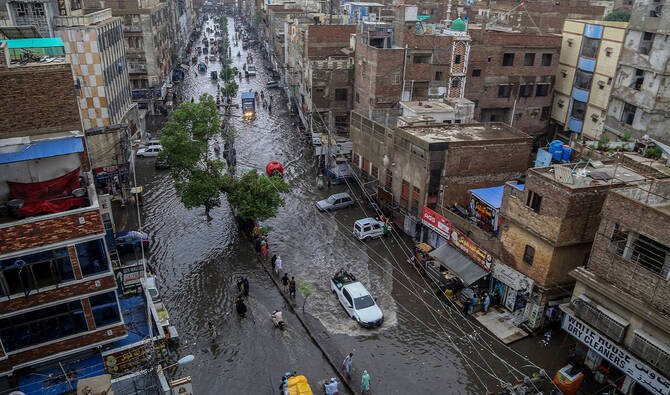
Commuters make their way through a flooded street during heavy monsoon rains in Hyderabad, in Sindh province, on July 14, 2025. (AFP)
Short Url
Updated 15 July 2025
Follow

Pakistan’s climate emergency hub warns of heavy rains, flooding over next 72 hours

  • Authorities have advised the public to stay away from weak structures and electricity poles
  • The alert comes as more than 100 people have died in rain-related incidents since June 26

ISLAMABAD: Pakistan’s central command hub for monitoring climate-related emergencies on Tuesday warned of heavy rains and potential flooding in multiple regions over the next 24 to 72 hours, urging the public to take precautionary measures as the ongoing monsoon system intensifies.

The National Emergencies Operation Center (NEOC) issued the warning a day after the government confirmed that 111 people have died in rain-related incidents since June 26, including 40 fatalities in Punjab, the country’s most populous province. An additional 212 people have been injured nationwide.

The NEOC alert comes amid the annual monsoon season, which brings 70 to 80 percent of South Asia’s rainfall and is crucial for agriculture. However, increasingly erratic and extreme weather patterns are turning the rains into a destructive force. Pakistan remains one of the world’s most climate-vulnerable countries, still reeling from the devastating 2022 floods that killed over 1,700 people, submerged a third of the country and caused more than $33 billion in economic losses.

“National Emergencies Operation Center (NEOC) of NDMA [National Disaster Management Authority] has issued multiple impact-based weather alerts in view of the ongoing monsoon system, which is expected to affect various parts of the country over the next 24 to 72 hours,” the center said in an official statement. “These alerts highlight the risks of heavy rainfall, urban flooding, flash floods, strong winds and associated structural and travel-related hazards.”

In Punjab, heavy rainfall is expected over the next 12 to 24 hours in several districts including Rawalpindi, Faisalabad, Multan, Bahawalpur and others. These areas may experience strong winds, temporary power outages and reduced visibility affecting daily life and road traffic.
Islamabad, the federal capital, is also forecast to see similar conditions.

A flash flood alert has been issued from July 15 to 18 for northeastern and southern Punjab, including Lahore, Sialkot, Gujranwala and D.G. Khan, where hill torrents and rapidly rising nullahs could trigger inundation and possible evacuation needs.

In Khyber Pakhtunkhwa, rain is expected in districts such as Swat, Mansehra, Peshawar and Waziristan, with possible flash floods, falling trees and traffic accidents due to low visibility and slippery roads.

Balochistan may see isolated thunderstorms in areas like Quetta, Zhob, Sibi and Dera Bugti, where gusty winds could lead to structural damage and driving hazards.

The statement said the NDMA has directed relevant authorities to ensure the deployment of emergency teams, improve drainage systems and coordinate closely with local administration authorities.

The public has also been advised to stay away from weak structures and electricity poles, avoid unnecessary travel and relocate vehicles and livestock to safer locations.

The authorities have strongly discouraged tourists from visiting mountainous or high-altitude areas until the ongoing monsoon rains continue.


Pakistan, ADB reaffirm commitment to ML-1 rail project amid economic reforms

Updated 6 sec ago
Follow

Pakistan, ADB reaffirm commitment to ML-1 rail project amid economic reforms

  • Flagship railway upgrade tied to IMF-backed stabilization, multilateral financing
  • ADB, World Bank working with Pakistan to address project delays, readiness gaps

ISLAMABAD: Pakistan and the Asian Development Bank (ADB) have reaffirmed their commitment to advancing the long-delayed Main Line-1 (ML-1) railway modernization project, a flagship infrastructure upgrade central to the country’s economic reform and connectivity agenda, the information ministry said on Thursday. 

The renewed focus on ML-1 follows meetings this week between senior Pakistani ministers and ADB officials in Islamabad, as the government seeks to revive large-scale infrastructure investment while maintaining fiscal discipline under an International Monetary Fund (IMF) program.

ML-1 is Pakistan Railways’ busiest north–south corridor, linking the southern port city of Karachi with major population and industrial centers in Punjab and Khyber Pakhtunkhwa. The project aims to modernize tracks, signaling and rolling stock to improve safety, cut travel times and lower transport costs. 

Originally envisioned as a flagship transport upgrade under the China-Pakistan Economic Corridor (CPEC), ML-1 has struggled to reach financial close amid cost concerns, debt sustainability debates and implementation challenges. Pakistan has since sought broader multilateral engagement, with institutions including the Asian Development Bank now playing a central role in project structuring, financing discussions and efforts to address execution bottlenecks.

During a meeting with Leah Gutierrez, Director General for Central and West Asia at the ADB, Federal Minister for Economic Affairs Ahad Cheema underscored the government’s reform priorities and the importance of the project’s timely execution.

“The Minister underscored the Government’s strong commitment to the timely implementation of the Main Line–1 (ML-1) railways project and emphasized that ADB’s continued support would be critical to achieving this milestone,” the information ministry said in a statement.

The ministry said Cheema also highlighted coordination with provincial governments and welcomed joint efforts by the ADB and the World Bank to identify implementation bottlenecks and improve project readiness to ensure timely disbursements.

Gutierrez commended Pakistan’s reform agenda and acknowledged the government’s focus on macroeconomic recovery and fiscal consolidation, reaffirming that ADB teams were working closely with Pakistani authorities on ML-1, according to the statement.

Separately, Federal Minister for Railways Muhammad Hanif Abbasi told Defense Secretary Lt. Gen. Muhammad Ali in a meeting that an agreement for the ML-1 project had been finalized with the ADB and that steps were being taken to move the project forward.

“Concrete steps are being taken to complete the project at the earliest,” the statement quoted Abbasi as telling Ali. “The ML-1 project will serve as a milestone in modernizing Pakistan Railways.”

Abbasi also briefed participants on parallel reform measures at Pakistan Railways, including the launch of an artificial intelligence-based monitoring system at Rawalpindi Railway Station, real-time tracking of trains and rolling stock through digital tagging, and the installation of a weigh bridge in Karachi to address overloading and improve safety.

Pakistan Railways has long struggled with aging infrastructure, safety challenges and financial losses, even as rail transport remains vital for passenger movement and freight. Multilateral lenders have repeatedly stressed the need for stronger execution capacity and governance reforms to translate infrastructure commitments into economic gains.