

Pakistan braces for new monsoon wave after rains kill 111 since late June

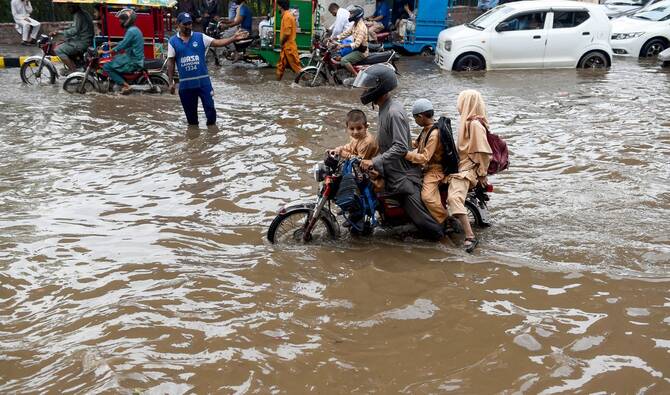
Commuters wade through a flooded street after heavy monsoon rains in Lahore on July 9, 2025. (AFP)
Short Url
Updated 14 July 2025
Follow

Pakistan braces for new monsoon wave after rains kill 111 since late June

  • Monsoon brings South Asia 70 to 80 percent of its annual rainfall, arriving in late June in Pakistan and lasting through Sept.
  • The annual rains, vital for agriculture and livelihoods, bring with them flooding, landslides and cause buildings to collapse

ISLAMABAD: Pakistan’s National Disaster Management Authority (NDMA) on Monday warned of another wet spell in the country from July 15 till July 17, with the death toll from monsoon rain-floods rising to 111 since June 26.

The toll includes 40 deaths in Punjab, Pakistan’s most populous province, followed by 37 in Khyber Pakhtunkhwa (KP), 17 in Sindh, 16 in Balochistan and one fatality in Azad Kashmir, according to official figures. Another 212 people have been injured in rain-related incidents.

In its fresh alert, the disaster authority said a low-pressure area, presently located over India’s Madhya Pradesh state, is likely to affect Pakistan in the next 24 to 72 hours.

“Under the influence of this weather system, strong monsoon currents are expected to penetrate central and upper parts [of Pakistan],” it said. “A westerly wave is also present over upper parts of the country.”

The system may result in heavy rains and flash floods in Islamabad, Rawalpindi, Murree, Galiyat, Dera Ghazi Khan and northeastern Punjab.

“Rains may trigger landslides in Murree and hilly areas,” the NDMA said. “Heavy downpour may cause urban flooding in low-lying areas of Islamabad, Rawalpindi, Gujranwala, Lahore, Sialkot and Faisalabad.”

It called on provincial and district administrations to prepare emergency response teams, ensure the availability of rescue machinery and clear drainage systems in urban areas.

“Avoid outdoor exposure in rains and windy weather,” the authority said. “Tourists and travelers visiting mountainous areas are advised to remain cautious of flash floods, avalanche, glaciers, landslides, rock fall/tree fall, derbies/mud flow during the period.”

Monsoon season brings South Asia 70 to 80 percent of its annual rainfall, arriving in early June in India and late June in Pakistan, and lasting through until September.

The annual rains are vital for agriculture and food security, and the livelihoods of millions of farmers. But the season brings with it flooding, landslides and causes buildings to collapse.

South Asia is getting hotter and in recent years has seen shifting weather patterns, but scientists are unclear on how exactly a warming planet is affecting the highly complex monsoon.

Pakistan is one of the world’s most vulnerable countries to the effects of climate change, and its 240 million residents are facing extreme weather events with increasing frequency.

In 2022, unprecedented monsoon floods submerged a third of Pakistan and killed 1,700 people, with some areas yet to recover from the damage. In May, at least 32 people were killed in severe storms, including strong hailstorms.


Pakistan army chief tells Kabul to choose Islamabad or Taliban militants amid strained ties

Updated 21 December 2025
Follow

Pakistan army chief tells Kabul to choose Islamabad or Taliban militants amid strained ties

  • Pakistan blames Afghanistan for facilitating cross-border attacks in its territory, allegations that Kabul denies 
  • Ties remain strained since October, when deadly border clashes left dozens dead on both sides of the border

ISLAMABAD: Pakistan’s Chief of Defense Forces Field Marshal Syed Asim Munir has told Afghanistan to choose between Islamabad and the outlawed Tehreek-e-Taliban Pakistan (TTP) militants, state media reported on Sunday as ties between both neighbors remain strained. 

Pakistan’s army and civilian government have both blamed the Afghan Taliban recently for facilitating cross-border attacks in Pakistan, a charge Kabul denies. Afghanistan says it does not allow its territory to be used for attacks against Pakistan and cannot be held responsible for Islamabad’s security challenges. 

Both countries were involved in deadly border clashes in October that saw dozens of soldiers killed and wounded on both sides. Officials from Afghanistan and Pakistan have held peace talks in Qatar, Türkiye and Saudi Arabia over the past few months but failed to reach an agreement. 

“Chief of Army Staff and Chief of Defense Forces Field Marshal Syed Asim Munir has said Afghanistan will have to choose between Fitna Al-Khawarij and Pakistan,” state broadcaster Radio Pakistan reported. 

Munir was addressing the National Ulema and Mashaikh Conference held in Islamabad earlier this month, the state media said.

“Fitna Al-Khawarij” is a term the Pakistan military frequently uses for the TTP. 

Munir highlighted that 70 percent of the TTP’s formations that enter Pakistan from Afghanistan comprise Afghan nationals. 

“He said innocent citizens, including children, are being targeted through terrorism with the backing of the Afghan Taliban,” Radio Pakistan reported. 

While Pakistan and Afghanistan have agreed to a temporary ceasefire, tensions persist between the two nations as militant attacks persist in Pakistan. 

Pakistan summoned Afghanistan’s deputy head of mission on Friday and demanded “decisive action” against TTP militants after four Pakistani soldiers were killed in an attack on a military camp in northwest Pakistan. 

The foreign office said the Afghan government had been informed that Pakistan “reserves the right to defend its sovereignty and protect its citizens” and would take all necessary measures to respond to attacks originating from Afghan territory.

Afghanistan has warned Pakistan in the past against attacking its territory, saying it reserves the right to respond to such provocations.