

German doctor goes on trial for 15 murders

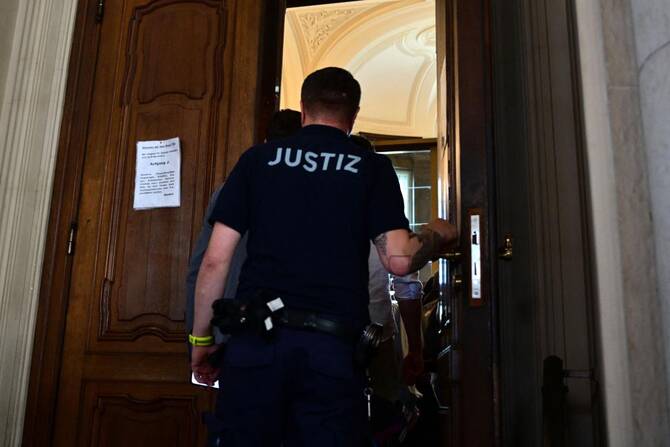
A justice officer closes the courtroom’s door prior the start of the trial of a palliative care doctor allegedly accused of killing 15 patients with lethal injections in Berlin on July 14, 2025. (AFP)
Short Url
Updated 14 July 2025
Follow

German doctor goes on trial for 15 murders

  • Palliative care specialist alleged to have killed 12 women and three men between September 2021 and July 2024 while working in Berlin
  • The case recalls that of notorious German nurse Niels Hoegel, who was handed a life sentence in 2019 for murdering 85 patients

BERLIN: A German doctor went on trial Monday accused of killing 15 patients with lethal injections and acting as “master of life and death” over those in his care.

The 40-year-old palliative care specialist, named by German media as Johannes M., is alleged to have killed 12 women and three men between September 2021 and July 2024 while working in Berlin.

The doctor is accused of injecting the victims, aged between 25 and 94, with deadly cocktails of sedatives and in some cases setting fire to their homes in a bid to cover up his crimes.

The accused had “visited his patients under the pretext of providing medical care,” prosecutor Philipp Meyhoefer said at the opening of the trial at the state court in Berlin.

Johannes M. had organized “home visits, already with the intention of killing” and exploited his patients’ trust in him as a doctor, Meyhoefer said.

“He acted with disregard for life... and behaved as the master of life and death.”

A co-worker first raised the alarm over Johannes M. last July after becoming suspicious that so many of his patients had died in fires, according to Die Zeit newspaper.

He was arrested in August, with prosecutors initially linking him to four deaths.

But subsequent investigations uncovered a host of other suspicious cases, and in April prosecutors charged Johannes M. with 15 counts of murder.

A further 96 cases were still being investigated, a prosecution spokesman said, including the death of Johannes M.’s mother-in-law.

She had been suffering from cancer and mysteriously died the same weekend that Johannes M. and his wife went to visit her in Poland in early 2024, according to media reports.

The suspect reportedly trained as a radiologist and a general practitioner before going on to specialize in palliative care.

According to Die Zeit, he submitted a doctoral thesis in 2013 looking into the motives behind a series of killings in Frankfurt, which opened with the words “Why do people kill?”

In the charges brought against Johannes M., prosecutors said the doctor had “administered an anesthetic and a muscle relaxant to his patients... without their knowledge or consent.”

The relaxant “paralyzed the respiratory muscles, leading to respiratory arrest and death within minutes.”

In five cases, Johannes M. allegedly set fire to the victims’ apartments after administering the injections.

On one occasion, he is accused of murdering two patients on the same day.

On the morning of July 8, 2024, he allegedly killed a 75-year-old man at his home in the Berlin district of Kreuzberg.

“A few hours later” he is said to have struck again, killing a 76-year-old woman in the neighboring Neukoelln district.

Prosecutors say he started a fire in the woman’s apartment, but it went out.

“When he realized this, he allegedly informed a relative of the woman and claimed that he was standing in front of her flat and that nobody was answering the doorbell,” prosecutors said.

In another case, Johannes M. “falsely claimed to have already begun resuscitation efforts” on a 56-year-old victim, who was initially kept alive by rescuers but died three days later in hospital.

Prosecutors said he had “no motive beyond killing” and are seeking a life sentence.

The case recalls that of notorious German nurse Niels Hoegel, who was handed a life sentence in 2019 for murdering 85 patients.

Hoegel, believed to be modern Germany’s most prolific serial killer, murdered hospital patients with lethal injections between 2000 and 2005, before he was eventually caught in the act.

More recently, a 27-year-old nurse was given a life sentence in 2023 for murdering two patients by deliberately administering unprescribed drugs.

In March, another nurse went on trial in Aachen accused of injecting 26 patients with large doses of sedatives or painkillers, resulting in nine deaths.

Last week, German police revealed they are investigating another doctor suspected of killing several mainly elderly patients.

Investigators are “reviewing” deaths linked to the doctor from the town of Pinneberg in northern Germany, just outside Hamburg, police and prosecutors said.


London police using withdrawn powers to clamp down on pro-Palestine rallies: Probe

Updated 5 sec ago
Follow

London police using withdrawn powers to clamp down on pro-Palestine rallies: Probe

  • ‘Cumulative disruption’ cited to ban, reroute rallies but power granted by concept withdrawn by Court of Appeal in May
  • Network for Police Monitoring: This demonstrates ‘ongoing crackdown on protest’ that has reached ‘alarming point’

LONDON: London’s Metropolitan Police have used powers that have been withdrawn to clamp down on pro-Palestine rallies in the capital, legal experts have said.

The Guardian and Liberty Investigates obtained evidence that police officers had imposed restrictions on at least two protests based on the principle of “cumulative disruption.” But that power was withdrawn by the Court of Appeal in May, according to legal experts.

All references to cumulative disruption have been removed from relevant legislation, yet the Home Office and the Met continue to insist that police officers retain the power to consider the concept when suppressing protests.

On May 7, five days after the powers were withdrawn, the Met banned a Jewish pro-Palestine group from holding its weekly rally in north London, citing the cumulative impact on the neighborhood’s Jewish community.

Last month, the Met forced the Palestine Coalition to change the route of its rally on three days’ notice, highlighting the cumulative impact on businesses during Black Friday weekend.

Raj Chada, a partner at Hodge, Jones & Allen and a leading criminal lawyer, said: “There is no reference to cumulative disruption in the original (legislation). The regulations that introduced this concept were quashed in May 2025, so I fail to see how this can still be the approach taken by police. There is no legal basis for this whatsoever.”

The Met appeared “not to care” if it was acting within the law, the Network for Police Monitoring said, adding that the revelation surrounding “cumulative disruption” demonstrated an “ongoing crackdown on protest” that had reached an “alarming point” by police in London.

Home Secretary Shabana Mahmood announced plans in October to reintroduce the power to consider cumulative impact in toughened form.

But Nick Glynn, a retired senior officer from Leicestershire Police, said: “The police have too many protest powers already and they definitely don’t need any more. If they are provided with them, they not only use them (but) as in this case, they stretch them.

“They go beyond what was intended. The right to protest is sacrosanct and more stifling of protest makes democracy worth less.”

Cumulative disruption was regularly considered and employed in regulations if protests met the threshold of causing “serious disruption to the life of the community.”

The Court of Appeal withdrew the power following a legal challenge by human rights group Liberty.

Ben Jamal, the Palestine Solidarity Campaign’s director, was reportedly told by Alison Heydari, the Met’s deputy assistant commissioner, that her decision on imposing protest regulations “will be purely around the cumulative effect of your protests.”

She reportedly added that “this is not just about Saturday’s protest but it’s a combination of all the impacts of all the processions so far,” referencing “serious disruption” to the business community.

“You’ve used this route in November 2024, and you’ve used it a few times before then as well. So, there is an impact.”

The repeated disruption to PSC-hosted marches, the largest pro-Palestine events in London, was a “demobilizer,” Jamal said.

It also caused confusion about march starting points and led to protesters being harassed by police officers who accused them of violating protest conditions, he added.

A Met spokesperson told The Guardian: “The outcome of the judicial review does not prevent senior officers from considering the cumulative impact of protest on the life of communities.

“To determine the extent of disruption that may result from a particular protest, it is, of course, important to consider the circumstances in which that protest is to be held, including any existing disruption an affected community is already experiencing.

“We recognise the importance of the right to protest. We also recognise our responsibility to use our powers to ensure that protest does not result in serious disorder or serious disruption. We use those powers lawfully and will continue to do so.”