

Pakistan launches new agri-trade authority to promote modern farming

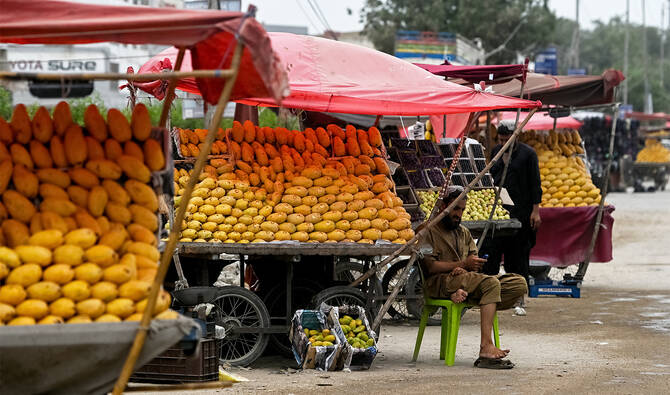
Fruit vendors wait for customers along a street in Karachi on June 18, 2025. (AFP/File)
Short Url
Updated 14 July 2025
Follow

Pakistan launches new agri-trade authority to promote modern farming

  • NAFSA aims to modernize agriculture, reduce chemical use, and boost trade transparency
  • Initiative comes under Special Investment Facilitation Council overseeing economic reforms

ISLAMABAD: Pakistan has established a new regulatory body to reform its agriculture sector and bring domestic food safety standards in line with international requirements, state-run Associated Press of Pakistan (APP) reported on Monday.

The new National Agri-Trade and Food Safety Authority (NAFSA) has been set up under a reform drive led by the Special Investment Facilitation Council (SIFC), a civil-military hybrid body formed in 2023 to fast-track foreign investment and economic reform in strategic sectors, including agriculture, mining, IT and defense production.

NAFSA consolidates the Department of Plant Protection (DPP) and the Animal Quarantine Department into a single authority aimed at promoting modern agricultural practices, reducing excessive chemical use and facilitating trade in agricultural products.

“The establishment of the new body, by merging DPP and Animal Quarantine, is an important milestone toward development of agriculture sector,” the APP report stated.

The report did not provide further details on NAFSA’s governance, regulatory powers and rollout timeline.

Agriculture remains a cornerstone of Pakistan’s economy, employing nearly 38 percent of the workforce and contributing around 19 percent to the country’s GDP. However, the sector has long faced challenges, including outdated practices, poor regulatory oversight, low export competitiveness and barriers in meeting international sanitary and phytosanitary (SPS) standards.

By centralizing regulatory oversight and compliance, the government hopes NAFSA will address long-standing inefficiencies and support value-added agricultural exports.

“NAFSA is aimed at introducing modern agricultural systems according to global standards,” the APP said. “It will help reduce unnecessary use of Methyl Bromide, saving up to forty thousand rupees per container.”

Methyl Bromide, a fumigant used to control pests during export processing, has been heavily restricted under global environmental protocols due to its ozone-depleting properties. NAFSA’s efforts to limit its use are expected to improve both environmental sustainability and export cost efficiency.

The move aligns with broader reforms spearheaded by the SIFC, which was formed through a civil-military consensus to fast-track investment decisions, cut bureaucratic delays and attract foreign capital, especially from Gulf and Chinese partners, to priority sectors.

“Transparency and innovation is being promoted in the agriculture sector with the support of the SIFC,” the APP report said.


Pakistan, UK sign £35 million Green Compact to strengthen climate resilience

Updated 21 December 2025
Follow

Pakistan, UK sign £35 million Green Compact to strengthen climate resilience

  • Pakistan ranks among nations most vulnerable to climate change and has seen erratic changes in its weather patterns
  • UK will help Pakistan mobilize climate finance, strengthen regulatory frameworks and develop bankable climate projects

ISLAMABAD: Pakistan and the United Kingdom (UK) have formalized a comprehensive climate partnership with the launch of a Green Compact that aims to enhance climate resilience, accelerate clean energy transition and scale up nature-based solutions, including mangrove conservation, Pakistani state media reported on Sunday.

The agreement, signed in Islamabad by Federal Minister for Climate Change and Environmental Coordination Dr. Musadik Malik and UK Minister for International Development Jennifer Chapman, unlocks £35 million in targeted support for green development and long-term climate action, according to Radio Pakistan broadcaster.

Pakistan ranks among nations most vulnerable to climate change and has seen erratic changes in its weather patterns that have led to frequent heatwaves, untimely rains, storms, cyclones, floods and droughts in recent years. In 2022, monsoon floods killed over 1,700 people, displaced another 33 million and caused over $30 billion losses, while another 1,037 people were killed in floods this year.

Mohammad Saleem Shaikh, a spokesperson for Pakistan’s Ministry of Climate Change, described the compact as a “decisive move toward action-oriented climate cooperation,” noting that its implementation over the next decade will be critical for Pakistan which regularly faces floods, heatwaves and water stress.

“The Compact is structured around five core pillars: climate finance and investment, clean energy transition, nature-based solutions, innovation and youth empowerment, and adaptation and resilience,” the report read.

“Under the agreement, the UK will work with Pakistan to mobilize public and private climate finance, strengthen regulatory frameworks for green investment, and develop bankable climate projects.”

Clean energy forms a central component of Pakistan’s transition, with Islamabad planning to expand solar and wind generation to reduce fossil fuel dependence, improve energy security and stabilize power costs, according to Shaikh.

“Renewable energy is now economically competitive, making the transition both environmentally and financially viable,” he was quoted as saying.

“Nature-based solutions, particularly large-scale mangrove restoration, will protect coastal communities from storm surges and erosion while enhancing biodiversity and carbon sequestration.”

Under the Compact, technical support, mentoring and access to investors will be provided to climate-smart startups and young innovators, reflecting Pakistan’s recognition of youth-led initiatives as central to future climate solutions.

On the occasion, Chapman, on her first official visit to Pakistan, underscored the urgency of climate action, highlighting the UK’s support for renewable energy, mangrove and ecosystem restoration, early-warning systems, climate budgeting and international investment flows into Pakistan.

Shaikh described the Green Compact as “a strategic turning point” in Pakistan–UK relations on climate change, saying its effective implementation is essential for Pakistan to meet its national climate targets.