

From Karachi to Lahore, free iftar spreads relief during Ramadan

A volunteer prepares the plates of Iftar food on the first day of the Islamic holy month of Ramadan at the Data Darbar shrine in Lahore on February 19, 2026. (AFP)
Short Url
Updated 20 February 2026
Follow

From Karachi to Lahore, free iftar spreads relief during Ramadan

  • Pakistan has increasingly experimented with targeted subsidies and digital systems to manage food affordability during Ramadan
  • Last week, PM Shehbaz Sharif launched $136 million relief package, pledging digital cash transfers to 12.1 million low-income families

ISLAMABAD: Mosques in Pakistan’s megacities Karachi and Lahore provide free iftar meal for the poor to break the fast during Ramadan, residents said.

Fasting during the holy month of Ramadan is one of the five pillars of Islam, where Muslims abstain from food and drink from sunrise to sunset.

This is followed by the sighting of the new moon and is marked by Eid-ul-Fitr, a religious holiday and celebration that is observed by Muslims across the world.

In Karachi, hundreds of people rush to sellers of traditional snacks to break the fast.

“You have to be patient, worship Allah, and keep Allah pleased by fulfilling your duties as described by Prophet Muhammad,” said Munir Qadri, a Karachi resident.
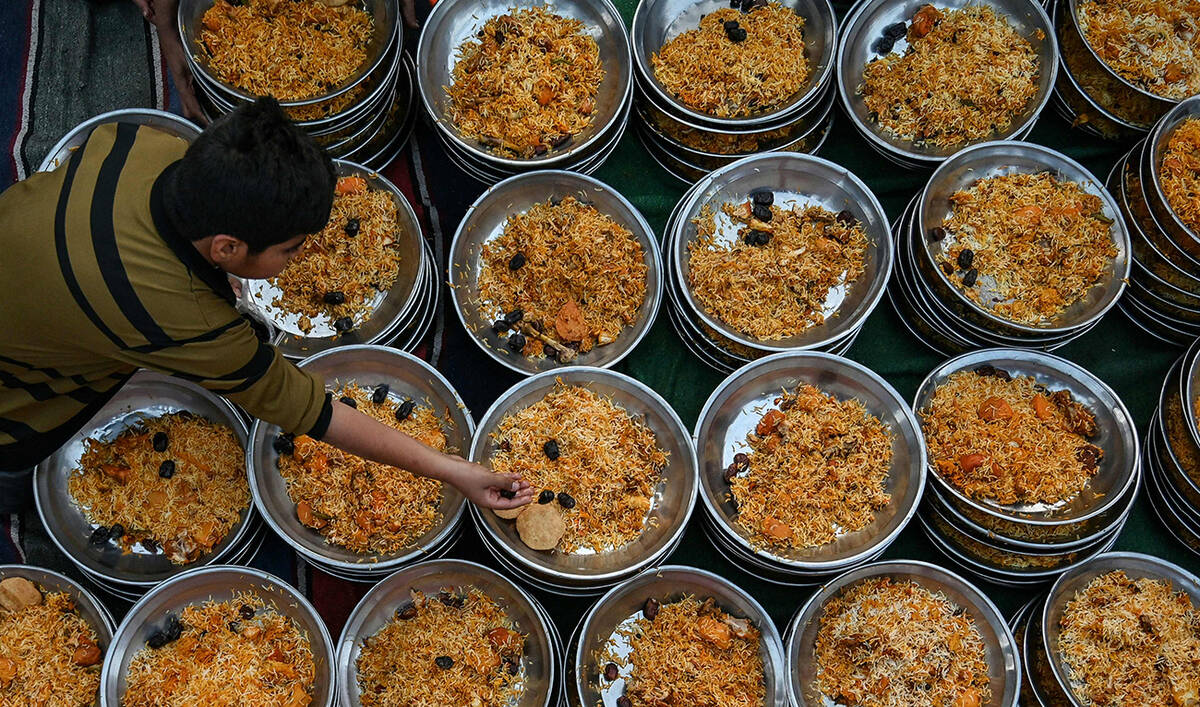


A volunteer arranges iftar meals on the first day of the Islamic holy month of Ramadan at the New Memon mosque in Karachi on February 19, 2026. (AFP)

“Yes, Allah has also allowed you to have a good iftar, but we must also think of the poor. All the people should eat equally, and may everyone receives the blessings of this Ramadan.”

Saad Sharif, another Karachi dweller, complained of higher food and commodity prices this Ramadan.

“The prices of everything are increasing,” he said.

“Petrol has become expensive, we can’t do anything about it. Flour has become expensive. Electricity, water, and gas, everything has become costly.”
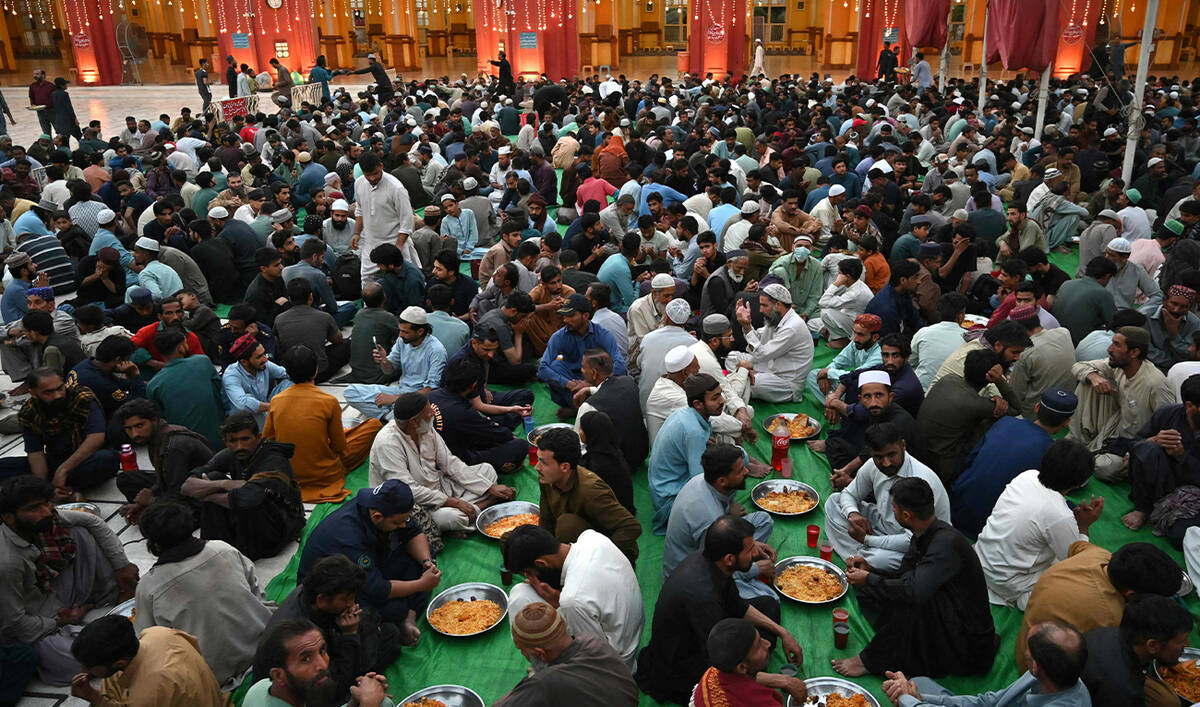


Muslim devotees pray before breaking their fast on the first day of the Islamic holy month of Ramadan in Karachi on February 19, 2026. (AFP)

Pakistan has increasingly experimented with targeted subsidies and digital systems to manage food affordability during Ramadan, when consumption rises sharply and lower-income households face pressure after years of high inflation.

Last week, Prime Minister Shehbaz Sharif launched a Rs38 billion ($136 million) Ramadan relief package, pledging direct digital cash transfers of Rs13,000 ($47) each to 12.1 million low-income families across Pakistan.

Yet hundreds of Muslims flock to the Data Darbar, a historical shrine in the eastern city of Lahore, and sit on floor as volunteers distribute free food and drinks during iftar and sehri, post-sunset and pre-dawn meals.

Qari Muhammad Younus, an elderly man in Lahore, said that collective iftar holds great importance and there is huge divine reward for the ones who offer iftar to those with no means.

“There are countless [people] here, 24 hours, day and night, and there is more than enough food from iftar till sehri,” he said.

“There is so much food here that iftar at Data Darbar is second only to iftar at Prophet’s Mosque.”

Mushtaq Ahmad, a Lahore resident, said Allah Almighty asks Muslims to “spend out of what I have provided for you as sustenance.”

“And that includes these iftar meals. May Allah Almighty incline us toward such good deeds,” he added.


79 foreign firms, including Middle Eastern investors, enter Pakistan in three years — SECP

Updated 6 sec ago
Follow

79 foreign firms, including Middle Eastern investors, enter Pakistan in three years — SECP

  • Foreign firms invested about $145 million across energy, logistics, IT and agriculture
  • Pakistani regulator says 19 companies exited market over the same three-year period

KARACHI: Middle Eastern energy and logistics companies including Saudi Aramco, Wafi Energy and DP World expanded their footprint in Pakistan, as 79 new foreign firms commenced operations in the country over the past three years, according to an official statement released on Tuesday.

The figures come as Pakistan seeks to rebuild investor confidence and attract foreign capital to shore up its economy after years of financial turbulence that saw foreign currency reserves shrink, the rupee weaken sharply and inflation surge. Islamabad has been pursuing structural reforms and courting overseas partners to stabilize growth and ease external financing pressures.

“79 new foreign companies commenced operations in Pakistan over the past three years, while foreign firms invested Rs 40.7 billion [$145 million] in key sectors during the same period,” the Securities and Exchange of Pakistan (SECP) said in a statement.

“A total of 61 foreign companies also carried out shareholding transactions involving local entities,” it added. “Of the 61 shareholding transactions, 29 involved transfers to other foreign companies, four to foreign individual investors, 20 to local individual investors, and eight to local corporate entities.”

According to the regulator, several transactions were linked to global corporate restructuring among multinational companies. Saudi Arabia’s Wafi Energy acquired Shell Pakistan’s operations, while Dubai-based PTA Global Holdings secured a majority stake in Lotte Chemical Pakistan.

Saudi Aramco purchased a 40 percent equity stake in Gas & Oil Pakistan Limited, and Switzerland’s Gunvor Group alongside Total Parco Limited acquired equal stakes in TotalEnergies Pakistan.

In logistics, UAE-based DP World entered into a joint venture with Pakistan’s National Logistics Corporation, while investments in the technology and telecommunications sectors included acquisitions and stake purchases involving regional and international firms.

The statement said 1,157 foreign companies are currently registered and operational in Pakistan, with 19 exits recorded over the past three years.