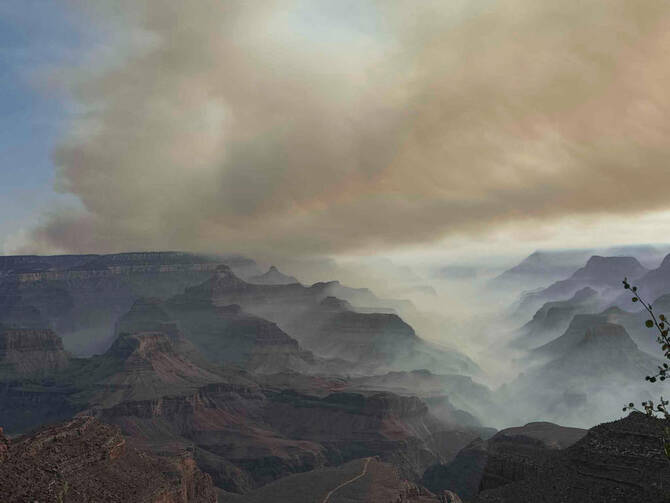
FLAGSTAFF: A fast-moving wildfire destroyed a historic lodge and dozens of other structures on the Grand Canyon’s North Rim, forcing officials to close access to that area for the season, the park said Sunday.
The Grand Canyon Lodge, the only lodging inside the park at the North Rim, was consumed by the flames, park Superintendent Ed Keable told park residents, staff and others in a meeting Sunday morning. He said the visitor center, the gas station, a waste water treatment plant, an administrative building and some employee housing were among the 50 to 80 structures lost. “Numerous” historic cabins in the area also were destroyed, the park said.
Two wildfires are burning at or near the North Rim, known as the White Sage Fire and the Dragon Bravo Fire. The latter is the one that impacted the lodge and other structures.
Started by lightning on July 4, the Dragon Bravo Fire was initially managed by authorities with a “confine and contain” strategy to clear fuel sources. They shifted to aggressive suppression a week later as it rapidly grew to 7.8 square miles (20 square kilometers) because of hot temperatures, low humidity and strong wind gusts, fire officials said.
No injuries have been reported.
Arizona Governor Katie Hobbs called on the federal government late Sunday to investigate the National Park Service’s response to the wildfire.
“They must first take aggressive action to end the wildfire and prevent further damage,” she said in a post on X. “But Arizonans deserve answers for how this fire was allowed to decimate the Grand Canyon National Park.”
Millions of people visit the park annually, with most going to the more popular South Rim. The North Rim is open seasonally. It was evacuated last Thursday because of wildfire, and will remain closed for the rest of the season, the park said in a statement.
Firefighters at the North Rim and hikers in the inner canyon were evacuated over the weekend. The park said along with the fire risk, they could potentially be exposed to chlorine gas after the treatment plant burned. Chlorine gas is heavier than air and can lead to blurred vision, irritation or respiratory problems if high amounts of it are breathed in, according to the Centers for Disease Control and Prevention.
Rafters on the Colorado River through the Grand Canyon also were told to bypass Phantom Ranch, which has a set of cabins and dormitories along the river.
Historic lodge burned
The Grand Canyon Lodge was often the first prominent feature that visitors see, even before viewing the canyon. A highway ends at the lodge, which was known for its sloped roof, huge ponderosa beams and massive limestone facade. By walking across the lobby and descending a stairwell, visitors could get their first view of the Grand Canyon shining through windows across the “Sun Room.”
“It just feels like you’re a pioneer when you walk through there (the lodge),” said Tim Allen, a longtime resident of Flagstaff, Arizona, and yearly visitor to the Grand Canyon. “It really felt like you were in a time gone by.”
Allen said the North Rim felt special and more personal because of its remoteness and reduced number of tourists. He often spent time there camping and doing rim-to-rim hikes, trekking all the way to the bottom of the canyon and back out.
“It’s heartbreaking,” he said of the destruction caused by the fire.
Caren Carney was staying at the lodge with her husband, parents and 12-year-old son when a park ranger knocked on their door Thursday and told them to evacuate. Carney’s parents first took her to the North Rim in the early 90s when she was 12, and the family decided to do the same with her son this year now that he was the same age. She was overjoyed to show her husband and son the serene beauty of the North Rim for the first time, and to bring her dad back to one of his favorite places in the world.
Carney said she was heartbroken Sunday to hear that such a “magical place” had burned down. After evacuating, the family from Georgia relocated to the South Rim to continue their vacation and they could see the blaze from across the canyon.
“We told my son while visiting that this is now a family tradition and he should bring his children when they are 12,” Carney said. I hope there will be something as magnificent for them to see in the future, and I’m so glad we got to have one final look at it in the present before it was lost.”
Aramark, the company that operated the lodge, said all employees and guests were safely evacuated.
“As stewards of some our country’s most beloved national treasures, we are devastated by the loss,” said spokesperson Debbie Albert.
An original lodge burned down from a kitchen fire in 1932, four years after construction was completed, according to the Grand Canyon Historical Society. The redesigned lodge using the original stonework opened in 1937.
Thomas Sulpizio, president of the historical society, said the lodge contained some valuable archives that he wasn’t sure were saved.
The lobby also contained a famous 600-pound bronze statue of a donkey named “Brighty the Burro.”
Meanwhile, officials reported progress in battling a second wildfire burning north of the Grand Canyon. Fire lines on the White Sage Fire that forced evacuations at the North Rim and in the community of Jacob Lake were holding, officials said. By Sunday afternoon the fire had charred 63 square miles (162 square kilometers) of terrain.
On the southern edge of the fire, hand crews and bulldozers were working uphill, and the spread of the blaze had been minimal.
But to the east and north, the fire has spread rapidly, with grasses and standing dead trees contributing to the fire’s intensity, officials said. The fire was pushing downhill toward the Vermilion Cliffs area, and crews were assessing opportunities to create buffer zones that help slow or halt the fire’s progress.
Wildfire closes national park in Colorado
Elsewhere, one of several wildfires burning in Colorado that closed Black Canyon of the Gunnison National Park, about 260 miles (420 kilometers) southwest of Denver, has burned 5.6 square miles (14.5 square kilometers) and forced the evacuation of homes near the park. The fire was started by lightning on Thursday on the south rim of the park, a dramatic, deep gorge carved by the Gunnison River.
Colorado Gov. Jared Polis issued a disaster declaration on Sunday because of it and other fires burning in western Colorado. His office said they were all started the same day by the same storm.
Another wildfire burning near the Colorado-Utah border near La Sal, Utah, also started Thursday and has burned around 14 square miles (36.3 square kilometers).


![]()

Wildfire destroys a historic Grand Canyon lodge and other structures
Short Url
https://arab.news/vkudq
Wildfire destroys a historic Grand Canyon lodge and other structures
- Millions of people visit the park annually, with most going to the more popular South Rim


Latest updates




© 2026 SAUDI RESEARCH & PUBLISHING COMPANY, All Rights Reserved And subject to Terms of Use Agreement.