

South Korea medical students end 17-month class boycott

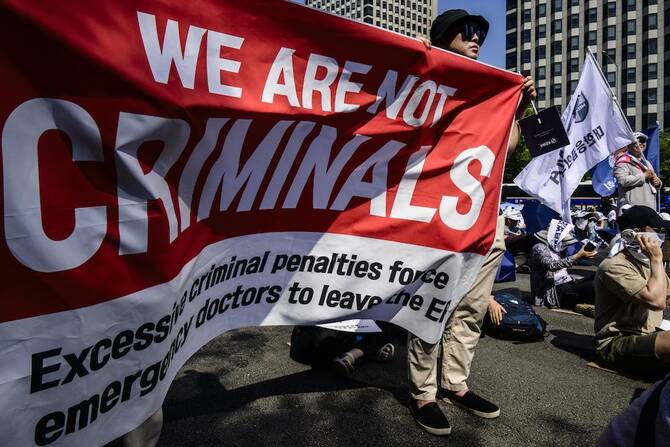
Members of The Korea Medical Association attend a rally in Seoul on June 18, 2024, as a months-long strike by junior medics drags on. (AFP)
Short Url
Updated 14 July 2025
Follow

South Korea medical students end 17-month class boycott

  • South Korean health care was plunged into chaos early last year when then-president Yoon Suk Yeol moved to sharply increase medical school admissions
  • The initiative met fierce protest, prompting junior doctors to walk away from hospitals and medical students to boycott their classrooms

SEOUL: Thousands of South Korean medical students are set to return to classrooms after a 17-month boycott, an industry body said Monday, ending part of a standoff which also saw junior doctors strike.

South Korean health care was plunged into chaos early last year when then-president Yoon Suk Yeol moved to sharply increase medical school admissions, citing an urgent need to boost doctor numbers to meet growing demand in a rapidly aging society.

The initiative met fierce protest, prompting junior doctors to walk away from hospitals and medical students to boycott their classrooms, with operations canceled and service provision disrupted nationwide.

The measure was later watered down, and the government eventually offered to scrap it in March 2025, after Yoon was impeached over his disastrous declaration of martial law.

“Students have agreed to return to school,” a spokesperson for the Korean Medical Association said Monday, adding that it was up to each medical school to decide the schedule for student returns.

The Korean Medical Students’ Association said in an earlier statement that the students had reached this decision because a continued boycott “could cause the collapse of the fundamentals of medical systems.”

Some 8,300 students are expected to return to school, but no specific timeline has been provided.

Prime Minister Kim Min-seok welcomed the decision, calling it a “big step forward” in a Facebook post Sunday, adding President Lee Jae Myung was deliberating ways to solve the issue.

In addition to the student boycott, some 12,000 junior doctors went on strike last year – with the vast majority of them still declining to return to work.

Lee – who took office in June after winning snap elections following Yoon’s removal from office – had said on the campaign trail he would seek to resolve the medical strike.

The increase in medical school admissions led to a record number of students re-taking the college entrance exam in November in a bid to capitalize on reforms that made it easier to get into coveted majors.


Prabowo, Trump expected to sign Indonesia-US tariff deal in January 2026

Updated 23 December 2025
Follow

Prabowo, Trump expected to sign Indonesia-US tariff deal in January 2026

  • Deal will mean US tariffs on Indonesian products are cut from a threatened 32 percent to 19 percent
  • Jakarta committed to scrap tariffs on more than 99 percent of US goods

JAKARTA: Indonesia expects to sign a tariff deal with the US in early 2026 after reaching an agreement on “all substantive issues,” Jakarta's chief negotiator said on Tuesday.

Indonesia’s Coordinating Minister for Economic Affairs Airlangga Hartarto met with US trade representative Jamieson Greer in Washington this week to finalize an Indonesia-US trade deal, following a series of discussions that took place after the two countries agreed on a framework for negotiations in July.

“All substantive issues laid out in the Agreement on Reciprocal Trade have been agreed upon by the two sides, including both the main and technical issues,” Hartarto said in an online briefing.

Officials from both countries are now working to set up a meeting between Indonesian President Prabowo Subianto and US President Donald Trump. 

It will take place after Indonesian and US technical teams meet in the second week of January for a legal scrubbing, or a final clean-up of an agreement text.

“We are expecting that the upcoming technical process will wrap up in time as scheduled, so that at the end of January 2026 President Prabowo and President Trump can sign the Agreement on Reciprocal Trade,” Hartarto said.  

Indonesian trade negotiators have been in “intensive” talks with their Washington counterparts since Trump threatened to levy a 32 percent duty on Indonesian exports. 

Under the July framework, US tariffs on Indonesian imports were lowered to 19 percent, with Jakarta committing to measures to balance trade with Washington, including removing tariffs on more than 99 percent of American imports and scrapping all non-tariff barriers facing American companies. 

Jakarta also pledged to import $15 billion worth of energy products and $4.5 billion worth of agricultural products such as soybeans, wheat and cotton, from the US. 

“Indonesia will also get tariff exemptions on top Indonesian goods, such as palm oil, coffee, cocoa,” Hartarto said. 

“This is certainly good news, especially for Indonesian industries directly impacted by the tariff policy, especially labor-intensive sectors that employ around 5 million workers.” 

In the past decade, Indonesia has consistently posted trade surpluses with the US, its second-largest export market after China. 

From January to October, data from the Indonesian trade ministry showed two-way trade valued at nearly $36.2 billion, with Jakarta posting a $14.9 billion surplus.