

What We Are Reading Today: ‘What Matters in Jane Austen?’

Photo/Supplied
Short Url
Updated 13 July 2025
Follow

What We Are Reading Today: ‘What Matters in Jane Austen?’

  • In this work he poses 20 questions such as: “Why is the weather important?” “How much money is enough?” “Why is Darcy so rude?” and “What do the characters call each other?”

Author: John Mullan

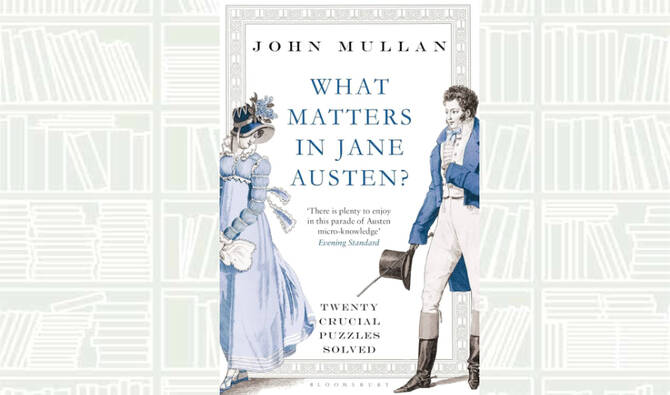
To mark 250 years since the birth of one of the most famous women authors in English literature, John Mullan’s “What Matters in Jane Austen? Twenty Crucial Puzzles Solved” has been reissued.

First published in 2012, the book is a kind of literary scavenger hunt, with Mullan as guide — witty, knowing and visibly delighted by the patterns and puzzles he uncovers.

We go on the journey with him, uncovering the meanings embedded in the seemingly minor, but not minute, details of Austen’s fiction.

The Lord Northcliffe professor of modern English literature at University College London, Mullan is a leading authority on Austen. He has edited “Sense and Sensibility” and “Emma” for Oxford World’s Classics and has published widely on 18th- and 19th-century literature.

In this work he poses 20 questions such as: “Why is the weather important?” “How much money is enough?” “Why is Darcy so rude?” and “What do the characters call each other?”

That last question forms one of the book’s most interesting chapters for me. It’s about the seemingly stealthy and subtle ways in which the characters address others by a name and the power of not saying their name at all.

In Austen’s world, names are never casual. A shift from a formal title to a first name can signal a change in status, desire or familiarity. A name can be a quiet form of rebellion or a coded expression of closeness or longing. It matters whether someone is “Miss Bennet” or “Elizabeth,” whether a man dares to use her given name directly and whether that liberty is permitted or returned.

Again and again, Mullan shows us how much Austen could signal with the smallest of choices. What seems like a passing detail is likely loaded with meaning.

This new edition, with a fresh preface, is a fitting tribute to Austen’s longevity. Rather than framing her novels as relics to admire, Mullan treats them as living texts full of sly codes and sharp decisions.

It offers fans of Austen’s work something they crave: evidence. A deep dive into the text itself.

By the end, the title becomes clear, not just because Mullan asked the right questions but because, through his close reading and sharp observations, we begin to get answers.

To Austen, who died in 1817, everything mattered: names, clothes, weather, silence. And more than two centuries later, her world — precise, constrained, emotionally charged — still has plenty to show and tell.


What We Are Reading Today: ‘I Who Have Never Known Men’

Photo/Supplied
Updated 05 December 2025
Follow

What We Are Reading Today: ‘I Who Have Never Known Men’

  • The story follows a nameless main character, the youngest of 39 women who have been trapped in a bunker for an X amount of years, guarded by men in rotation for reasons unknown

Author: Jacqueline Harpman

“I Who Have Never Known Men” is a tale of resilience and an inquiry into the human condition. 

The book, by Jacqueline Harpman, had little to no reception in 1995 when it was first published, but it has seen a revival like no other, becoming one of the most-read novels in recent years. 

The story follows a nameless main character, the youngest of 39 women who have been trapped in a bunker for an X amount of years, guarded by men in rotation for reasons unknown. In this dystopian, post-apocalyptic world, they are given minimal supplies to sustain themselves and have learned to coexist with the fact that they may live the rest of their lives in entrapment. 

The other captives are older and faintly remember their past, but having been taken at the age of 4 or 5, the “Child” — as they call her — has no recollection of her past; not even her name. The women are all numb to their condition. 

“For a very long time, the days went by, each just like the day before. Then I began to think, and everything changed,” a section of the book reads. 

All she knows is life inside these walls, and the stories women tell her. “My memory begins with my anger,” she narrates. She is isolated from the rest, but eventually forms a bond with Anthea, who teaches her most of what she knows about the world. With a stroke of luck, and the girl’s cleverness, they finally see the day they get to leave the cage. 

But what happens now? How will they survive on their own? What chaos induced their abduction? Why were they chosen as captives? Why were they the ones lucky enough to escape? Were they still on Earth? What happened to their families? Why was the electricity still on? They ponder many questions throughout their journey. 

But one thing the book doesn’t do is provide answers. 

If you’re looking for a read that’s tied with a neat little bow at the end, this may not be the book for you. 

Although the novel is a quick read, less than 200 pages, it is by no means a light one. But it does provide an important, yet bleak, contemplation of the lengths humanity will go to in order to find hope.