‘Inexcusable’ failures led to Trump assassination attempt: Senate report

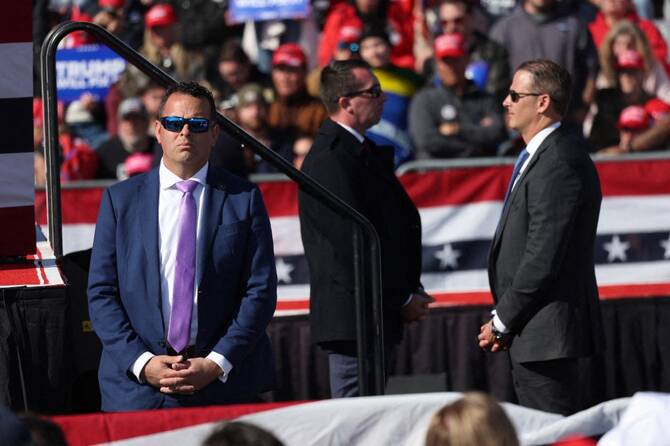
Secret Service agents stand guard as Donald Trump speaks during a campaign rally at Lancaster Airport in Lititz, Pennsylvania, Nov. 3, 2024. (AFP)
Short Url
Updated 14 July 2025
Follow

‘Inexcusable’ failures led to Trump assassination attempt: Senate report

  • A congressional inquiry accused the Secret Service of ‘a cascade of preventable failures that nearly cost President Trump his life’
  • Six unidentified Secret Service staff have been disciplined with punishments range from 10 to 42 days’ suspension without pay

WASHINGTON: A congressional inquiry into the attempt to assassinate US President Donald Trump at a campaign rally a year ago on Sunday lamented “inexcusable” failures in the Secret Service’s operations and response, and called for more serious disciplinary action.

On July 13, 2024, a gunman shot the then-Republican presidential candidate during a campaign rally in Butler, Pennsylvania, grazing his ear.

One bystander was killed and two other people in addition to Trump were wounded before a government sniper killed the gunman, 20-year-old Thomas Crooks.

“What happened was inexcusable and the consequences imposed for the failures so far do not reflect the severity of the situation,” said the report released by the US Senate Homeland Security and Governmental Affairs Committee.

The dramatic incident energized Trump’s bid to return to the White House, with his campaign using a photo of him bloodied and pumping his fist as he was hurried offstage to woo voters.

The report did not shed new light on the gunman’s motive, which still remains a mystery, but accused the Secret Service of “a cascade of preventable failures that nearly cost President Trump his life.”

“The United States Secret Service failed to act on credible intelligence, failed to coordinate with local law enforcement,” said the committee’s Republican chairman Rand Paul.

“Despite those failures, no one has been fired,” he added.

“It was a complete breakdown of security at every level-fueled by bureaucratic indifference, a lack of clear protocols, and a shocking refusal to act on direct threats.

“We must hold individuals accountable and ensure reforms are fully implemented so this never happens again.”

Staff disciplined

The Secret Service cited communication, technical and human errors and said reforms were underway, including on coordination between different law enforcement bodies and establishment of a division dedicated to aerial surveillance.

Six unidentified staff have been disciplined, according to the agency. The punishments range from 10 to 42 days’ suspension without pay, and all six were put into restricted or non-operational positions.

Reflecting on the assassination attempt earlier this week, Trump said “mistakes were made” but that he was satisfied with the investigation.

In an interview with his daughter-in-law on Fox News’ “My View with Lara Trump,” Trump said the sniper “was able to get him from a long distance with one shot. If he didn’t do that, you would have had an even worse situation.”

“It was unforgettable,” Trump said of the events.

“I didn’t know exactly what was going on. I got whacked. There’s no question about that. And fortunately, I got down quickly. People were screaming.”


Nigerian president vows security reset in budget speech

Updated 6 sec ago
Follow

Nigerian president vows security reset in budget speech

  • Government plans to buy 'cutting-edge' equipment to boost the fighting capability of military


ABUJA: Nigeria’s president vowed a national security overhaul as he presented the government budget, allocating the largest share of spending to defense after criticism over the handling of the country’s myriad conflicts.
Nigeria faces a long-running insurgency in the northeast, while armed “bandit” gangs commit mass kidnappings and loot villages in the northwest, and farmers and herders clash in the center over dwindling land and resources.
President Bola Tinubu last month declared a nationwide security emergency and ordered mass recruitment of police and military personnel to combat mass abductions, which have included the kidnapping of hundreds of children at their boarding school.
He told the Senate that his government plans to increase security spending to boost the “fighting capability” of the military and other security agencies by hiring more personnel and buying “cutting-edge” equipment.
Tinubu promised to “usher in a new era of criminal justice” that would treat all violence by armed groups or individuals as terrorism, as he allocated 5.41 trillion naira ($3.7 billion) for defense and security.
Security officials and analysts say there is an increasing alliance between bandits and extremists from Nigeria’s northeast, who have in recent years established a strong presence in the northwestern and central regions.
“Under this new architecture, any armed group or gun-wielding non-state actors operating outside state authority will be regarded as terrorists,” said Tinubu, singling out, among others, bandits, militias, armed gangs, armed robbers, violent cult groups, and foreign-linked mercenaries.
He said those involved in political or sectarian violence would also be classified as terrorists.
On the economic front, Tinubu hailed his “necessary” but not “painless” reforms that have plunged Nigeria into its worst economic crisis in a generation.
He said inflation has “moderated” for eight successive months, declining to 14.45 percent in the last month from 24.23 percent in March this year.
He projected that the budget deficit will drop next year to 4.28 percent of GDP from around 6.1 percent of GDP in 2023, the year he came into office.