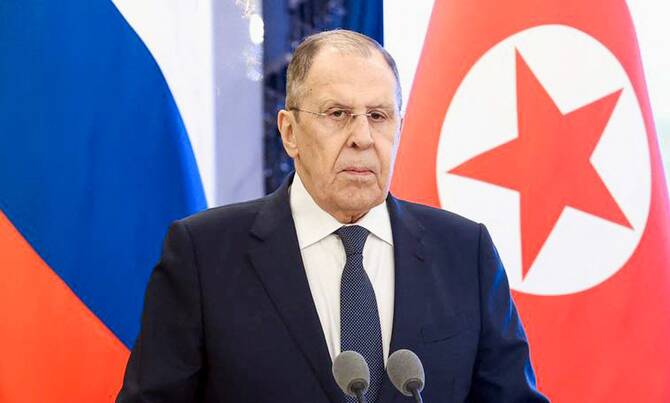
MOSCOW: Russian Foreign Minister Sergei Lavrov met Sunday in Beijing with his Chinese counterpart to discuss Ukraine and relations with the United States.
Russia’s top diplomat arrived in China following a visit to North Korea, where he received assurances of support in its conflict with Ukraine.
Lavrov and Wang Yi “discussed relations with the United States and the outlook for settling the Ukrainian crisis,” Russia’s foreign ministry said in a statement.
China, a diplomatic and economic ally of Moscow, claims to be neutral in the conflict between Russia and Ukraine.
But it has never denounced Russia’s 2022 invasion nor called for it to withdraw its troops, and many of Ukraine’s allies believe that China has provided support for Russia.
Beijing regularly calls for an end to the fighting, while also accusing Western countries of prolonging the conflict by arming Ukraine.
The statement from the Russian foreign ministry said Levrov and Yi also discussed other “burning issues” such as the war in Gaza and the “situation on the Korean peninsula.”

Russia’s Lavrov visits Beijing to discuss Ukraine
Short Url
https://arab.news/2txye
Russia’s Lavrov visits Beijing to discuss Ukraine
- Russia’s top diplomat arrived in China following a visit to North Korea
- China claims to be neutral in the conflict between Russia and Ukraine
Three Afghan migrants die of cold while trying to cross into Iran
AFGHANISTAN: Three Afghans died from exposure in freezing temperatures in the western province of Herat while trying to illegally enter Iran, a local army official said on Saturday.
“Three people who wanted to illegally cross the Iran-Afghanistan border have died because of the cold weather,” the Afghan army official told AFP on condition of anonymity.
He added that a shepherd was also found dead in the mountainous area of Kohsan from the cold.
The migrants were part of a group that attempted to cross into Iran on Wednesday and was stopped by Afghan border forces.
“Searches took place on Wednesday night, but the bodies were only found on Thursday,” the army official said.
More than 1.8 million Afghans were forced to return to Afghanistan by the Iranian authorities between January and the end of November 2025, according to the latest figures from the United Nations refugee agency (UNHCR), which said that the majority were “forced and coerced returns.”
“These mass returns in adverse circumstances have strained Afghanistan’s already overstretched resources and services” which leads to “risks of onward and new displacement, including return movements back into Pakistan and Iran and onward,” UNHCR posted on its site dedicated to Afghanistan’s situation.
This week, Amnesty International called on countries to stop forcibly returning people to Afghanistan, citing a “real risk of serious harm for returnees.”
Hit by two major earthquakes in recent months and highly vulnerable to climate change, Afghanistan faces multiple challenges.
It is subject to international sanctions particularly due to the exclusion of women from many jobs and public places, described by the UN as “gender apartheid.”
More than 17 million people in the country are facing acute food insecurity, the UN World Food Programme said Tuesday.
“Three people who wanted to illegally cross the Iran-Afghanistan border have died because of the cold weather,” the Afghan army official told AFP on condition of anonymity.
He added that a shepherd was also found dead in the mountainous area of Kohsan from the cold.
The migrants were part of a group that attempted to cross into Iran on Wednesday and was stopped by Afghan border forces.
“Searches took place on Wednesday night, but the bodies were only found on Thursday,” the army official said.
More than 1.8 million Afghans were forced to return to Afghanistan by the Iranian authorities between January and the end of November 2025, according to the latest figures from the United Nations refugee agency (UNHCR), which said that the majority were “forced and coerced returns.”
“These mass returns in adverse circumstances have strained Afghanistan’s already overstretched resources and services” which leads to “risks of onward and new displacement, including return movements back into Pakistan and Iran and onward,” UNHCR posted on its site dedicated to Afghanistan’s situation.
This week, Amnesty International called on countries to stop forcibly returning people to Afghanistan, citing a “real risk of serious harm for returnees.”
Hit by two major earthquakes in recent months and highly vulnerable to climate change, Afghanistan faces multiple challenges.
It is subject to international sanctions particularly due to the exclusion of women from many jobs and public places, described by the UN as “gender apartheid.”
More than 17 million people in the country are facing acute food insecurity, the UN World Food Programme said Tuesday.
© 2025 SAUDI RESEARCH & PUBLISHING COMPANY, All Rights Reserved And subject to Terms of Use Agreement.


