

Saudi Arabia issues over 1,300 new industrial licenses in 2024: Ministry report

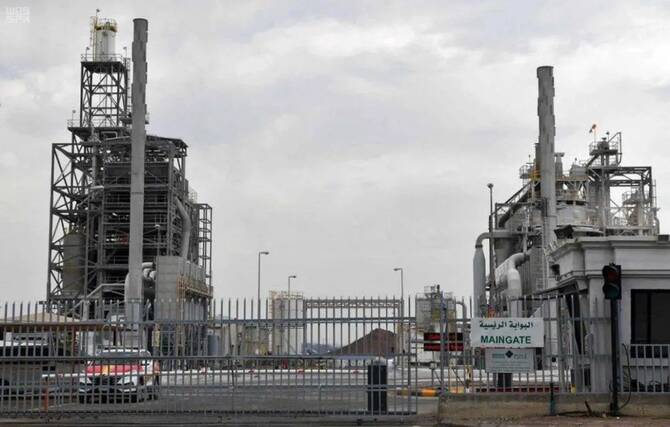
In June, Saudi Arabia launched the second phase of its standardized industrial incentives program. File/SPA
Short Url
Updated 13 July 2025
Follow

Saudi Arabia issues over 1,300 new industrial licenses in 2024: Ministry report

  • Private sector investments in industrial cities and zones totaled SR1.9 trillion
  • Ministry developed 454 investment opportunities worth SR143 billion

RIYADH: Saudi Arabia has issued 1,346 new industrial licenses in 2024, attracting over SR50 billion ($13.3 billion) in new investments, a recent report revealed.

Private sector investments in industrial cities and zones totaled SR1.9 trillion, and the number of licensed workers in the field was 1.09 million, with a 36 percent Saudization rate, the analysis by the Kingdom’s Ministry of Industry and Mineral Resources said.

The new figures are consistent with the nation’s efforts to transform its industrial sector to boost the number of factories to 36,000 by 2035, of which 4,000 will be fully automated. The goal is part of the Kingdom’s strategy to foster a dynamic, innovation-driven industrial sector.

They also align with data from January, when the country’s industrial production index rose by 1.3 percent year-on-year, driven by ongoing growth in manufacturing and waste management, according to the General Authority for Statistics. Monthly, the index remained stable at 103.9, unchanged from December.

“We have all the capabilities to achieve a competitive and sustainable industrial economy, including ambitious young talent, a distinguished geographical location, rich natural resources, and leading national industrial companies,” the report said, citing Crown Prince Mohammed bin Salman. 

“Through the National Industrial Strategy and in partnership with the private sector, the Kingdom will become a leading industrial power, contributing to securing global supply chains and exporting high-tech products to the world,” he added.

The ministry has also developed 454 investment opportunities worth SR143 billion, which are linked to the industrial sectors targeted in the National Industrial Strategy.

The report shed light on how Saudi Arabia has achieved a global ranking of 33 in the Competitive Industrial Production Index.

“This progress reflects the Kingdom’s significant efforts to strengthen its industrial sector as part of Saudi Vision 2030, which aims to diversify the economy and reduce dependence on oil. This achievement also represents an advance of two places from the target, which is 35th place globally,” the Minister of Industry and Mineral Resources, Bandar Alkhorayef, said.

“These visions and objectives set forth major ambitions to align with the Kingdom’s position as an influential regional power within the G20 group and achieve Saudi Arabia 2030, which envisions the Kingdom as a leading industrial nation in which the mining sector is the third pillar of the national economy,” Alkhorayef added.

In June, Saudi Arabia launched the second phase of its standardized industrial incentives program to enhance competitiveness and strengthen the Kingdom’s trade balance.

Speaking at the Saudi Industry Forum in Dhahran at the time, Khalil Ibn Salamah, deputy minister of industry and mineral resources for industrial affairs, said the initiative supports the government’s efforts to drive high-value investments in priority sectors.

This comes as the nation works to position itself as a regional and global industrial hub. Since its initial launch, the program has drawn more than 1,000. Of the 118 applications received, 12 have reached the final qualification stage.


Egypt’s Suez Canal, Namibian Ports Authority sign MoU to propel port development, training

Updated 17 December 2025
Follow

Egypt’s Suez Canal, Namibian Ports Authority sign MoU to propel port development, training

RIYADH: Egypt’s Suez Canal Authority and the Namibian Ports Authority have signed a memorandum of understanding amid efforts to propel cooperation in development and training.

The agreement aims to exchange expertise and enhance bilateral cooperation in several areas, most notably marine construction, the sale and leasing of marine units, and advanced training through the Suez Canal Authority’s academies, according to a statement.

This is supported by figures from the Suez Canal Authority, which reported revenues of $1.97 billion from 5,874 ship transits since early July, representing a 17.5 percent year-on-year increase, chairman Osama Rabie said during a recent meeting with an International Monetary Fund delegation.

It also aligns well with Rabie’s further forecast that the canal’s revenues would improve during the 2026/2027 fiscal year to around $8 billion, rising to approximately $10 billion the following year, according to a statement issued by the authority.

The newly released statement said: “Rabie affirmed the authority’s readiness for fruitful and constructive cooperation with the Namibian Ports Authority, given the expansion of the entity’s international projects and its efforts to open new markets and engage with the African continent.”

“The chairman explained that the Suez Canal Authority’s efforts succeeded in developing and reopening the Libyan port of Sirte after 14 years of closure, marking a successful start to international projects with friendly and sister nations,” it added.

The chairman instructed that all necessary support and procedures be put in place to initiate practical cooperation on multiple projects, highlighting that the authority offers a comprehensive system for maritime and logistics services through its shipyards and subsidiaries.

For her part, Nangula Hamunyela, chairperson of the Namibian Ports Authority, voiced her enthusiasm for collaborating with the Suez Canal Authority on advancing Namibia’s ambitious port development plan, home to the largest ports in West Africa.

She stressed that this partnership highlights the strong relationship between Egypt and Namibia and will help further deepen bilateral ties.

Hamunyela further highlighted that the Suez Canal Authority’s advanced technology and vast expertise across multiple sectors will play a key role in supporting and speeding up development efforts in Namibian ports, reducing dependence on foreign expertise and technology from outside the region.

Egypt’s Suez Canal generated a total of $40 billion between 2019 and 2024 and remains the country’s most important source of foreign currency.