

India marks inclusion of 12 Maratha forts on UNESCO World Heritage List

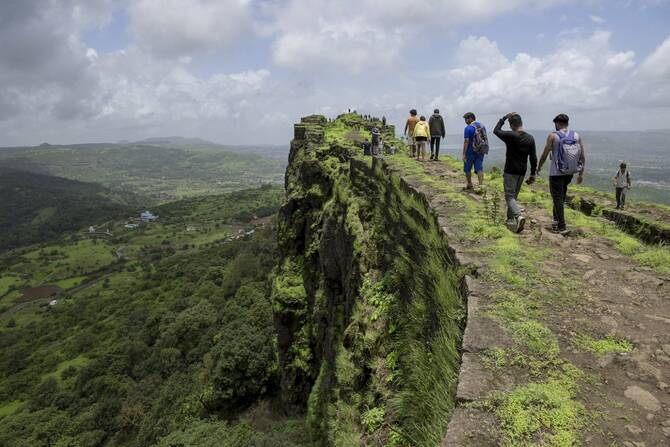
Visitors walk along the ruins of the Lohagad hill fort, near Lonavla in the western Indian state of Maharashtra. (File/AFP)
Short Url
Updated 13 July 2025
Follow

India marks inclusion of 12 Maratha forts on UNESCO World Heritage List

  • Forts were once used by the Maratha Empire between the 17th and 19th centuries
  • India now ranks 6th globally and 2nd in Asia for the number of World Heritage Sites

NEW DELHI: India’s Maratha Military Landscapes — a network of 12 strategic forts — have been added to the UNESCO World Heritage List, becoming the country’s 44th site to receive the designation.

The forts were used by the rulers of the Maratha Empire, who held power across parts of central, western and southern India between the late 17th century and the early 19th century.

Marathas rose to prominence after the decline of the Mughal Empire, following the death of Emperor Aurangzeb in 1707, the last powerful Mughal ruler, who alone had controlled much of India for nearly 50 years.

The proposal to include the Maratha forts on the UNESCO list was submitted by India to the World Heritage Committee in January 2024.

The inscription, which took place during the 47th session of the World Heritage Committee in Paris on Friday, marked “a significant milestone in the global acknowledgment of India’s rich and diverse cultural heritage,” the Ministry of Culture said in a statement.

The Maratha Military Landscapes of India were nominated under the criteria in recognition of “their exceptional testimony to a living cultural tradition, their architectural and technological significance, and their deep associations with historic events and traditions.”

The fortification network covers 11 forts in the state of Maharashtra — Salher, Shivneri, Lohagad, Khanderi, Raigad, Rajgad, Pratapgad, Suvarnadurg, Panhala, Vijaydurg, and Sindhudurg — and one, Gingee Fort, in Tamil Nadu.

With the newest addition, India now ranks sixth globally and second in the Asia-Pacific region for the number of UNESCO World Heritage sites.

“The fact that UNESCO selected 12 forts from the Maratha dynasty as World Heritage Sites is a matter of great pride for the history of the Marathas, Maharashtra and India,” Prof. Santosh Mahadevrao Ghuge, who heads the Department of History at the Fergusson College in Pune, one of the main cities of Maharashtra, told Arab News.

“The war strategy of the Marathas has unique significance in Indian and world history, and forts have an important place in this war strategy. In the 17th and 18th centuries, the Maratha military prowess and the use of forts in warfare enabled the Marathas to defeat the powerful Mughals.”


Tens of thousands attend funeral of killed Bangladesh student leader

Updated 3 sec ago
Follow

Tens of thousands attend funeral of killed Bangladesh student leader

  • Tens of thousands of mourners gathered in the Bangladeshi capital Dhaka on Saturday for the funeral of a student leader, after two days of violent protests over his killing
DHAKA: Tens of thousands of mourners gathered in the Bangladeshi capital Dhaka on Saturday for the funeral of a student leader, after two days of violent protests over his killing.
Huge crowds accompanied the funeral procession of Sharif Osman Hadi, a key figure in last year’s pro-democracy uprising who died in a hospital in Singapore on Thursday after being shot by masked gunmen while leaving a Dhaka mosque.
Police wearing body cameras were deployed in front of the parliament building where the funeral prayers were held.
Hadi’s body, which was brought to the capital on Friday, was buried at the central mosque of Dhaka University.
“We have not come here to say goodbye,” interim leader Muhammad Yunus said in an emotional speech.
“You are in our hearts and you will remain in the heart of all Bangladeshis as long as the country exists.”
Hadi, 32, was an outspoken critic of India and was set to contest the general elections in February.
Iqbal Hossain Saikot, a government employee who traveled from afar to attend the prayers, said Hadi was killed because he staunchly opposed India.
He will continue to live “among the millions of Bangladeshi people who love the land and its sovereign territory,” Saikot, 34, told AFP.
Hadi’s death has triggered widespread unrest, with protesters across the South Asian nation demanding the arrest of those responsible.
Late Thursday, people set fire to several buildings in Dhaka including the offices of leading newspapers Prothom Alo and the Daily Star.
Critics accuse the publications of favoring neighboring India, where Bangladesh’s ousted prime minister Sheikh Hasina has taken refuge since fleeing Dhaka in the wake of the 2024 uprising.
Rights group Amnesty International on Saturday urged Bangladesh’s interim government to carry out “prompt, thorough, independent and impartial” investigations into Hadi’s killing and the violence that followed.
It also expressed alarm over the lynching of Hindu garment worker Dipu Chandra Das following allegations of blasphemy.
Yunus said seven suspects had been arrested in connection with Das’s killing in the central district of Mymensingh on Thursday.