

India marks inclusion of 12 Maratha forts on UNESCO World Heritage List

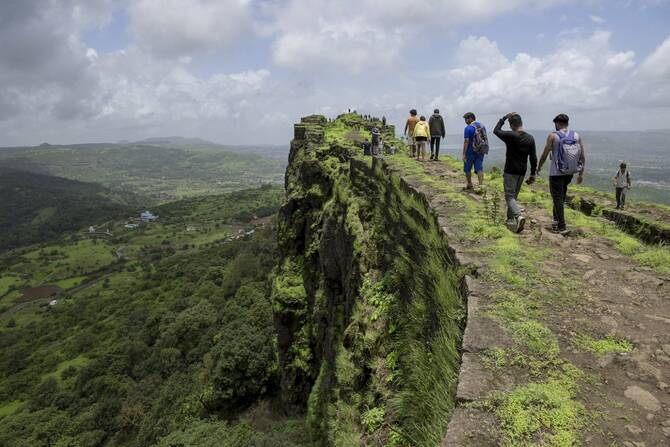
Visitors walk along the ruins of the Lohagad hill fort, near Lonavla in the western Indian state of Maharashtra. (File/AFP)
Short Url
Updated 13 July 2025
Follow

India marks inclusion of 12 Maratha forts on UNESCO World Heritage List

  • Forts were once used by the Maratha Empire between the 17th and 19th centuries
  • India now ranks 6th globally and 2nd in Asia for the number of World Heritage Sites

NEW DELHI: India’s Maratha Military Landscapes — a network of 12 strategic forts — have been added to the UNESCO World Heritage List, becoming the country’s 44th site to receive the designation.

The forts were used by the rulers of the Maratha Empire, who held power across parts of central, western and southern India between the late 17th century and the early 19th century.

Marathas rose to prominence after the decline of the Mughal Empire, following the death of Emperor Aurangzeb in 1707, the last powerful Mughal ruler, who alone had controlled much of India for nearly 50 years.

The proposal to include the Maratha forts on the UNESCO list was submitted by India to the World Heritage Committee in January 2024.

The inscription, which took place during the 47th session of the World Heritage Committee in Paris on Friday, marked “a significant milestone in the global acknowledgment of India’s rich and diverse cultural heritage,” the Ministry of Culture said in a statement.

The Maratha Military Landscapes of India were nominated under the criteria in recognition of “their exceptional testimony to a living cultural tradition, their architectural and technological significance, and their deep associations with historic events and traditions.”

The fortification network covers 11 forts in the state of Maharashtra — Salher, Shivneri, Lohagad, Khanderi, Raigad, Rajgad, Pratapgad, Suvarnadurg, Panhala, Vijaydurg, and Sindhudurg — and one, Gingee Fort, in Tamil Nadu.

With the newest addition, India now ranks sixth globally and second in the Asia-Pacific region for the number of UNESCO World Heritage sites.

“The fact that UNESCO selected 12 forts from the Maratha dynasty as World Heritage Sites is a matter of great pride for the history of the Marathas, Maharashtra and India,” Prof. Santosh Mahadevrao Ghuge, who heads the Department of History at the Fergusson College in Pune, one of the main cities of Maharashtra, told Arab News.

“The war strategy of the Marathas has unique significance in Indian and world history, and forts have an important place in this war strategy. In the 17th and 18th centuries, the Maratha military prowess and the use of forts in warfare enabled the Marathas to defeat the powerful Mughals.”


London police using withdrawn powers to clamp down on pro-Palestine rallies: Probe

Updated 5 sec ago
Follow

London police using withdrawn powers to clamp down on pro-Palestine rallies: Probe

  • ‘Cumulative disruption’ cited to ban, reroute rallies but power granted by concept withdrawn by Court of Appeal in May
  • Network for Police Monitoring: This demonstrates ‘ongoing crackdown on protest’ that has reached ‘alarming point’

LONDON: London’s Metropolitan Police have used powers that have been withdrawn to clamp down on pro-Palestine rallies in the capital, legal experts have said.

The Guardian and Liberty Investigates obtained evidence that police officers had imposed restrictions on at least two protests based on the principle of “cumulative disruption.” But that power was withdrawn by the Court of Appeal in May, according to legal experts.

All references to cumulative disruption have been removed from relevant legislation, yet the Home Office and the Met continue to insist that police officers retain the power to consider the concept when suppressing protests.

On May 7, five days after the powers were withdrawn, the Met banned a Jewish pro-Palestine group from holding its weekly rally in north London, citing the cumulative impact on the neighborhood’s Jewish community.

Last month, the Met forced the Palestine Coalition to change the route of its rally on three days’ notice, highlighting the cumulative impact on businesses during Black Friday weekend.

Raj Chada, a partner at Hodge, Jones & Allen and a leading criminal lawyer, said: “There is no reference to cumulative disruption in the original (legislation). The regulations that introduced this concept were quashed in May 2025, so I fail to see how this can still be the approach taken by police. There is no legal basis for this whatsoever.”

The Met appeared “not to care” if it was acting within the law, the Network for Police Monitoring said, adding that the revelation surrounding “cumulative disruption” demonstrated an “ongoing crackdown on protest” that had reached an “alarming point” by police in London.

Home Secretary Shabana Mahmood announced plans in October to reintroduce the power to consider cumulative impact in toughened form.

But Nick Glynn, a retired senior officer from Leicestershire Police, said: “The police have too many protest powers already and they definitely don’t need any more. If they are provided with them, they not only use them (but) as in this case, they stretch them.

“They go beyond what was intended. The right to protest is sacrosanct and more stifling of protest makes democracy worth less.”

Cumulative disruption was regularly considered and employed in regulations if protests met the threshold of causing “serious disruption to the life of the community.”

The Court of Appeal withdrew the power following a legal challenge by human rights group Liberty.

Ben Jamal, the Palestine Solidarity Campaign’s director, was reportedly told by Alison Heydari, the Met’s deputy assistant commissioner, that her decision on imposing protest regulations “will be purely around the cumulative effect of your protests.”

She reportedly added that “this is not just about Saturday’s protest but it’s a combination of all the impacts of all the processions so far,” referencing “serious disruption” to the business community.

“You’ve used this route in November 2024, and you’ve used it a few times before then as well. So, there is an impact.”

The repeated disruption to PSC-hosted marches, the largest pro-Palestine events in London, was a “demobilizer,” Jamal said.

It also caused confusion about march starting points and led to protesters being harassed by police officers who accused them of violating protest conditions, he added.

A Met spokesperson told The Guardian: “The outcome of the judicial review does not prevent senior officers from considering the cumulative impact of protest on the life of communities.

“To determine the extent of disruption that may result from a particular protest, it is, of course, important to consider the circumstances in which that protest is to be held, including any existing disruption an affected community is already experiencing.

“We recognise the importance of the right to protest. We also recognise our responsibility to use our powers to ensure that protest does not result in serious disorder or serious disruption. We use those powers lawfully and will continue to do so.”