

Pakistani man deported after boarding wrong flight to Jeddah serves legal notice to airline

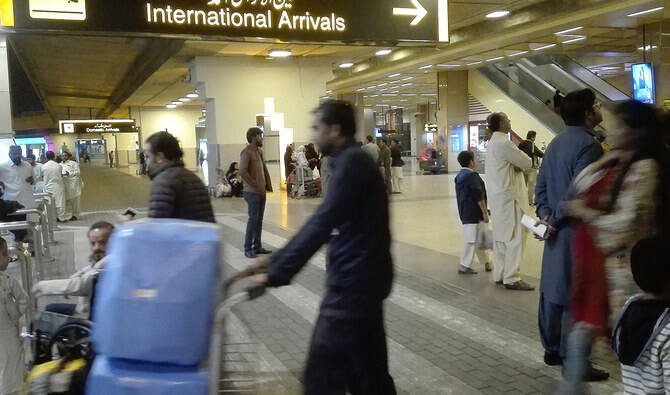
Passengers walk after their arrival at the Jinnah International Airport in Karachi, Pakistan, on January 31, 2020. (AFP/File)
Short Url
Updated 13 July 2025
Follow

Pakistani man deported after boarding wrong flight to Jeddah serves legal notice to airline

  • Civil aviation regulator urged to impose ‘heavy fine’ on the private airline over security lapse
  • Malik Shahzain Ahmed ‘mistakenly’ boarded Jeddah flight instead of Lahore–Karachi route

KARACHI: A Pakistani man who was mistakenly flown to Saudi Arabia earlier this week has issued a legal notice to Air Sial, seeking compensation for “gross negligence,” his lawyer said on Saturday.

Malik Shahzain Ahmed, a resident of Karachi, was scheduled to fly from Lahore to Karachi on July 8 on the private airline’s flight PF-146. However, he boarded an international flight to Jeddah without any visa or passport and was subsequently detained and deported by Saudi immigration authorities.

A legal notice sent by Ahmed’s counsel to Air Sial’s chief executive reads the airline’s “gross dereliction of duty, reckless conduct and operational failure” had led to the wrongful boarding of his client on the international flight.

“We have served the airline a notice, and if they fail to compensate my client, we will file a petition,” Advocate Muhammad Nawaz Dahri told Arab News.

The legal notice says Ahmed was denied assistance by the airline and subjected to humiliation, distress. He also faced severe mental trauma and had to purchase another ticket to return to Karachi.

The notice accuses the airline of violating the Sindh Consumer Protection Act, 2014, citing “defective” service, lack of identity verification and “misleading representations regarding safety and professionalism.”

It also alleges breaches of Pakistan’s Civil Aviation Rules, 1994, the Pakistan Immigration Ordinance, 1979, and international air travel conventions, including the Montreal Convention of 1999.

“Your airline’s failure to perform this basic due diligence endangered passenger security and violated air travel norms,” the notice added.

In a statement on Friday, the Pakistan Airport Authority said it had taken notice of the lapse and written letters to the civil aviation regulator and the station manager.

“In the letter, the civil aviation regulator has been requested to impose a heavy fine on the airline that is guilty of negligence,” PAA spokesman Saifullah, who goes by a single name, told Arab News.

In a video clip circulating online, Ahmed said he went to Lahore airport to board the Karachi-bound flight on July 8 but “mistakenly” sat in the Jeddah-bound flight after collecting his boarding pass.

“After two hours, I asked [myself], ‘This plane doesn’t seem to be landing,’” he said. “Then I got to know that I had boarded the wrong plane.”

The legal notice demands a written response within two days alongside compensatory damages.

It warns of legal proceedings if the airline fails to comply, including a constitutional petition and complaints to Pakistan’s aviation and human rights authorities.

Air Sial is yet to comment publicly on the matter.


Pakistan terms climate change, demographic pressures as ‘pressing existential risks’

Updated 06 December 2025
Follow

Pakistan terms climate change, demographic pressures as ‘pressing existential risks’

  • Pakistan has suffered frequent climate change-induced disasters, including floods this year that killed over 1,000
  • Pakistan finmin highlights stabilization measures at Doha Forum, discusses economic cooperation with Qatar 

ISLAMABAD: Pakistan’s Finance Minister Muhammad Aurangzeb on Saturday described climate change and demographic pressures as “pressing existential risks” facing the country, calling for urgent climate financing. 

The finance minister was speaking as a member of a high-level panel at the 23rd edition of the Doha Forum, which is being held from Dec. 6–7 in the Qatari capital. Aurangzeb was invited as a speaker on the discussion titled: ‘Global Trade Tensions: Economic Impact and Policy Responses in MENA.’

“He reaffirmed that while Pakistan remained vigilant in the face of geopolitical uncertainty, the more pressing existential risks were climate change and demographic pressures,” the Finance Division said. 

Pakistan has suffered repeated climate disasters in recent years, most notably the 2022 super-floods that submerged one-third of the country, displaced millions and caused an estimated $30 billion in losses. 

This year’s floods killed over 1,000 people and caused at least $2.9 billion in damages to agriculture and infrastructure. Scientists say Pakistan remains among the world’s most climate-vulnerable nations despite contributing less than 1 percent of global greenhouse-gas emissions.

Aurangzeb has previously said climate change and Pakistan’s fast-rising population are the only two factors that can hinder the South Asian country’s efforts to become a $3 trillion economy in the future. 

The finance minister noted that this year’s floods in Pakistan had shaved at least 0.5 percent off GDP growth, calling for urgent climate financing and investment in resilient infrastructure. 

When asked about Pakistan’s fiscal resilience and capability to absorb external shocks, Aurangzeb said Islamabad had rebuilt fiscal buffers. He pointed out that both the primary fiscal balance and current account had returned to surplus, supported significantly by strong remittance inflows of $18–20 billion annually from the Middle East and North Africa (MENA) and Gulf Cooperation Council (GCC) regions. 

Separately, Aurangzeb met his Qatari counterpart Ali Bin Ahmed Al Kuwari to discuss bilateral cooperation. 

“Both sides reaffirmed their commitment to strengthening economic ties, particularly by maximizing opportunities created through the newly concluded GCC–Pakistan Free Trade Agreement, expanding trade flows, and deepening energy cooperation, including long-term LNG collaboration,” the finance ministry said. 

The two also discussed collaboration on digital infrastructure, skills development and regulatory reform. They agreed to establish structured mechanisms to continue joint work in trade diversification, technology, climate resilience, and investment facilitation, the finance ministry said.