SEOUL: Russia’s foreign minister warned the US, South Korea and Japan against forming a security partnership targeting North Korea as he visited his country’s ally for talks on further solidifying their booming military and other cooperation.
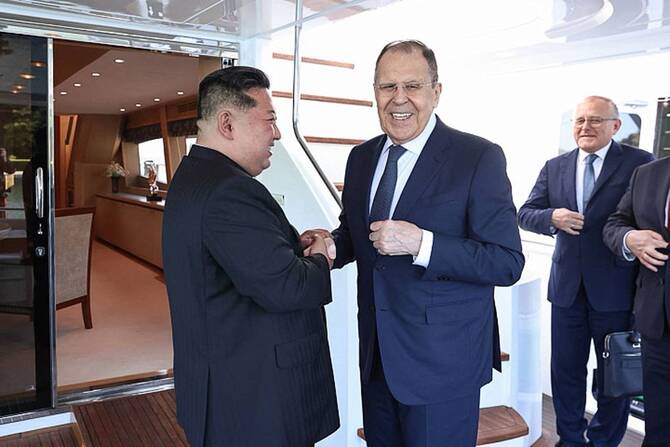
Russian Foreign Minister Sergey Lavrov spoke Saturday at North Korea’s eastern Wonsan city, where he met the country’s leader, Kim Jong Un, and conveyed greetings from President Vladimir Putin.
Kim during the meeting reaffirmed his government’s commitment to “unconditionally support and encourage all measures” taken by Russia in its conflict with Ukraine.
He said Pyongyang and Moscow share identical views on “all strategic issues in conformity with the level of alliance,” according to North Korea’s official Korean Central News Agency.
Lavrov called for the two countries to further strengthen their “strategic and tactical cooperation and intensify concerted action” in international affairs, KCNA reported.
Relations between Russia and North Korea have been flourishing in recent years, with North Korea supplying troops and ammunition to support Russia’s war against Ukraine in return for military and economic assistance.
That has raised concerns among South Korea, the US and others that Russia might also transfer sensitive technologies to North Korea that can increase the danger of its nuclear and missile programs.
Speaking with reporters after a meeting with his North Korean counterpart Choe Son Hui, Lavrov accused the US, South Korea and Japan of what he called military buildups around North Korea.
“We warn against exploiting these ties to build alliances directed against anyone, including North Korea and, of course, Russia,” he said, according to Russia’s state Tass news agency.
The US, South Korea and Japan have expanded or restored their trilateral military exercises in response to North Korea’s advancing nuclear program. The three countries held a joint air drill Friday involving US nuclear-capable bombers near the Korean Peninsula as their top military officers met in Seoul and urged North Korea to cease all unlawful activities threatening regional security.
North Korea views major US-led military drills as invasion rehearsals and has long argued it is forced to develop nuclear weapons to defend itself from US military threats.
Russia understands North Korea’s decision to seek nuclear weapons, Lavrov said.
“The technologies used by North Korea are the result of the work of its own scientists. We respect North Korea’s aspirations and understand the reasons why it is pursuing nuclear development,” Lavrov said, according to Tass.
During their meeting, Choe reiterated North Korea “unconditionally” supports Russia’s fight against Ukraine, as Lavrov repeated Russia’s gratitude for the contribution North Korean troops made in efforts to repel a Ukrainian incursion into Russia’s Kursk border region.
North Korea recently opened a mammoth beach resort in Wonsan city, the meeting venue, that it says can accommodate nearly 20,000 people.
In his comments at the start of his meeting with Choe, Lavrov said, “I am sure that Russian tourists will be increasingly eager to come here. We will do everything we can to facilitate this, creating conditions for this, including air travel,” according to the Russian Foreign Ministry.
The Wonsan-Kalma tourist zone is at the center of Kim’s push to boost tourism to improve his country’s troubled economy. However, prospects for the tourist complex aren’t clear as North Korea appears unlikely to fully reopen its borders and embrace Western tourists anytime soon.


Russia warns US, South Korea and Japan against forming security alliance targeting North Korea
https://arab.news/7n6kt
Russia warns US, South Korea and Japan against forming security alliance targeting North Korea

- Russian FM Lavrov issued the warning as he visited North Korea for talks on further solidifying their booming cooperation
- N. Korea had been supplying troops and ammunition to support Russia’s war against Ukraine in return for military and economic assistance


US Justice Department official eyes cases against Cuba leaders as Trump floats ‘friendly takeover’
- “Working group” formed to build cases against people connected to the Cuban government
- Trump’s has increasingly displayed aggressive stance against Cuba’s communist leadership
MIAMI: The top Justice Department prosecutor in Miami is considering criminal investigations of Cuban government officials, according to people familiar with the matter. The inquiry comes as President Donald Trump has raised the possibility of a “friendly takeover” of the communist-run island.
Jason Reding Quiñones, the US attorney for the Southern District of Florida, has created a “working group” that includes federal prosecutors and officials from the Drug Enforcement Administration and other agencies to try to build cases against people connected to the Cuban government and its Communist Party, according to one of the people. They spoke on the condition of anonymity because they were not authorized to publicly discuss the effort.
It was not immediately clear which Cuban officials the office is targeting or what criminal charges prosecutors may be looking to bring.
The Justice Department said in a statement Friday that “federal prosecutors from across the country work every day to pursue justice, which includes efforts to combat transnational crime.”
The effort is taking place against the backdrop of Trump’s increasingly aggressive stance against Cuba’s communist leadership.
Emboldened by the US capture of Cuba’s close ally, Venezuelan President Nicolás Maduro, Trump last month said his administration was in high-level talks with officials in Havana to pursue “a friendly takeover” of the country. He repeated those claims this week, saying his attention would turn back to Cuba once the war with Iran winds down.
“They want to make a deal so bad,” Trump said of Cuba’s leadership.
While Cuba has faded from Washington’s radar as a major national security threat in recent decades, it remains a priority in the US Attorney’s office in Miami, whose political, economic and cultural life is dominated by Cuban-American exiles.
The FBI field office has a dedicated Cuba group that in 2024 was instrumental in the arrest of former US Ambassador Victor Manuel Rocha on charges of serving as a secret agent of Cuba stretching back to the 1970s.
In recent weeks, several Miami Republicans, in addition to Florida Sen. Rick Scott, have called on the Trump administration to reopen its criminal investigation into the 1996 shootdown of four planes operated by anti-communist exiles.
In a letter to Trump on Feb. 13, lawmakers including Reps. Maria Elvira Salazar and Carlos Gimenez highlighted decades-old news reports indicating that former President Raúl Castro — the head of Cuba’s military at the time — gave the order to shoot down the unarmed Cessna aircraft.
“We believe unequivocally that Raúl Castro is responsible for this heinous crime,” lawmakers wrote. “It is time for him to be brought to justice.”
While no indictment against Castro has been announced, Florida’s attorney general said this week that he would open a state-level investigation into the crime.
The Trump administration has also accused Cuba of not cooperating with American counterterrorism efforts, adding it alongside North Korea and Iran to a select few nations the US considers state sponsors of terrorism.
The designation stems from Cuba’s harboring of US fugitives and its refusal to extradite several Colombian rebel leaders while they were engaged in peace talks with the South American nation.


