

Pakistan PM defends tough structural reforms, says country can’t afford ‘business as usual’

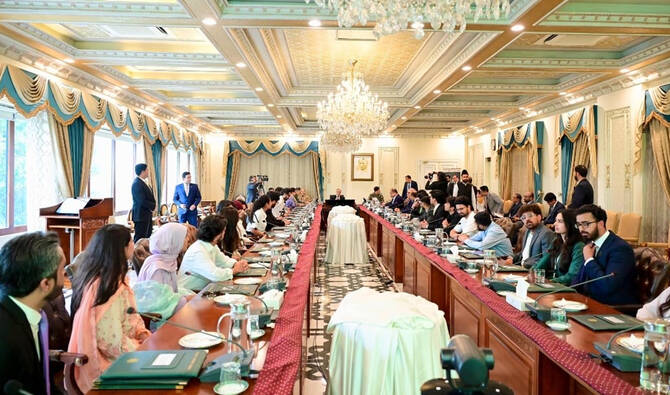
Pakistan Prime Minister Shehbaz Sharif speaks during a meeting with a delegation of overseas Pakistani students selected for URAAN Pakistan Summer Scholars Internship, in Islamabad on July 12, 2025. (Handout/PMO)
Short Url
Updated 12 July 2025
Follow

Pakistan PM defends tough structural reforms, says country can’t afford ‘business as usual’

  • Shehbaz Sharif describes Pakistan’s economic stabilization efforts as ‘a long and thorny journey’
  • He says merit is central to his governance model as his administration works to fix the economy

ISLAMABAD: Prime Minister Shehbaz Sharif on Saturday strongly defended his government’s structural reform agenda, particularly in tax administration, saying that difficult and often unpopular decisions were necessary to rebuild national institutions, as the country could no longer afford “business as usual.”

Speaking at an orientation session for participants of the Uraan Pakistan youth program, Sharif recalled the fragile economic conditions he inherited after assuming power following last year’s general elections.

He noted that Pakistan had narrowly avoided a sovereign default in mid-2023, when inflation surged to nearly 38 percent, before securing a critical bailout package from the International Monetary Fund (IMF).

The prime minister said his administration took on the “onerous task” of stabilizing the economy under immense pressure, choosing to pursue long-delayed reforms rather than temporary fixes.

“Pakistan had to undertake these long-overdue, deep structural changes if we had to find our lost place in the comity of nations through hard and untiring efforts,” he said.

Sharif pointed to a set of key reforms aligned with IMF recommendations, including the digitization of the Federal Board of Revenue (FBR).

He noted the transition from paper-based tax systems to digital and AI-led processes was already bearing fruit.

“Faceless interactions — these terminologies were unknown in FBR,” he said, adding that one previously underperforming sector saw its tax contribution rise from Rs12 billion to over Rs50 billion within a year due to improved enforcement.

The prime minister said his administration had prioritized accountability, removing senior FBR officials accused of corruption and resisting political pressure in doing so.

“It’s a long and thorny journey,” he continued. “We are facing bumps on the way and mountain-like impediments. But I can assure you, we will not shy away from discharging our responsibility.”

Sharif maintained that merit would remain the cornerstone of his governance model.

“Delivery is the name of the game,” he said. “Performance is the name of the game.”


Pakistan police say 27 cops killed in 134 attacks in restive Bannu district in 2025

Updated 25 December 2025
Follow

Pakistan police say 27 cops killed in 134 attacks in restive Bannu district in 2025

  • Bannu is a restive district in northwestern Pakistan where militants frequently attack law enforcers
  • Police say at least 20 drone attacks by militants killed nine civilians, injured 19 cops during the year

PESHAWAR: Police in Pakistan’s northwestern Bannu district said this week that at least 27 police personnel were killed in 134 attacks while 53 militants were killed during various security operations in the volatile area during the year, as Islamabad grapples with a surge in militancy. 

Bannu district in Khyber Pakhtunkhwa (KP) province is one of Pakistan’s most dangerous districts, where militants affiliated with the Tehreek-e-Taliban Pakistan (TTP) frequently target law enforcers in attacks. 

Regional Police Officer Sajjad Khan told reporters during a press briefing on Wednesday that at least 134 “terrorist attacks” were recorded in Bannu district during 2025 that targeted police stations, posts, checkpoints, police mobiles and police parties.

“As a result of these attacks, 27 police personnel were martyred and 79 were injured,” a statement issued by Bannu Police said on Wednesday. 

It said at least 168 intelligence-based operations were conducted by police across the district during the year, in which 105 militants were arrested and 65 were killed. 

Khan informed media that militants carried out 20 drone attacks targeting police installations and civilian areas in 2025, killing nine civilians and injuring 19 police personnel. 

“However, following the installation of an anti-drone system in Bannu district on Jul. 18, 2025, the situation improved significantly,” the statement said. “More than 300 drone attacks were thwarted, and four drones were struck/spoofed.”

He said the Bannu police force has been equipped with drones, anti-drone guns, sniper rifles, armored personnel carriers (APCs), thermal imaging systems, tactical helmets and bulletproof vehicles. 

“Bannu police reiterates its resolve to continue its struggle to maintain law and order in the district, completely eliminate terrorism and protect the lives and property of the public,” the statement concluded. 

Pakistan blames the Afghan government for facilitating TTP attacks inside its territory, a charge Kabul denies. The surge in militant attacks has strained ties between Pakistan and Afghanistan, leading to deadly border clashes in October that saw dozens killed and several wounded on both sides.