

Sand and dust storms affect about 330 million people in over 150 countries, UN agency says

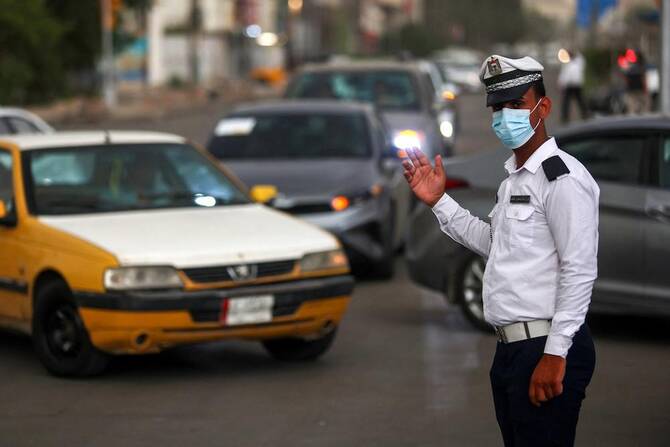
Above, a police officer directs traffic during a sand storm in the Iraqi capital Baghdad on May 1, 2025. Severe storms in Iraq have overwhelmed hospitals with respiratory cases. (AFP)
Short Url
Updated 12 July 2025
Follow

Sand and dust storms affect about 330 million people in over 150 countries, UN agency says

  • More than 80 percent of the world’s dust comes from the deserts in North Africa and the Middle East
  • About 2 billion tons of dust are emitted yearly, equivalent to 300 Great Pyramids of Giza

UNITED NATIONS: Sand and dust storms affect about 330 million people in over 150 countries and are taking an increasing toll on health, economies and the environment, the UN World Meteorological Organization says.

“About 2 billion tons of dust are emitted yearly, equivalent to 300 Great Pyramids of Giza” in Egypt, the organization’s UN representative, Laura Paterson, told the General Assembly.

More than 80 percent of the world’s dust comes from the deserts in North Africa and the Middle East, she said, but it has a global impact because the particles can travel hundreds and even thousands of kilometers (miles) across continents and oceans.

The General Assembly was marking the International Day of Combating Sand and Dust Storms on Saturday and its designation of 2025 to 2034 as the UN decade on combating sand and dust storms.

Assembly President Philemon Yang said the storms “are fast becoming one of the most overlooked yet far-reaching global challenges of our time.”

“They are driven by climate change, land degradation and unsustainable practices,” he said.

Yang, in a speech Thursday that was read by an assembly vice president, said airborne particles from sand and dust storms contribute to 7 million premature deaths every year. He said they trigger respiratory and cardiovascular disease, and reduce crop yields by up to 25 percent, causing hunger and migration.

Undersecretary-General Rola Dashti, head of the UN Economic and Social Commission for Western Asia, told the assembly the storms’ economic costs are “staggering.”

In the Middle East and North Africa, the annual cost of dealing with dust and sandstorms is $150 billion, roughly 2.5 percent of GDP, she said.

“This spring alone, the Arab region experienced acute disruption,” Dashti said, citing severe storms in Iraq that overwhelmed hospitals with respiratory cases and storms in Kuwait and Iran that forced schools and offices to close.

Dust from the Sahara Desert in Africa has reached as far as the Caribbean and Florida, she said.

Dashti, who also co-chairs the UN Coalition on Combating Sand and Dust Storms, said over 20 UN and international agencies are working to unite efforts on early warning systems for storms and to deal with other issues, including health and financing.

She urged all countries to put sand and dust storms into global and national agendas.

“From land restoration and sustainable agriculture to integrated early warning systems, we have the tools to act,” Dashti said. “What we need now is collective determination and financing to bring these solutions to scale.”


In show of support, Canada, France open consulates in Greenland

Updated 06 February 2026
Follow

In show of support, Canada, France open consulates in Greenland

  • Decisions taken in a strong show of support for Greenland government amid threats by US President Trump to seize the island

COPENHAGEN, Denmark: Canada and France, which both adamantly oppose Donald Trump’s wish to control Greenland, will open consulates in the Danish autonomous territory’s capital on Friday, in a strong show of support for the local government.
Since returning to the White House last year, Trump has repeatedly insisted that Washington needs to control the strategic, mineral-rich Arctic island for security reasons.
The US president last month backed off his threats to seize Greenland after saying he had struck a “framework” deal with NATO chief Mark Rutte to ensure greater American influence.
A US-Denmark-Greenland working group has been established to discuss ways to meet Washington’s security concerns in the Arctic, but the details of the talks have not been made public.
While Denmark and Greenland have said they share Trump’s security concerns, they have insisted that sovereignty and territorial integrity are a “red line” in the discussions.
“In a sense, it’s a victory for Greenlanders to see two allies opening diplomatic representations in Nuuk,” said Jeppe Strandsbjerg, a political scientist at the University of Greenland.
“There is great appreciation for the support against what Trump has said.”
French President Emmanuel Macron announced Paris’s plans to open a consulate during a visit to Nuuk in June, where he expressed Europe’s “solidarity” with Greenland and criticized Trump’s ambitions.
The newly-appointed French consul, Jean-Noel Poirier, has previously served as ambassador to Vietnam.
Canada meanwhile announced in late 2024 that it would open a consulate in Greenland to boost cooperation.
The opening of the consulates is “a way of telling Donald Trump that his aggression against Greenland and Denmark is not a question for Greenland and Denmark alone, it’s also a question for European allies and also for Canada as an ally, as a friend of Greenland and the European allies also,” Ulrik Pram Gad, Arctic expert at the Danish Institute of International Studies, told AFP.
“It’s a small step, part of a strategy where we are making this problem European,” said Christine Nissen, security and defense analyst at the Europa think tank.
“The consequences are obviously not just Danish. It’s European and global.”

Recognition

According to Strandsbjerg, the two consulates — which will be attached to the French and Canadian embassies in Copenhagen — will give Greenland an opportunity to “practice” at being independent, as the island has long dreamt of cutting its ties to Denmark one day.
The decision to open diplomatic missions is also a recognition of Greenland’s growing autonomy, laid out in its 2009 Self-Government Act, Nissen said.
“In terms of their own quest for sovereignty, the Greenlandic people will think to have more direct contact with other European countries,” she said.
That would make it possible to reduce Denmark’s role “by diversifying Greenland’s dependence on the outside world, so that it is not solely dependent on Denmark and can have more ties for its economy, trade, investments, politics and so on,” echoed Pram Gad.
Greenland has had diplomatic ties with the European Union since 1992, with Washington since 2014 and with Iceland since 2017.
Iceland opened its consulate in Nuuk in 2013, while the United States, which had a consulate in the Greenlandic capital from 1940 to 1953, reopened its mission in 2020.
The European Commission opened its office in 2024.