

Pakistan plans to launch transshipment operations between Gwadar and Gulf region

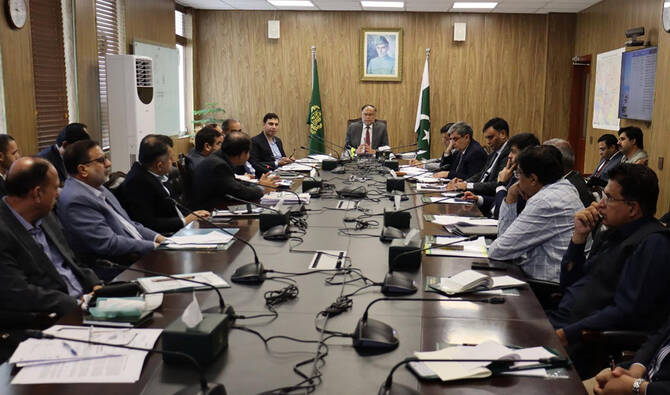
Pakistan’s Planning Minister Ahsan Iqbal chairs a high-level meeting of the Cabinet Committee on Gwadar Port operationalization in Islamabad on July 12, 2025. (PID)
Short Url
Updated 12 July 2025
Follow

Pakistan plans to launch transshipment operations between Gwadar and Gulf region

  • The country has been looking to capitalize on its geostrategic location to boost transit trade and foreign investment
  • Islamabad also seeks to cut container dwell time at ports by up to 70 percent to improve trade competitiveness, ease congestion

ISLAMABAD: The Pakistani government is actively engaging private shipping liners to commence transshipment operations between Gwadar and the Gulf region, Pakistani state media reported on Friday. 

The statement came from officials at a high-level meeting of the Cabinet Committee on Gwadar Port operationalization, which was presided over by Planning Minister Ahsan Iqbal.

Maritime officials informed the participants that initial cargo categories will include minerals, dates, seafood, and cement, targeting sectors such as mining, fisheries, and processing industries.

Iqbal said Gwadar’s geostrategic position as the shortest trade route to the Gulf and Central Asia highlighted the port’s potential as a regional transshipment hub, the Radio Pakistan broadcaster reported.

“Iqbal emphasized the need to showcase Gwadar Port in international road-shows as a strategic trade hub linking the Gulf and Central Asia,” the report read. “He directed stakeholders to promote the port’s cost-effective trade routes and available incentives for international businesses.”

Gwadar, situated along the Arabian Sea, lies at the heart of the China-Pakistan Economic Corridor (CPEC), under which Beijing has funneled tens of billions of dollars into massive transport, energy and infrastructure projects in Pakistan.

Pakistan, slowly recovering from a macroeconomic crisis under a $7 billion International Monetary Fund (IMF) deal, has been looking to capitalize on its geostrategic location to boost transit trade and foreign investment for a sustainable economic recovery.

The country plans to cut container dwell time at its seaports by up to 70 percent to improve trade competitiveness and ease congestion, while it last month reduced port charges for exporters by 50 percent at the country’s second biggest Port Qasim.


Pakistani president arrives in Iraq to deepen trade, energy cooperation

Updated 20 December 2025
Follow

Pakistani president arrives in Iraq to deepen trade, energy cooperation

  • Visit follows recent high-level contacts as Islamabad seeks to expand limited commercial ties with Baghdad
  • Talks are expected to cover investment, manpower and facilitation of Pakistani pilgrims visiting holy sites in Iraq

ISLAMABAD: President Asif Ali Zardari arrived in Iraq on Saturday on an official visit aimed at expanding cooperation in trade, energy and investment, as Pakistan seeks to deepen ties with Baghdad after years of limited engagement.

Pakistan and Iraq established diplomatic relations in 1947 and have traditionally maintained cordial ties, though commercial links remain modest, with officials and business groups identifying scope for cooperation in construction services, pharmaceuticals, manpower and agricultural exports.

“President Asif Ali Zardari arrived in Baghdad on a four-day official visit to Iraq,” his office said in a post on X. “He was received by Culture Minister Dr. Ahmed Fakkak Al-Badrani. During the visit, meetings with senior Iraqi leadership are expected to advance cooperation and further strengthen Pakistan-Iraq relations.”

Zardari’s visit follows a series of recent high-level contacts between the two countries, reflecting efforts to broaden bilateral engagement beyond traditional diplomatic ties and explore collaboration across economic, political and people-to-people domains.

According to Pakistan’s foreign office, the president is expected to hold meetings with Iraq’s senior leadership to discuss cooperation in various areas such as trade and investment, energy, technology, education and manpower.

He is also expected to discuss regional and international issues with Iraqi officials.

Earlier this month, Pakistan’s Interior Minister Mohsin Naqvi met his Iraqi counterpart, Abdul Ameer Al-Shammari, on the sidelines of meetings in Brussels, where both sides agreed to enhance cooperation on security and facilitate travel for Pakistani Shia pilgrims to Najaf and Karbala.

The two officials discussed measures to ensure the smoother movement of these pilgrims and their compliance with visa regulations.