Moveable feast: Danish chef serves up gastronomic journey by bike

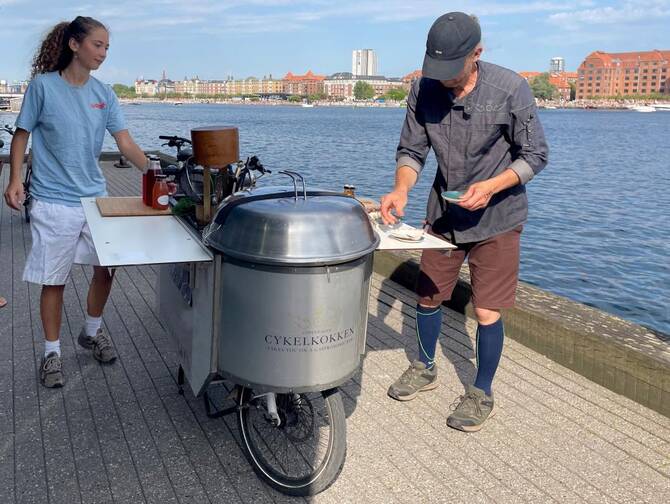
Danish chef Morten Kryger Wulff cooks on his self-designed kitchen-bike during a stop of a gastronomical bike tour on July 2, 2025 in Copenhagen, Denmark. (AFP)
Short Url
Updated 12 July 2025
Follow

Moveable feast: Danish chef serves up gastronomic journey by bike

  • Morten Kryger Wulff got the idea more than two decades ago to take his cooking to the great outdoors
  • This lead customers on a gastronomic bike ride through Copenhagen – with delectable food served at every stop

COPENHAGEN: Hopping off his custom-built bicycle-turned-portable kitchen, Danish chef Morten Kryger Wulff started whipping up a feast of tantalizing, original dishes – served with a generous side of nature.

The 56-year-old chef, a veteran of prestigious kitchens across Europe, got the idea more than two decades ago to take his cooking to the great outdoors, leading customers on a gastronomic bike ride through Copenhagen – with delectable food served at every stop.

On a sunny weekday in July, grilled seaweed, dill cream, bean fricassee, Nordic pizza, and blackcurrant ice cream were on the menu for the ride from the Danish capital’s harbor to the Amager Nature Park.

“This is as close as I can come to nature, cooking-wise, in a chef way,” said Wulff.

The tour lasts about four hours total, covering three to five kilometers (around two to three miles).

It is broken into bike rides of about 15 minutes each, in between which the chef gets off his bike, unfolds his table and starts cooking.

“You take away the walls of a traditional restaurant and you expose yourself to the city and to the elements you’re in,” he said.

In his cargo bike – a contraption he designed himself, measuring over two meters (six feet seven inches) long and weighing 130 kilograms (287 pounds) – he brings everything he needs: a foldable work surface, a refrigerator, a gas burner and all his ingredients.

“It is impressive to watch him cook from that small kitchen, to see how compressed everything is,” said Pernille Martensson, a Copenhagen local who joined the tour with her husband to celebrate his birthday.

The route is “part of the menu,” said Wulff.

“For example, the dish with fish or shellfish or seaweed are typically served by the channels,” he said.

On the docks, he sautes shrimp before serving them in shells.

As Wulff and his group gradually move away from Copenhagen’s city center, the chef – who has worked at The Savoy hotel in London and Geneva’s InterContinental – shares stories about the city and the project.

It all began in 2002, when he was kicked out of a municipal park for trying to have a barbecue with friends, and decided to start cooking outdoors legally.

Wulff takes an ecologically gentle approach.

“The food we get for these tours is, of course, all harvested and bought locally,” he said, adding that even the wines come from around Copenhagen.

“Bicycle, it’s the most sensible vehicle, the smartest vehicle. It does not use any energy. You can have a battery, but it’s pedal-powered,” he said.

The mobile approach to dining means he and his customers “meet the city, we meet the locals,” he said.

The self-proclaimed “bicycle chef” said he is “very passionate about cargo bikes and what they can do.”

He frequently participates in the Danish cargo bike championships, an unconventional competition held annually in Copenhagen.

In 2016, he was named courier of the year.

The award committee said he had “demonstrated the many possibilities of the cargo bike with his mobile kitchen project.”

Bicycle-loving Copenhagen has over 385 kilometers (239 miles) of bike lanes, the oldest dating back to 1892.


Cambodia takes back looted historic artifacts handled by British art dealer

Updated 28 February 2026
Follow

Cambodia takes back looted historic artifacts handled by British art dealer

  • The objects were returned under a 2020 agreement between the Ministry of Culture and Fine Arts and the family of the late Douglas Latchford, a British art collector and dealer who allegedly had the items smuggled out of Cambodia

PHNOM PENH, Cambodia: Cambodian officials on Friday received more than six dozen historic artifacts described as part of the country’s cultural heritage that had been looted during decades of war and instability.
At a ceremony attended by Deputy Prime Minister Hun Many, the 74 items were unveiled at the National Museum in Phnom Penh after their repatriation from the United Kingdom.
The objects were returned under a 2020 agreement between the Ministry of Culture and Fine Arts and the family of the late Douglas Latchford, a British art collector and dealer who allegedly had the items smuggled out of Cambodia.
“This substantial restitution represents one of the most important returns of Khmer cultural heritage in recent years, following major repatriations in 2021 and 2023 from the same collection,” the Culture Ministry said in a statement. “It marks a significant step forward in Cambodia’s continued efforts to recover, preserve, and restore its ancestral legacy for future generations.”
The artifacts were described as dating from the pre-Angkorian period through the height of the Angkor Empire, including “monumental sandstone sculptures, refined bronze works, and significant ritual objects.” The Angkor Empire, which extended from the ninth to the 15th century, is best known for the Angkor Wat archaeological site, the nation’s biggest tourist attraction.
Latchford was a prominent antiquities dealer who allegedly orchestrated an operation to sell looted Cambodian sculptures on the international market.
From 1970 to the 1980s, during Cambodia’s civil wars and the communist Khmer Rouge ‘s brutal reign, organized looting networks sent artifacts to Latchford, who then sold them to Western collectors, dealers, and institutions. These pieces were often physically damaged, having been pried off temple walls or other structures by the looters.
Latchford was indicted in a New York federal court in 2019 on charges including wire fraud and conspiracy. He died in 2020, aged 88, before he could be extradited to face charges.
Cambodia, like neighboring Thailand, has benefited from a trend in recent decades involving the repatriation of art and archaeological treasures. These include ancient Asian artworks as well as pieces lost or stolen during turmoil in places such as Syria, Iraq and Nazi-occupied Europe. New York’s Metropolitan Museum of Art is one of the prominent institutions that has been returning illegally smuggled art, including to Cambodia.
“The ancient artifacts created and preserved by our ancestors are now being returned to Cambodia, bringing warmth and joy, following the country’s return to peace,” said Hun Many, who is the younger brother of Prime Minister Hun Manet.