

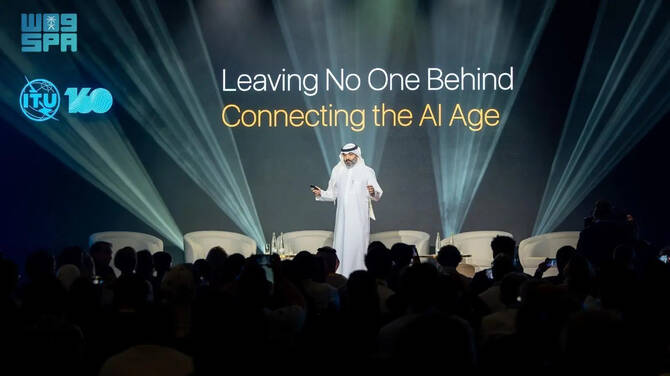
Saudi communications minister urges decisive action, global cooperation to address AI divide

The world needs to act decisively to bridge the divides so that no nation would be left behind, Minister Abdullah Al-Swaha said. (SPA)
Short Url
Updated 12 July 2025
Follow

Saudi communications minister urges decisive action, global cooperation to address AI divide

  • World faces ‘existential gap’ due to alarming disparities in access to AI technologies: Abdullah Al-Swaha 
  • Urgent action needed as next 10 years will be critical for bridging the divides, he said at ITU event

GENEVA: Saudi Arabia’s minister of communications and IT has called for “decisive international collaboration” to address the inequality in computing infrastructure that could leave other nations behind in the era of artificial intelligence.

In a keynote address at the 160th anniversary of the International Telecommunication Union in Geneva, Abdullah Al-Swaha cited the “concentration of computing power in a few regions, the lack of AI infrastructure in many countries, and the limited participation of the Global South in shaping governance frameworks and regulatory policies.”

“Today, the world faces an ‘existential gap’ due to alarming disparities in access to AI technologies,” the minister said, according to the Saudi Press Agency.

Alswaha said that the world could learn lessons from the past phases of technological transformation: The analog era, which took more than a century to connect 800 million people, and the digital era, which linked 5.5 billion individuals in just 50 years but still left 2.6 billion unconnected.


Minister Al-Swaha said Saudi Arabia under King Salman and Crown Prince Mohammed bin Salman had positioned the Kingdom as a global leader in the age of AI through a series of bold initiatives. (SPA)

In the AI era, he said, current gaps exist in computing infrastructure, data availability, and algorithms that could slow the advances needed to support human progress.

Al-Swaha reiterated Saudi Arabia’s ”unwavering commitment” to support and lead international efforts to close the emerging technological divides.

He highlighted Saudi Arabia’s efforts to address these gaps, citing the digital empowerment of women in the Kingdom — who now have a participation rate of about 35 percent — and the Kingdom’s top global rankings in digital competitiveness for two consecutive years.

He also noted that researchers at Saudi Arabia’s King Abdullah University of Science and Technology rank among the top one percent globally in scientific citations, offering hope for the future of AI.


Minister Abdullah Al-Swaha and his delegation. (SPA)

He likewise underlined the Kingdom’s progress in data protection regulations and the development of ”language models that promote inclusive access to technology for diverse communities.”

Al-Swaha further cited the HUMAIN project launched by Saudi Crown Prince and Prime Minister Mohammed bin Salman “to provide the full spectrum of AI capabilities, from advanced processors to top talent, and to position the Kingdom as a global AI pioneer.”

“The Kingdom’s efforts are a direct response to urgent global challenges,” he said.

Al-Swaha emphasized that the next 10 years will be critical for bridging the divides. He called for multination “partnerships under the umbrella of the ITU to build a fair, safe, and inclusive AI ecosystem that supports sustainable development and enhances human well-being.”


Nobel Prize winner discusses art of writing at Ithra

Updated 06 December 2025
Follow

Nobel Prize winner discusses art of writing at Ithra

  • Jon Fosse offers insights into storytelling at the 10th iRead celebration

DHAHRAN: Nobel Prize-winning Norwegian author and playwright Jon Fosse drew a full house to Ithra on Friday, as he discussed art, writing, and the human experience during a session entitled “Nobel Minds” at the 10th edition of the institution’s iRead program.

Fosse, who won the 2023 Nobel Prize in Literature, appeared on stage with moderator Tariq Khawaji, Ithra’s cultural consultant.

Jon Fosse, who won the 2023 Nobel Prize in Literature, appeared on stage with moderator Tariq Khawaji, Ithra’s cultural consultant. (Supplied)

Outside, the landmark Ithra building, designed by Norwegian firm Snohetta, was lit in purple to mark the celebration. 

Fosse, whose work includes more than 70 novels, plays, poems, essays, and children’s books, and has been translated into more than 50 languages, including Arabic, is known for his minimalist, introspective style. His unconventional syntax and pared-down prose have significantly influenced postdramatic theater and contemporary experimental fiction. 

HIGHLIGHTS

• The landmark Ithra building, designed by Norwegian firm Snohetta, was lit in purple to mark the 10th anniversary of the institution’s iRead program.

• During the ‘Nobel Minds’ session, Jon Fosse discussed his writing process, sources of inspiration, and how writers might develop their own signature styles.

• Tariq Khawaji told Arab News that bringing Fosse to Saudi Arabia was especially meaningful as Arabic translations of his work remain relatively new to many readers. 

Khawaji told Arab News that bringing Fosse to Saudi Arabia was especially meaningful as Arabic translations of his work remain relatively new to many readers. 

Jon Fosse, who won the 2023 Nobel Prize in Literature, appeared on stage with moderator Tariq Khawaji, Ithra’s cultural consultant. (Supplied)

At a book signing following the session, he noted that Fosse’s pared-back lyrical language is a boon to both translators and new audiences. 

“I think one of Fosse’s strengths is his extremely simple language, he always uses the simplest phrasing and avoids inflated vocabulary or difficult expressions. This is why translators often find his writing both lyrical and clear,” Khawaji said. 

If I’m writing well, I have to bring something new to the book for me, and hopefully also for other people; something that didn’t exist before.

Jon Fosse, Norwegian Nobel laureate

“I think he speaks to the world through the problem of the individual — this tendency toward the quiet, the stripped-down. And I believe the Norwegian landscape, especially the western region, plays a very strong role in shaping him. His characters often feel like they come from a place with vast silence and depth. Even outside the session, you could sense many layers in how he spoke — something almost carved by that landscape,” he continued.

On the topic of artificial intelligence, Fosse said that while it can mimic a writer’s voice, it cannot replicate the essence behind it. (Supplied)

After noting Fosse’s 18 major awards, Khawaji added: “I think his Arabic readership is still small — though his plays have been translated and performed. I believe introducing him to the Arab world will increase his readership significantly, and I think the reception will change. Readers will discover a unique, unfamiliar voice. It was important to have him here.”

During his hour-long English-language conversation with Khawaji before the book signing, Fosse discussed his writing process, sources of inspiration, and how writers might develop their own signature styles.

“I think you can say all literature, in a certain sense, comes from literature. So the more you read — and the better literature you read — the cleverer you most likely will be,” he said.

“If I’m writing well, I have to bring something new to the book for me, and hopefully also for other people; something that didn’t exist before. And to get to that, you have to leave yourself (somehow). If you don’t leave yourself, you know exactly what you knew before,” he added.

On the topic of artificial intelligence, Fosse said that while it can mimic a writer’s voice, it cannot replicate the essence behind it.

“I’ve done it myself. I asked the computer to write something (in my style) and it was like a kind of parody, but still there were some very interesting sides to it. And there were some great metaphors that happened that I couldn’t have figured out myself,” he said. 

“Perhaps it is a childish idea but I think that art has so much to do with this universal individuality of the artist. It cannot possibly be replaced by a machine,” Fosse concluded.