

Bangladesh mourns slain activist as tensions rise ahead of elections

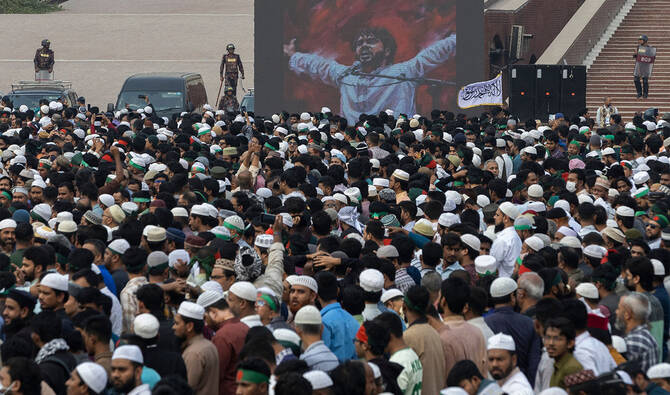
Mourners attend the funeral of the deceased youth leader Sharif Osman Hadi, in Dhaka on December 20, 2025. (AFP)
Short Url
Updated 21 December 2025
Follow

Bangladesh mourns slain activist as tensions rise ahead of elections

  • Sharif Osman Hadi, who took part in 2024 uprising against Sheikh Hasina, passed away last week after getting shot
  • Hadi’s death has sparked a new diplomatic squabble with India, as police say shooter has probably fled to India

DHAKA, Bangladesh: Hundreds of thousands of people attended the funeral Saturday of a leading Bangladeshi activist who died of gunshot wounds sustained in an attack in Dhaka earlier this month, as political tensions gripped the country ahead of elections.

Sharif Osman Hadi, who took part in last year’s political uprising that ended former Prime Minister Sheikh Hasina’s 15-year rule, died in a hospital in Singapore on Thursday after being shot Dec. 12 in Dhaka.

Police said they had identified suspects and that the shooter had most probably fled to India, where Hasina has been in exile. The development sparked a new diplomatic squabble with India and prompted New Delhi this week to summon Bangladesh’s envoy. Bangladesh also summoned the Indian envoy to Dhaka.

Security was tight in Dhaka on Saturday as the funeral prayers were held outside the nation’s Parliament complex.

Hadi’s body returned on Friday night, and Saturday was declared a national mourning day.
Hadi was a spokesperson for the Inqilab Moncho culture group, which said he would be buried on the Dhaka University campus beside the country’s national poet Kazi Nazrul Islam.

Mourners carried Bangladesh flags and chanted slogans, such as “We will be Hadi, we will be fighting decades after decades,” and “We will not let Hadi’s blood go in vain.”

The news of his death on Thursday evening triggered violence, with groups of protesters attacking and torching the offices of two leading national dailies. The country’s interim leader, Nobel Peace Prize laureate Muhammad Yunus, has urged the people to stay calm.

Hadi was a fierce critic of both neighboring India and Hasina, who has been in exile since Aug. 5, 2024, when she fled Bangladesh. Hadi had planned to run as an independent candidate in a major constituency in Dhaka in the next national elections in February.

Bangladesh has been going through a critical transition under Yunus in a bid to return to democracy through the upcoming elections. But the government has been Hasina’s Awami League party, which is one of two major political parties. 

Hasina’s archrival, former Prime Minister Khaleda Zia’s Bangladesh Nationalist Party is the other key party, which hopes to forms the next government. The Jamaat-e-Islami party, the country’s largest Islamist party with a dark history involving the nation’s independence war in 1971, is leading an alliance to carve out a bigger political space in the absence of Hasina’s party and its allies.

Hasina has been sentenced to death on charges of crimes against humanity, but India’s has not responded to repeated requests by the Yunus-led government for her extradition.


Pakistan PM calls privatization top priority, discusses selling power firms after PIA stake sale

Updated 7 sec ago
Follow

Pakistan PM calls privatization top priority, discusses selling power firms after PIA stake sale

  • Government plans to privatize five electricity distributors as part of IMF-backed economic reforms
  • Last year, a consortium led by Arif Habib Group won the bid for a 75 percent controlling stake in PIA

ISLAMABAD: Prime Minister Shehbaz Sharif described the privatization of state-owned enterprises (SOEs) as his administration's top priority on Tuesday, as he discussed the sale of loss-making power distribution companies after the government successfully divested a 75 percent stake in Pakistan International Airlines (PIA) in December.

The push to privatize power utilities follows the government’s efforts to restructure and offload state firms under broader economic reforms recommended by the International Monetary Fund (IMF) under a $7 billion loan program with Pakistan.

The IMF has repeatedly urged Islamabad to reduce fiscal losses by privatizing or restructuring chronically loss-making SOEs.

“Privatization of loss-making state-owned enterprises is among the government’s top priorities,” the prime minister said, according to a statement released by his office after a meeting on privatization. “The successful privatization of 75 percent shares of PIA is the first drop of rain.”

Last month, a consortium led by the Arif Habib Group won the bid for a 75 percent controlling stake in the national flag carrier, offering Rs 135 billion ($482 million) in a transaction the government described as a milestone in its privatization drive.

Building on that momentum, officials said the Privatization Commission plans to divest electricity distribution companies in two batches. The first phase will include Islamabad Electric Supply Company, Gujranwala Electric Power Company and Faisalabad Electric Supply Company, followed by Hyderabad Electric Supply Company and Sukkur Electric Power Company in the second batch.

Prime Minister Shehbaz Sharif also directed the commission to accelerate digitalization and strengthen its public relations and marketing functions to improve transparency, governance and engagement with investors, according to the statement.

The power sector has long been a drain on public finances due to high losses, inefficiencies and mounting subsidies, making it a central focus of Pakistan’s reform agenda under the IMF program.

Prior to the PIA sale, the United Arab Emirates-based International Holding Company acquired a majority stake in First Women Bank Limited under a government-to-government privatization deal.

That transaction was finalized in October 2025, with Pakistani and UAE officials attending the signing ceremony.