

Indonesian boy’s ‘aura farming’ dance brings global spotlight to centuries-old tradition

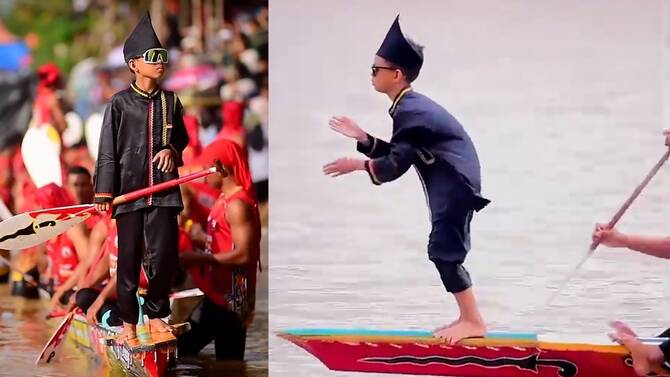
Indonesian boy Rayyan Arkhan Dikha has gone viral in recent weeks for "aura farming" through his role as a dancer in a traditional boat race in Indonesia's Riau province. (Youtube Screengrab)
Short Url
Updated 11 July 2025
Follow

Indonesian boy’s ‘aura farming’ dance brings global spotlight to centuries-old tradition

  • Pacu jalur is a boat tradition from Indonesia’s Riau province that can be traced back to the 17th century
  • Dika was named tourism ambassador of his home province after going viral with his dance moves

JAKARTA: An Indonesian boy dancing on the front of a boat has become an Internet sensation in recent weeks, setting a global trend of “aura farming” that has been recreated by famous athletes and thousands of others worldwide.

“Aura farming” is an Internet expression popularized in 2024, largely in reference to anime characters and celebrities. It refers to the act of consistently looking cool to build one’s “aura.”

Dressed in a black traditional costume and wearing sunglasses, 11-year-old Rayyan Arkhan Dikha from Indonesia’s Riau province has been dubbed “the ultimate aura farmer” on social media for performing a series of repetitive movements calmly on the bow of a thin boat, videos of which have amassed millions of views globally.

The Indonesian boy who goes by the name of Dika was participating in a local event known as “pacu jalur,” which roughly translates to “boat race.” A tradition that dates back to the early 17th century, the event is now held every August to commemorate the Indonesian Independence Day.

“Pacu jalur has been one of Indonesia’s Intangible Cultural Heritage since 2015,” Indonesia’s Culture Minister Fadli Zon said in a statement, after hosting Dika in his office in Jakarta on Wednesday.

The water sport tradition originated in Riau’s Kuantan Singingi regency at a time when boats were the main mode of transportation for the communities living along the local river.

“It has always been a part of life for people in (Kuantan Singingi), including to celebrate the most important Islamic holidays and also our independence day,” Fadli said.

During the race, each of the long, canoe-like boats and its large crew has an “anak coki,” a dancer who moves with rhythmic hand movements and body waves to provide inspiration for the rowers.

While every anak coki brings their own charm to the race, Dika — who has participated in the races since he was 9 — has since become the face of the pacu jalur tradition.

Though the original clip featuring Dika was posted to TikTok in January by a user named Lensa Rams and the event itself was held last August, the boy shot to global popularity over the past few weeks, as various creators on Instagram and TikTok have tried their own hand at Dika’s dance.

The list includes soccer team Paris Saint-Germain and Travis Kelce, American football star and boyfriend of pop singer Taylor Swift. When the US men’s national soccer team won against Guatemala last week, American soccer player Diego Luna copied Dika’s moves to celebrate a goal.

The massive impact of the video garnered him special attention from the government in Riau, where the governor on Tuesday named Dika as a tourism ambassador for the province and awarded him a scholarship for 20 million rupiah (about $1,200) for his education.

“Today, almost everyone opened their eyes to the vibrant and thriving culture of Riau, especially pacu jalur. This is why I wanted to show my appreciation to Dika,” Governor Abdul Wahid said.

In a statement, the local government confirmed that Dika will participate in the races next month.

Speaking to reporters in Jakarta following his meeting with the culture minister, Dika said: “I’m happy that I’ve gone viral globally.”



As an uncertain 2026 begins, virtual journeys back to 2016 become a trend

Updated 30 January 2026
Follow

As an uncertain 2026 begins, virtual journeys back to 2016 become a trend

  • Over the past few weeks, millions have been sharing throwback photos to that time on social media, kicking off one of the first viral trends of the year

LONDON: The year is 2016. Somehow it feels carefree, driven by Internet culture. Everyone is wearing over-the-top makeup.
At least, that’s how Maren Nævdal, 27, remembers it — and has seen it on her social feeds in recent days.
For Njeri Allen, also 27, the year was defined by the artists topping the charts that year, from Beyonce to Drake to Rihanna’s last music releases. She also remembers the Snapchat stories and an unforgettable summer with her loved ones. “Everything felt new, different, interesting and fun,” Allen says.
Many people, particularly those in their 20s and 30s, are thinking about 2016 these days. Over the past few weeks, millions have been sharing throwback photos to that time on social media, kicking off one of the first viral trends of the year — the year 2026, that is.
With it have come the memes about how various factors — the sepia hues over Instagram photos, the dog filters on Snapchat and the music — made even 2016’s worst day feel like the best of times.
Part of the look-back trend’s popularity has come from the realization that 2016 was already a decade ago – a time when Nævdal says she felt like people were doing “fun, unserious things” before having to grow up.
But experts point to 2016 as a year when the world was on the edge of the social, political and technological developments that make up our lives today. Those same advances — such as developments under US President Donald Trump and the rise of AI — have increased a yearning for even the recent past, and made it easier to get there.
2016 marked a year of transition
Nostalgia is often driven by a generation coming of age — and its members realizing they miss what childhood and adolescence felt like. That’s certainly true here. But some of those indulging in the online journeys through time say something more is at play as well.
It has to do with the state of the world — then and now.
By the end of 2016, people would be looking ahead to moments like Trump’s first presidential term and repercussions of the United Kingdom leaving the EU after the Brexit referendum. A few years after that, the COVID-19 pandemic would send most of the world into lockdown and upend life for nearly two years.
Janelle Wilson, a professor of sociology at the University of Minnesota-Duluth, says the world was “on the cusp of things, but not fully thrown into the dark days that were to come.”
“The nostalgia being expressed now, for 2016, is due in large part to what has transpired since then,” she says, also referencing the rise of populism and increased polarization. “For there to be nostalgia for 2016 in the present,” she added, “I still think those kinds of transitions are significant.”
For Nævdal, 2016 “was before a lot of the things we’re dealing with now.” She loved seeing “how embarrassing everyone was, not just me,” in the photos people have shared.
“It felt more authentic in some ways,” she says. Today, Nævdal says, “the world is going downhill.”
Nina van Volkinburg, a professor of strategic fashion marketing at University of the Arts, London, says 2016 marked the beginning of “a new world order” and of “fractured trust in institutions and the establishment.” She says it also represented a time of possibility — and, on social media, “the maximalism of it all.”
This was represented in the bohemian fashion popularized in Coachella that year, the “cut crease” makeup Nævdal loved and the dance music Allen remembers.
“People were new to platforms and online trends, so were having fun with their identity,” van Volkinburg says. “There was authenticity around that.”
And 2016 was also the year of the “boss babe” and the popularity of millennial pink, van Volkinburg says, indications of young people coming into adulthood in a year that felt hopeful.
Allen remembers that as the summer she and her friends came of age as high school graduates. She says they all knew then that they would remember 2016 forever.
Ten years on, having moved again to Taiwan, she said “unprecedented things are happening” in the world. “Both of my homes are not safe,” she said of the US and Taiwan, “it’s easier to go back to a time that’s more comfortable and that you felt safe in.”
Feelings of nostalgia are speeding up
In the last few days, Nævdal decided to hide the social media apps on her phone. AI was a big part of that decision. “It freaks me out that you can’t tell what’s real anymore,” she said.
“When I’ve come off of social media, I feel that at least now I know the things I’m seeing are real,” she added, “which is quite terrifying.”
The revival of vinyl record collections, letter writing and a fresh focus on the aesthetics of yesterday point to nostalgia continuing to dominate trends and culture. Wilson says the feeling has increased as technology makes nostalgia more accessible.
“We can so readily access the past or, at least, versions of it,” she said. “We’re to the point where we can say, ‘Remember last week when we were doing XYZ? That was such a good time!’”
Both Nævdal and Allen described themselves as nostalgic people. Nævdal said she enjoys looking back to old photos – especially when they show up as “On This Day” updates on her phone, She sends them to friends and family when their photos come up.
Allen wished that she documented more of her 2016 and younger years overall, to reflect on how much she has evolved and experienced since.
“I didn’t know what life could be,” she said of that time. “I would love to be able to capture my thought process and my feelings, just to know how much I have grown.”
