

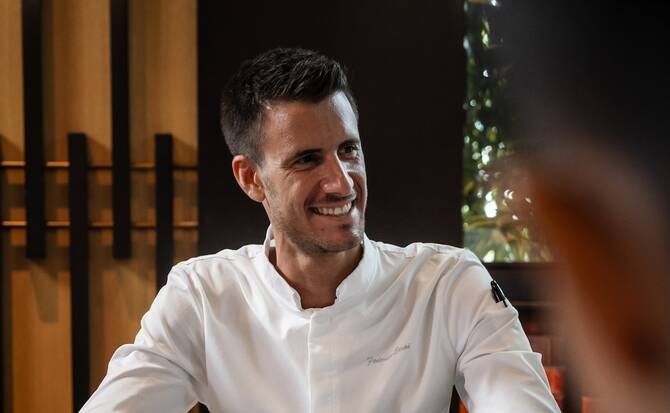

DUBAI: Federico Erroi’s culinary story begins in Florence, Italy, guided by his grandmother’s steady hands. She taught young Federico how to make pastry cream, sparking his lifelong fascination with desserts and the discipline behind them.
“I was never the best at theoretical subjects in school,” Erroi tells Arab News. “But when it came to getting my hands dirty in the kitchen, I always found success and great satisfaction.”

Caption
By the age of 21, Erroi was already working professionally in Florence. After nearly a decade honing his craft in Italy, he moved to Dubai in 2017. Since then, he has led pastry programs at top-tier restaurants including Rue Royale and Cipriani. Today, he heads the pastry team at CÉ LA VI Dubai, a restaurant featured in the city’s Michelin Guide for three consecutive years.
Erroi was recently shortlisted for Pastry Chef of the Year by the Hotel and Catering Awards.
When you started out, what was the most common mistake you made?
If there’s one thing I’ve always struggled with — not just in the kitchen, but in life — it’s patience. I always wanted to finish everything as quickly as possible, but still perfectly. This has been one of my biggest challenges, because pastry — especially baking — requires time. Long resting periods, fermentation and proofing are what give flavor, texture and structure to the best products. A mousse that hasn’t rested long enough will be too runny, and dough that hasn’t been rested long enough will lack flavor. That’s how I’ve come to master the ancient art of patience.

CÉ LA VI Dubai. (Supplied)
What’s your top tip for amateurs?
When it comes to pastry, the most common mistake is always the same: precision. Pastry is a perfect balance, an alchemy based on carefully selected and precisely measured ingredients. Many amateurs get the measurements wrong out of haste or distraction, or they replace ingredients or alter quantities as they please, which inevitably leads to disappointing results.
My mother, for example, has the bad habit of reducing the amounts of butter or cream in my recipes. She’s very health-conscious and always afraid of overdoing it. But without fail, the result never satisfies her, and she always asks the same questions: “Federico, why are these cookies so hard?” or “Why is this cream flavorless?” or “Why is this mousse so runny?” And my response is always the same: “Mom, are you sure you followed the recipe?”
Desserts aren’t always healthy. They are indulgences and guilty pleasures. We can absolutely enjoy them, as long as it’s in moderation.

CÉ LA VI Dubai. (Supplied)
What one ingredient can instantly improve any dish?
Any dish, if made with care, passion and — above all — love, will never disappoint. And maybe it’s the love we put into cooking that gets passed on to the ingredients we touch and makes our meal a moment of pure pleasure. That’s probably why your mom’s or grandma’s food always tastes the best. Then again, maybe a good quality vanilla or a pinch of salt — a contrast to the sweetness in pastry — is the real secret ingredient.
When you go out to eat, do you find yourself critiquing the food?
I’m simply grateful to share that moment with the people around the table. What scares my friends and family most when they cook for me is the fear of being judged, but I always tell them this: “For those of us who work in kitchens, just sitting at a table with loved ones is already a wonderful meal, because we’re used to eating in a rush, standing up or sitting on a cardboard box in a kitchen corner, alone, at odd hours, or while working.”
What’s your favorite cuisine or dish to order?
I always like to try something new — something beyond my culinary culture or dishes that require complex preparation that I can’t replicate at home. Sometimes, I just enjoy a perfectly executed croissant or a pizza baked in a wood-fired oven. As for desserts, I prefer to stick with the classics — a good tiramisu or quality gelato.
What’s your go-to dish if you have to cook something quickly at home?
Probably pasta with cherry tomatoes, basil and parmesan. If I need a quick dessert, I’ll make a tiramisu, a passion fruit panna cotta or a chocolate soufflé. What do these recipes have in common? Simplicity. Just a few ingredients, each carefully selected and blended or cooked in a way that creates a dish with a unique flavor.
What customer request or behavior most annoys you?
Cooking in a restaurant also means learning to accept criticism, to really listen to what customers say, and to understand their preferences. It’s not always easy to accept certain comments like “This chocolate mousse is too airy” or “This dessert is too sweet or too bitter,” because everyone has their own palette. But sometimes, feedback, if listened to and understood, can genuinely help us improve. That’s why I always stay open to customer opinions, whether positive or negative. In fact, I’m often more interested in the negative feedback, because it’s from that input that I’ve been able to create new ideas or improve dishes I thought were already perfect. The truth is, in this profession, you never truly “arrive.” There’s always something more to learn.
What’s your favorite dish to make?
Panettone. It’s one of those desserts made with just a few ingredients: sourdough starter, water, flour, butter, eggs and sugar, along with raisins and candied orange. But making it is a true magic act that starts with the sourdough itself, a simple mixture of water and flour that’s fermented and refreshed daily for at least three months. This creates a colony of bacteria that will make the panettone rise and give it a unique, unrepeatable flavor, as the bacteria’s development depends on the surrounding temperature, the water used, and good microbes in the working environment. Only when the sourdough is ready can we proceed with the first dough, mixing the starter with water, flour, sugar, butter and eggs.
This rests for 12 hours, followed by the final dough with the remaining ingredients. Then, after another six-hour rest, we reach the magical moment of baking, the moment of truth, where, based on the final volume, we truly understand whether all the previous steps were done perfectly, or if we made mistakes in temperature, fermentation or even the pH of our precious star ingredient, the sourdough starter.
As a head chef, what are you like?
I believe I’ve changed a lot over the years. I love teaching and sharing everything I’ve learned. I have no secrets — there truly are none, even if some professionals still claim otherwise. I always try to motivate my team and keep morale high, especially when the work hours get longer and more stressful. Today, I consider myself a very patient person — maybe thanks to this beautiful profession. I’ve never raised my voice in the kitchen, never insulted or scolded anyone. I firmly believe that kindness and good manners are the foundation of any relationship, and they can truly make a difference in the workplace.
Chef Federico’s pineapple creme brûlée

Ingredients for the coconut pastry cream:
Coconut milk 350 g
Coconut cream 50 g
Sugar 1 38 g
Lime zest 1/2 pc
Sugar 2 38 g
Salt 0.6 g
Flour 32 g
Corn starch 12 g
Egg yolk 80 g
Method:
Mix coconut milk, coconut cream, sugar 1, lime zest in a pot and bring to a boil.
In a separate bowl mix sugar 2, salt, flour, starch, egg yolk till powder is completely absorbed avoiding the lumps formations.
Pour hot liquid onto the egg mix and bring back on fire stirring continuously till first bubble appear.
Pour in a terrine and let it set covered with cling film on touching the cream (to avoid skin formation).
When is completely cold mix till creamy texture and pour it onto the pineapple compote into the pineapple cup.
Coat the surface with sugar and brulee till golden dark brown.
Ingredients for the pineapple compote:
Pineapple juice 100 g
Sugar agar agar 10 g
Finely chopped pineapple 100 g
Method: (One portion 70 g of compote)
Take a whole pineapple, cut off the leaf and slice it into three thick slices horizontally.
With a spoon or a scooper scoop off the pulp creating a cup.
Warm up the juice to 40°.
Mix sugar and agar and add to pineapple juice.
Boil for one min.
Let it set in the chiller and blend it nicely.
Add pineapple chopped and mix.
Spread it evenly inside the pineapple cup.


 ‘Ghoyoum’


