

Russia seizes $50 billion in assets as economy shifts during war in Ukraine, research shows

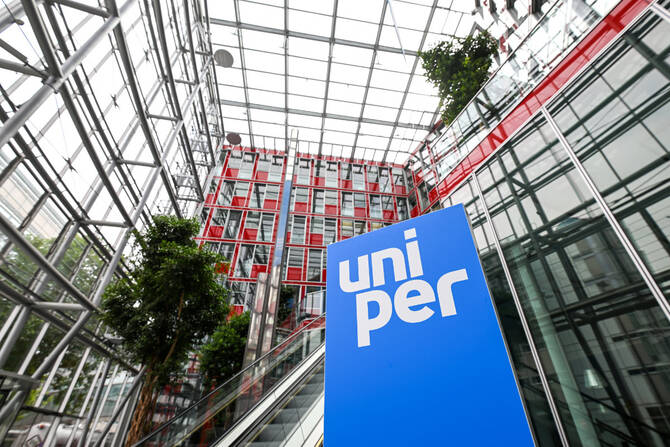
A photo taken on July 22, 2022 shows the logo of energy supplier Uniper in the entrance hall at the company's headquarters in Dusseldorf, western Germany. Uniper's assets in Russia were seized by the state when Western companies fled the Russian market after Vladimir Putin ordered the invasion of Ukraine. (AFP/File)
Short Url
Updated 11 July 2025
Follow

Russia seizes $50 billion in assets as economy shifts during war in Ukraine, research shows

  • ‘Fortress Russia’ uses host of mechanisms to take major assets
  • Some domestic businesses also face nationalization, report says

MOSCOW: Russian authorities have confiscated assets worth some $50 billion over the past three years, underscoring the scale of the transformation into a “fortress Russia” economic model during the war in Ukraine, research showed on Wednesday.
The conflict has been accompanied by a significant transfer of assets as many Western companies fled the Russian market, others’ assets were expropriated and the assets of some major Russian businesses were seized by the state.
In response to what Russia called illegal actions by the West, President Vladimir Putin signed decrees over the past three years allowing the seizure of Western assets, entangling firms ranging from Germany’s Uniper to Danish brewer Carlsberg.
Besides the Western assets, major domestic companies have changed hands on the basis of different legal mechanisms including the need for strategic resources, corruption claims, alleged privatization violations, or poor management.
Moscow law firm NSP (Nektorov, Saveliev & Partners) said that the scale of what it called the “nationalization” amounted to 3.9 trillion roubles over three years, and it listed the companies involved.
The research was first reported by Kommersant, one of Russia’s leading newspapers, which said it illustrated a “fortress Russia” economic model.
The 1991 break-up of the Soviet Union ushered in hopes that Russia could transform into a free-market economy integrated into the global economy, but vast corruption, economic turmoil and organized crime undermined confidence in democratic capitalism through the 1990s.
Putin, in his first eight years in power, supported economic freedoms, targeted some so-called oligarchs and presided over a significant growth of the economy to $1.8 trillion in 2008 from $200 billion in 1999.
In the 2008-2022 period, the economy grew to $2.3 trillion, though Western sanctions hit it hard after Russia annexed Crimea from Ukraine in 2014, according to figures from the International Monetary Fund.
Though the Russian economy has performed better than expected during the war in Ukraine, its nominal dollar size in 2024 was just $2.2 trillion, according to IMF figures, much smaller than China, the European Union or United States.

‘Fortress Russia’
Russian officials say that the Ukraine war — the biggest confrontation with the West since the depths of the Cold War — has demanded extraordinary measures to prevent what they say was a clear Western attempt to sink the Russian economy.
Putin says the exit of Western firms has allowed domestic producers to take their place and that the Western sanctions have forced domestic business to develop. He has called for a “new development model” distinct from “outdated globalization.”
But the wartime economy, geared toward producing weapons and supporting a long conflict with Ukraine, has put the state — and those officials who operate it — in a much more powerful position than private Russian businesses.
Russian prosecutors are now seeking to seize billionaire Konstantin Strukov’s majority stake in major gold producer Uzhuralzoloto (UGC) for the state.
More than a thousand companies — from McDonald’s to Mercedes-Benz — have left Russia since the February 2022 start of Russia’s war in Ukraine by selling, handing the keys to existing managers or simply abandoning their assets.
Others had their assets seized and a sale forced through. 


Italian police fire tear gas as protesters clash near Winter Olympics hockey venue

Updated 08 February 2026
Follow

Italian police fire tear gas as protesters clash near Winter Olympics hockey venue

  • Police vans behind a temporary metal fence secured the road to the athletes’ village, but the protest veered away, continuing on a trajectory toward the Santagiulia venue

MILAN: Italian police fired tear gas and a water cannon at dozens of protesters who threw firecrackers and tried to access a highway near a Winter Olympics venue on Saturday.
The brief confrontation came at the end of a peaceful march by thousands against the environmental impact of the Games and the presence of US agents in Italy.
Police held off the violent demonstrators, who appeared to be trying to reach the Santagiulia Olympic ice hockey rink, after the skirmish. By then, the larger peaceful protest, including families with small children and students, had dispersed.
Earlier, a group of masked protesters had set off smoke bombs and firecrackers on a bridge overlooking a construction site about 800 meters (a half-mile) from the Olympic Village that’s housing around 1,500 athletes.
Police vans behind a temporary metal fence secured the road to the athletes’ village, but the protest veered away, continuing on a trajectory toward the Santagiulia venue. A heavy police presence guarded the entire route.
There was no indication that the protest and resulting road closure interfered with athletes’ transfers to their events, all on the outskirts of Milan.
The demonstration coincided with US Vice President JD Vance’s visit to Milan as head of the American delegation that attended the opening ceremony on Friday.
He and his family visited Leonardo da Vinci’s “The Last Supper” closer to the city center, far from the protest, which also was against the deployment of US Immigration and Customs Enforcement agents to provide security to the US delegation.
US Homeland Security Investigations, an ICE unit that focuses on cross-border crimes, frequently sends its officers to overseas events like the Olympics to assist with security. The ICE arm at the forefront of the immigration crackdown in the US is known as Enforcement and Removal Operations, and there is no indication its officers are being sent to Italy.
At the larger, peaceful demonstration, which police said numbered 10,000, people carried cardboard cutouts to represent trees felled to build the new bobsled run in Cortina. A group of dancers performed to beating drums. Music blasted from a truck leading the march, one a profanity-laced anti-ICE anthem.
“Let’s take back the cities and free the mountains,” read a banner by a group calling itself the Unsustainable Olympic Committee. Another group called the Association of Proletariat Excursionists organized the cutout trees.
“They bypassed the laws that usually are needed for major infrastructure project, citing urgency for the Games,” said protester Guido Maffioli, who expressed concern that the private entity organizing the Games would eventually pass on debt to Italian taxpayers.
Homemade signs read “Get out of the Games: Genocide States, Fascist Police and Polluting Sponsors,” the final one a reference to fossil fuel companies that are sponsors of the Games. One woman carried an artificial tree on her back decorated with the sign: “Infernal Olympics.”
The demonstration followed another last week when hundreds protested the deployment of ICE agents.
Like last week, demonstrators Saturday said they were opposed to ICE agents’ presence, despite official statements that a small number of agents from an investigative arm would be present in US diplomatic territory, and not operational on the streets.