

Report: Japan, UK, Italy open to Saudi joining fighter-jet program

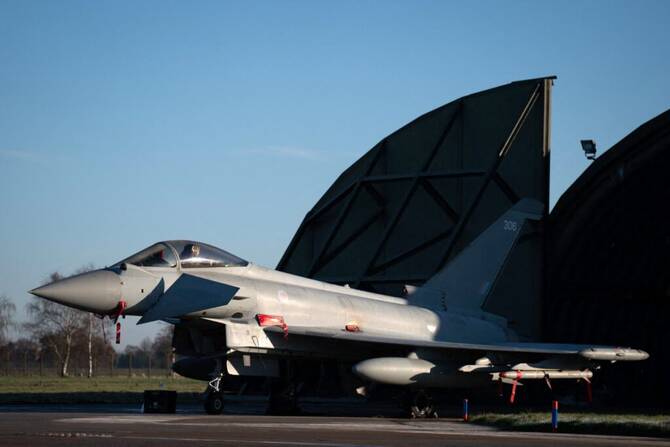
The Global Combat Air Program is a joint effort to develop a sixth-generation fighter. (FILE/AFP)
Short Url
Updated 10 July 2025
Follow

Report: Japan, UK, Italy open to Saudi joining fighter-jet program

  • Tech sharing, and other issues need resolution, says report
  • Riyadh ‘encouraged’ to boost its nascent aerospace industry

DUBAI: Japan, the UK and Italy are open to having Saudi Arabia join their next-generation fighter-jet initiative, but only once the project has reached a more advanced stage and key issues have been resolved, according to The Japan Times.

The Global Combat Air Program is a joint effort to develop a sixth-generation fighter.

It will likely remain a trilateral initiative until after the GCAP International Government Organization, or GIGO, and the industry-led joint venture Edgewing sign their first international contract, likely by the end of 2025, the newspaper reported recently.

The GIGO, officially inaugurated on Monday in Reading, England, was established last year to oversee government-level coordination for the program.

Edgewing, launched last month, brings together the UK’s BAE Systems, Italy’s Leonardo, and the Japan Aircraft Industrial Enhancement Co., and is responsible for designing and developing the aircraft.

“There is no preclusion in having Saudi Arabia join the program, but we first have to define certain criteria and clarify all the points,” one source told The Japan Times, speaking after a virtual meeting between the GCAP nations’ defense ministers on Monday.

Riyadh has been “encouraged” to build up its aerospace expertise — including potentially acquiring and assembling Eurofighter Typhoons — before entering the GCAP, the newspaper reported.

In addition to Saudi Arabia, several other countries are said to have expressed interest in joining the program. These include two unnamed European countries, as well as one Middle Eastern and one Asian nation, according to a source cited by The Japan Times.

The terms of participation and contributions of any future member states remain undefined. Any expansion of the program would require unanimous approval from Japan, the UK and Italy.

The GCAP aircraft will be Japan’s first major defense development with partners other than the US.

It is intended to replace the aging F-2 fighter jets used by Japan’s Air Self-Defense Force, as well as the Eurofighters operated by the UK and Italy. The new jets are scheduled to enter service by 2035.

With the conceptual design phase complete, the program is moving into detailed design and development, and a demonstrator flight is expected within two to three years.

Despite overall satisfaction with the program’s progress, some tensions remain, particularly around access to sensitive intellectual property and full technology sharing.

In April, Italy’s Defense Minister Guido Crosetto publicly criticized the UK for not fully disclosing technology to its partners, in an interview with Reuters.

It is a concern that The Japan Times understands is still unresolved.


Mystery of CIA’s lost nuclear device haunts Himalayan villagers 60 years on

Updated 56 min 44 sec ago
Follow

Mystery of CIA’s lost nuclear device haunts Himalayan villagers 60 years on

  • Plutonium-fueled spy system was meant to monitor China’s nuclear activity after 1964 atomic tests
  • Porter who took part in Nanda Devi mission warned family of ‘danger buried in snow’

NEW DELHI: Porters who helped American intelligence officers carry a nuclear spy system up the precarious slopes of Nanda Devi, India’s second-highest peak, returned home with stories that sent shockwaves through nearby villages, leaving many in fear that still holds six decades later.

A CIA team, working with India’s Intelligence Bureau, planned to install the device in the remote part of the Himalayas to monitor China, but a blizzard forced them to abandon the system before reaching the summit.

When they returned, the device was gone.

The spy system contained a large quantity of highly radioactive plutonium-238 — roughly a third of the amount used in the atomic bomb dropped by the US on the Japanese city of Nagasaki in the closing stages of the Second World War.

“The workers and porters who went with the CIA team in 1965 would tell the story of the nuclear device, and the villagers have been living in fear ever since,” said Narendra Rana from the Lata village near Nanda Devi’s peak.

His father, Dhan Singh Rana, was one of the porters who carried the device during the CIA’s mission in 1965.

“He told me there was a danger buried in the snow,” Rana said. “The villagers fear that as long as the device is buried in the snow, they are safe, but if it bursts, it will contaminate the air and water, and no one will be safe after that.”

During the Sino-Indian tensions in the 1960s, India cooperated with the US in surveillance after China conducted its first nuclear tests in 1964. The Nanda Devi mission was part of this cooperation and was classified for years. It only came under public scrutiny in 1978, when the story was broken by Outsider magazine.

The article caused an uproar in India, with lawmakers demanding the location of the nuclear device be revealed and calling for political accountability. The same year, then Prime Minister Morarji Desai set up a committee to assess whether nuclear material in the area near Nanda Devi could pollute the Ganges River, which originates there.

The Ganges is one of the world’s most crucial freshwater sources, with about 655 million people in India, Nepal, and Bangladesh depending on it for their essential needs.

The committee, chaired by prominent scientists, submitted its report a few months later, dismissing any cause for concerns, and establishing that even in the worst-case scenario of the device’s rupture, the river’s water would not be contaminated.

But for the villagers, the fear that the shell containing radioactive plutonium could break apart never goes away, and peace may only come once it is found.

Many believe the device, trapped within the glacier’s shifting ice, may have moved downhill over time.

Rana’s father told him that the device felt hot when it was carried, and he believed it might have melted its way into the glacier, remaining buried deep inside.

An imposing mass of rock and ice, Nanda Devi at 7,816 m is the second-highest mountain in India after Kangchenjunga. 

When a glacier near the mountain burst in 2021, claiming over 200 lives, scientists explained that the disaster was due to global warming, but in nearby villages the incident was initially blamed on a nuclear explosion.

“They feared the device had burst. Those rescuing people were afraid they might die from radiation,” Rana said. “If any noise is heard, if any smoke appears in the sky, we start fearing a leak from the nuclear device.”

The latent fear surfaces whenever natural disasters strike or media coverage puts the missing device back in the spotlight. Most recently, a New York Times article on the CIA mission’s 60th anniversary reignited the unease.

“The apprehensions are genuine. After 1965, Americans came twice to search for the device. The villagers accompanied them, but it could not be found, which remains a concern for the local community,” said Atul Soti, an environmentalist in Joshimath, Uttarakhand, about 50 km from Nanda Devi.

“People are worried. They have repeatedly sought answers from the government, but no clear response has been provided so far. Periodically, the villagers voice their concerns, and they need a definitive government statement on this issue.”

Despite repeated queries whenever media attention arises, Indian officials have not released detailed updates since the Desai-appointed committee submitted its findings.

“The government should issue a white paper to address people’s concerns. The white paper will make it clear about the status of the device, and whether leakage from the device could pollute the Ganges River,” Soti told Arab News.

“The government should be clear. If the government is not reacting, then it further reinforces the fear.”