

Pakistani finmin calls for reworking federal funding to provinces to reflect human development priorities

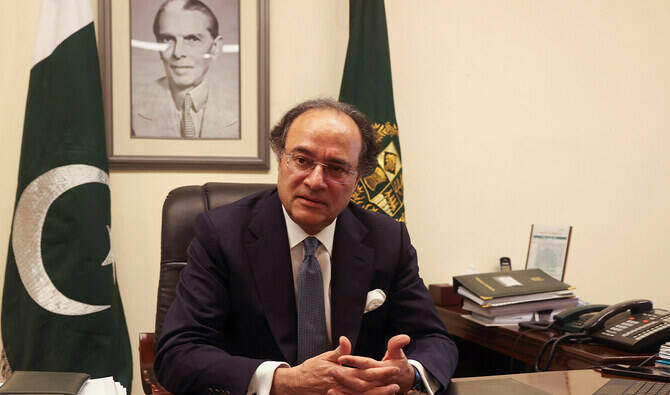
Pakistan’s Finance Minister Muhammad Aurangzeb speaks during an interview at his office in Islamabad, Pakistan on July 19, 2024. (Reuters/File)
Short Url
Updated 10 July 2025
Follow

Pakistani finmin calls for reworking federal funding to provinces to reflect human development priorities

  • Muhammad Aurangzeb identifies climate change, population growth as ‘existential issues’
  • The minister calls for a ‘shift from infrastructure-heavy thinking to human capital investments’

ISLAMABAD: Federal Minister for Finance and Revenue Muhammad Aurangzeb on Thursday called for a rethinking of how federal funds are allocated to provinces, arguing that future disbursements should reflect human development indicators instead of just population size.

Speaking at an event organized by the Ministry of National Health Services in connection with World Population Day in the federal capital, Aurangzeb said Pakistan’s rapid population growth posed a serious challenge and must be addressed through coordinated, long-term policy interventions.

“As we move forward with revisiting and reviewing the NFC [National Finance Commission] award, the current allocation driver must be reconsidered,” he said while addressing the gathering.

“There are broader factors, such as human development indicators, which should be incorporated,” he added. “These can help shape a revised formula for how we divvy up resources between the federation and the provinces.”

The NFC is a constitutional mechanism that determines how financial resources are distributed from the federal government to Pakistan’s provinces. The existing formula primarily weighs population, though there are several influential voices within the government demanding that future formulas consider a broader range of development metrics.

The finance minister also noted Pakistan must confront two “existential issues” — climate change and population growth — if it wants to reach its long-term goal of becoming a $3 trillion economy by 2047.

“Just think about it: 40 percent of children under the age of five in this country are stunted,” he said. “If we don’t address this, there is no sustainable path forward.”

Aurangzeb noted the issue extended beyond food and sanitation, pointing to the need for birth spacing, women’s education and family planning awareness.

He also emphasized the scale of available resources for addressing these challenges.

Referring to Pakistan’s recently signed 10-year Country Partnership Framework with the World Bank, he said the agreement includes $20 billion in financing, with $600–700 million annually earmarked for population-related measures.

“We have a lot of funds already at our disposal, provided we find the right places to invest and prioritize them correctly,” he said.

Aurangzeb also argued that Pakistan’s total development spending across federal and provincial budgets exceeds Rs 4.2 trillion ($14.7 billion).

“The issue isn’t funding,” he said. “We must shift from infrastructure-heavy thinking to human capital investments.”


Pakistan’s Sharif hails Trump as ‘man of peace’ at inaugural Gaza board meeting

Updated 21 min 35 sec ago
Follow

Pakistan’s Sharif hails Trump as ‘man of peace’ at inaugural Gaza board meeting

  • Shehbaz Sharif says calls for end to Israeli ceasefire violations in Gaza and ‘credible pathway to Palestinian self-determination’
  • Islamabad hopes involvement in Gaza peace board will allow it to shape post-war arrangements while protecting Palestinian rights

ISLAMABAD: Pakistan Prime Minister Shehbaz Sharif on Thursday hailed President Donald Trump as a “man of peace” as he attended an inaugural meeting of the Gaza Board of Peace in Washington.

The board, formed under a UN Security Council resolution following a fragile October 2025 ceasefire between Israel and Hamas, is intended to oversee international stabilization and rebuilding efforts in Gaza after Israeli war.

Pakistan’s premier called for an end to ceasefire violations by Israel to achieve long-lasting peace and to advance reconstruction efforts in Gaza, praising Trump for his efforts to bring about peace in various parts of the world.

“Your timely and very effective intervention to achieve ceasefire between India and Pakistan potentially averted loss of tens of millions of people,” Sharif said, addressing Trump at the meeting.

“You have truly proved to be a man of peace and let me say Mr. president you are truly savior of South Asia.”

In the past, Sharif has gained favor with Trump for publicly praising him for helping broker a ceasefire between Pakistan and India following their intense, four-day military conflict in May, while Islamabad also formally endorsed the US president for a Nobel Peace Prize.

Speaking at the meeting, the Pakistan premier said the people of Palestine must exercise “full control of their land and future” in line with the UN Security Council’s resolutions.

“The people of Palestine have long endured illegal occupation and immense suffering. And to achieve long lasting peace, it is very important that ceasefire violations must end to preserve lives and advance reconstruction efforts,” he said.

“The people of Palestine must exercise full control of the land and their future, in line with UN Security Council resolutions. Mr. president, we must work together toward a credible pathway to Palestinian self-determination through the establishment of an independent, sovereign and contiguous State of Palestine, in line with the relevant resolutions.”

Earlier, Trump also spoke at the gathering and praised Sharif as well as Pakistan’s Chief of Defense Forces Field Marshal Syed Asim Munir.

Pakistan formally joined the Board of Peace last month after Sharif signed its charter alongside other world leaders in Davos. The forum includes an eight-nation Muslim bloc comprising Türkiye, Egypt, Jordan, Indonesia, Qatar, Saudi Arabia and the United Arab Emirates.

Islamabad hopes involvement in the forum will allow it to shape post-war governance arrangements while protecting Palestinian political rights.

Separately, Sharif met with US Secretary of State Marco Rubio, who appreciated Pakistan’s ongoing support of Trump’s peace plan for Gaza and for joining the Board of Peace.

“In our meeting, we discussed the importance of our strategic relationship on critical minerals development and counterterrorism,” Rubio said on X.

Sharif also held informal meetings in Washington with global leaders who arrived to attend the inaugural meeting of the Board of Peace.

The prime minister met informally with the Bahrain’s King Hamad bin Isa Al-Khalifa, Azerbaijan President Ilham Aliyev, Uzbekistan President Shavkat Mirziyoyev, Kazakhstan President Kassym-Jomart Tokayev and Indonesian President Prabowo Subianto.

“Important global and regional matters were discussed during the meetings,” Sharif’s office said.