

US reaffirms Trump’s role in India-Pakistan ceasefire, contradicting New Delhi’s denials

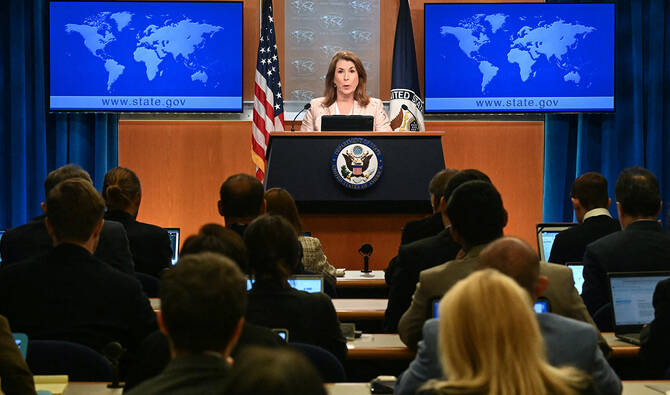
US State Department spokesperson Tammy Bruce speaks during a press briefing at the State Department in Washington, DC, on April 15, 2025. (AFP/File)
Short Url
Updated 09 July 2025
Follow

US reaffirms Trump’s role in India-Pakistan ceasefire, contradicting New Delhi’s denials

  • Tammy Bruce says people today can see events unfold for themselves and don’t need official statements to know what really happened
  • New Delhi has denied any US role in the ceasefire with Pakistan, while Islamabad has acknowledged and praised American involvement

ISLAMABAD: A US State Department official reaffirmed on Tuesday President Donald Trump and his top administration officials were involved in negotiations that led to a ceasefire between India and Pakistan earlier this year, contradicting repeated statements from Indian officials denying any American role.

Speaking at a State Department media briefing in Washington, spokesperson Tammy Bruce responded to a question about New Delhi’s rejection of Trump’s involvement in the truce.

Indian Prime Minister Narendra Modi and members of his cabinet have insisted that the ceasefire was achieved bilaterally, without third-party mediation.

“So many comments speak for themselves,” she said. “That’s one of the good-news aspects of our modern world — people can see what’s really occurring. You’re not reliant on a comment to know what has really happened.”

She maintained “Secretary [of State] Marco Rubio ... the Vice President of the United States [JD Vance were] also involved in the negotiations with Pakistan and India,” which was announced by President Donald Trump on May 10.

Bruce’s comments came amid continued tension between Indian and American narratives about the circumstances that led to the ceasefire after four days of intense military conflict between the two South Asian nuclear rivals.

The Trump administration announced the two countries had agreed to halt hostilities and engage in talks at a neutral venue.

While the Trump administration publicly claimed credit for defusing the crisis, New Delhi maintained silence initially. In recent weeks, however, Indian officials have pushed back against suggestions of US mediation.

Suggestions of foreign involvement in Indian foreign policy engagements in the region, particularly with Pakistan, are often politically sensitive.

The Ministry of External Affairs in New Delhi announced in a statement after last month’s G7 meeting in Canada that Modi had challenged the American perspective, saying there was no US mediation in the Pakistan truce.

Subsequently, India’s Foreign Minister Subrahmanyam Jaishankar made similar remarks to clarify India’s position on the issue.

Pakistan, in contrast, has openly acknowledged and praised US involvement, with the government even nominating Trump for a Nobel Peace Prize following the ceasefire announcement.


Pakistani president arrives in Iraq to deepen trade, energy cooperation

Updated 20 December 2025
Follow

Pakistani president arrives in Iraq to deepen trade, energy cooperation

  • Visit follows recent high-level contacts as Islamabad seeks to expand limited commercial ties with Baghdad
  • Talks are expected to cover investment, manpower and facilitation of Pakistani pilgrims visiting holy sites in Iraq

ISLAMABAD: President Asif Ali Zardari arrived in Iraq on Saturday on an official visit aimed at expanding cooperation in trade, energy and investment, as Pakistan seeks to deepen ties with Baghdad after years of limited engagement.

Pakistan and Iraq established diplomatic relations in 1947 and have traditionally maintained cordial ties, though commercial links remain modest, with officials and business groups identifying scope for cooperation in construction services, pharmaceuticals, manpower and agricultural exports.

“President Asif Ali Zardari arrived in Baghdad on a four-day official visit to Iraq,” his office said in a post on X. “He was received by Culture Minister Dr. Ahmed Fakkak Al-Badrani. During the visit, meetings with senior Iraqi leadership are expected to advance cooperation and further strengthen Pakistan-Iraq relations.”

Zardari’s visit follows a series of recent high-level contacts between the two countries, reflecting efforts to broaden bilateral engagement beyond traditional diplomatic ties and explore collaboration across economic, political and people-to-people domains.

According to Pakistan’s foreign office, the president is expected to hold meetings with Iraq’s senior leadership to discuss cooperation in various areas such as trade and investment, energy, technology, education and manpower.

He is also expected to discuss regional and international issues with Iraqi officials.

Earlier this month, Pakistan’s Interior Minister Mohsin Naqvi met his Iraqi counterpart, Abdul Ameer Al-Shammari, on the sidelines of meetings in Brussels, where both sides agreed to enhance cooperation on security and facilitate travel for Pakistani Shia pilgrims to Najaf and Karbala.

The two officials discussed measures to ensure the smoother movement of these pilgrims and their compliance with visa regulations.