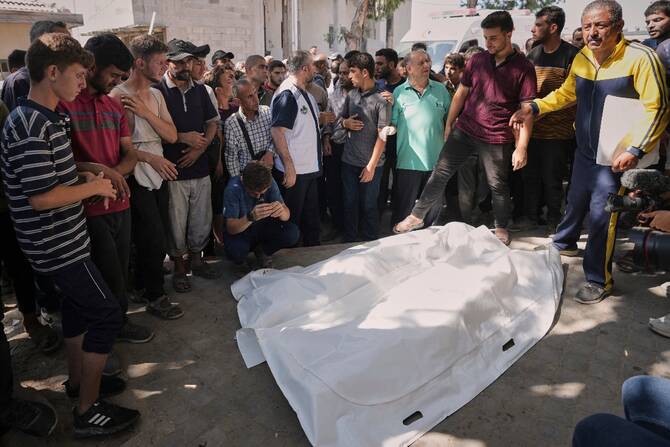
JERUSALEM: When the onetime director of a Gaza Strip hospital was killed by an Israeli airstrike last week, he joined a growing list of prominent Palestinian doctors who have died during 21 months of war that has devastated the territory’s health system.
The death of Dr. Marwan Al-Sultan, a 49-year-old cardiologist, was described by colleagues as a major blow personally and professionally, leaving another void in Gaza’s medical establishment that will not be easily replaced.
“He was one of two cardiologists, so by losing Dr. Marwan, thousands of people will lose and suffer,” said Mohammed Abu Selmia, a close friend of his for 15 years, and the director of Shifa Hospital, Gaza’s largest medical facility.
A photograph from 2022 shows Abu Selmia, Al-Sultan and 30 other leading doctors and medical experts in Gaza, all faculty smiling after the graduation of medical school students from Islamic University in Gaza City. At least five of those veteran doctors, mentors to the next generation, are now dead – each killed by Israeli airstrikes, except for one who died while in captivity in Israel.
Al-Sultan and three other specialists in the 2022 photo who were killed in airstrikes died during off-duty hours, though it is not clear if these were targeted killings.
When asked why Al-Sultan’s building was attacked last Wednesday, the Israeli military said it had struck a “key terrorist” from Hamas, without elaborating. The military said it “regrets any harm to uninvolved individuals” and that the “the incident is under review.”
It will take years to educate a new generation of surgeons and other specialists to replace the ones killed during the war between Hamas and Israel, Abu Selmia said. For now, hospitals have too few experts to provide urgent care at a time of extraordinary need, he said.
Hospitals across Gaza also face supply shortages amid steady Israeli bombardment that is resulting in a high number of wounded people seeking treatment on a near-daily basis.
A health care system in crisis
More than 1,400 Palestinian health workers have been killed in Gaza since the war began in October 2023, according to the United Nations.
The Israeli military has raided or laid siege to hospitals throughout the war, accusing Hamas of using them as command centers and to hide fighters, though it has only provided evidence for some of its claims. The World Health Organization has documented nearly 700 attacks on health care facilities during the war.
Al-Sultan gained respect and notoriety within Gaza’s medical community because he refused to leave his hospital in the northern Gaza city of Beit Lahiya, even when it came under attack. He was outspoken on social media about the dangers health workers faced in the hospital under Israeli bombardment and siege.
Al-Sultan was the last director of the Indonesian Hospital, the largest in northern Gaza before the Israeli military forced it to close in early June because of military operations around it.
In May, Al-Sultan described the difficult situation health workers at his facility faced. “We will keep holding on for our patients, for our jobs and our people,” he said in a video posted online by his hospital’s backers.
Al-Sultan had plenty of opportunities to practice medicine in other countries, said Dr. Mohammed Al-Assi, who studied with him in Jordan. But he decided to go home to serve in Gaza in 2019. Al-Assi, inspired by his friend, followed him.
When he heard the news of his killing, Al-Assi was shattered. “I’m wondering as any doctor would, was it his fault that he was helping people?”
Other former colleagues were similarly overwhelmed by news of Al-Sultan’s death.
“A wave of emotion hit me as I suddenly remembered our last video call — how he kept asking me about me and my family when it should have been the other way around,” said Dr. Emad Shaqoura, a former vice dean of the medical faculty at Islamic University who is now in the UK
The missile that killed Al-Sultan struck the third-floor apartment he was renting with his family in the Gaza City neighborhood of Tal Al-Hawa, witnesses and doctors said. His wife, a daughter, and son-in-law were also killed.
Another daughter, Lubna Al-Sultan, said the missile crashed into his room around 2 p.m., leaving other units in the building intact. The Al-Sultan family had been displaced from their home.
“It was not collateral damage,” said Dr. Hadiki Habib, chairman of the Indonesian humanitarian organization that built and funded the Indonesian hospital.
The day before he was killed, Al-Sultan spoke with Abu Selmia about how they would prepare a new schedule for cases and treatment. He was one of two doctors left capable of performing a procedure to diagnose and treat heart problems, said Abu Selmia.
“Dr. Marwan was the trainer and mentor for all those students in Shifa Hospital and in the entirety of Gaza City,” Abu Selmia said.
Other prominent doctors in Gaza have also been killed
In the 2022 photo of Islamic University’s faculty of medicine, four other members are also no longer alive.
— Dr. Adnan Al-Bursh, once the head of Shifa’s orthopedics department, died in Israeli detention, allegedly of ill-treatment, according to Palestinian authorities and advocacy groups. An independent autopsy on his body, which has not been returned to his family, has not been conducted. His wife said repeated requests to return his body have not been answered.
— Dr. Hammam Alloh, a kidney expert, was killed at home with his family by an airstrike in November 2023.
— Dr. Mohammed Dabbour, Gaza’s first cancer pathologist, was killed in an airstrike on October 2023, along with his father and son.
— Dr. Rafat Lubbad, head of internal medicine at Shifa and one of few specialists in autoimmune diseases, was killed in November 2023, along with 7 family members, in Gaza City.
Hospitals overwhelmed with casualties
Only 17 of Gaza’s 36 hospitals remain operational, according to the WHO, which says that all are struggling with severe supply shortages. Of the hospitals that are functioning, only 12 provide services beyond basic emergency care.
Conditions in northern Gaza, where Al-Sultan lived and worked, are particularly dire. The area has been site of some of the most intense Israeli military operations since the start of the war, and although there were many evacuation orders, many of its residents remain.
Abu Selmia considers what the future might hold for the doctors still alive and forever smiling in that 2022 medical school graduation photo. There are barely enough of them to tend to the vast numbers of sick and wounded, he said.
But he holds on to some small hope.
Al-Sultan’s son, Ahmed, is a medical student. “God willing, he will follow his father’s footsteps.”


![]()

Gaza doctors say Israel’s killing of a prominent colleague leaves a hard-to-fill void
Short Url
https://arab.news/j8thz
Gaza doctors say Israel’s killing of a prominent colleague leaves a hard-to-fill void
- More than 1,400 Palestinian health workers have been killed in Gaza since the war began in October 2023, according to the United Nations


Latest updates


© 2026 SAUDI RESEARCH & PUBLISHING COMPANY, All Rights Reserved And subject to Terms of Use Agreement.