

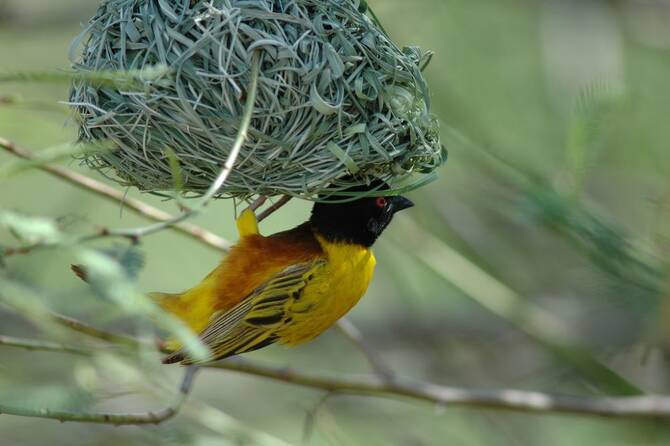
Golden-backed weaver builds its nest in the mountains of Asir

Golden-backed weavers, known for their remarkable nest-building skills, are thriving in the majestic mountains of Asir. (Wikimedia Commons)
Short Url
Updated 08 July 2025
Follow

Golden-backed weaver builds its nest in the mountains of Asir

  • Male bird structures the nest by manipulating threads of grass through its claws and beak, resulting in precise geometric shapes
  • Opening to the nest is narrow and faces downward to protect the young chicks from predators and other birds or animals

RIYADH: Golden-backed weavers, known for their remarkable nest-building skills, are thriving in the majestic mountains of Asir, the Saudi Press Agency reported.

The small yellow bird gets its name from the elaborate nests its constructs using its strong beaks and claws.

Golden-backed weavers (Ploceus jacksoni) first select an area where they want to build a nest, typically choosing the small branches of a tree. They start with a ring of woven straw or grass and then complete the structure by intersecting threads at a specific angle.

The nest usually hangs from the branch to offer safe shelter for the bird’s offspring. The opening to the nest is narrow and faces downward to protect the young chicks from predators and other birds or animals.

Golden-backed weavers are known for their weaving ability, and are one of the most highly skilled species in the wild, according to SPA.

Additionally, the male bird structures the nest by manipulating threads of grass through its claws and beak, resulting in precise geometric shapes.

The bird has unique colors, with either a black or a brown head, and yellow feathers covering its entire body.

Golden-backed weavers, along with many other bird species, thrive in the southern Asir region due to its moderate temperatures, varied plant environment, and biodiversity.

The region has an area of 81,000 sq. km, and borders Yemen in the southeast and the Jazan region in the southwest.

Almost 500 species of birds have been recorded in Saudi Arabia, along with a variety of wildlife and 2,400 flowering plants, according to estimates.


King Abdulaziz Foundation reveals rare images from king’s 1916 Basra visit

Updated 20 December 2025
Follow

King Abdulaziz Foundation reveals rare images from king’s 1916 Basra visit

  • Photographs form part of a wider collection documented by British photographer Gertrude Bell

RIYADH: The King Abdulaziz Foundation has revealed archival photographs documenting King Abdulaziz’s tour of the outskirts of Basra in 1916, a visit that came at an early stage of his efforts to build regional relationships.

One of the photographs, taken by British photographer Gertrude Bell, shows King Abdulaziz standing with his men in the Basra desert, the Saudi Press Agency reported. 

The image reflects his early political and diplomatic engagement in the region, as he sought to strengthen ties with neighboring areas and engage with the wider Arab and international community, SPA added.

The photograph forms part of a wider collection documented by Bell, which records key developments and transformations across the Arabian Peninsula during the early 20th century.

The Basra visit holds particular significance in King Abdulaziz’s journey as a unifying leader. 

Rather than crossing borders in pursuit of power, the visit reflected an approach focused on stability, cooperation and long-term regional harmony, laying the groundwork for a leadership style defined by pragmatism and openness, SPA said.