

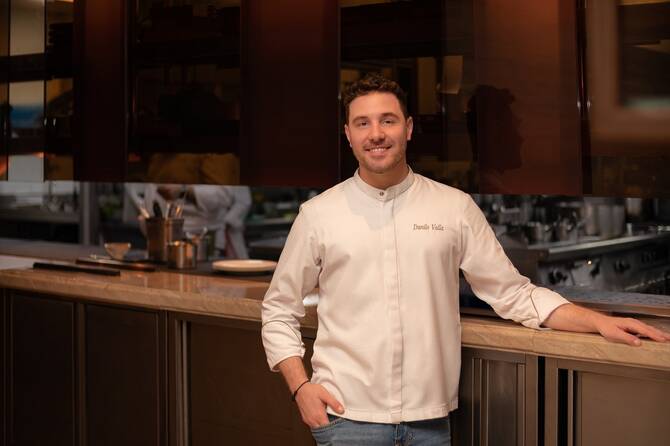

DUBAI: Danilo Valla is the executive chef of Italian fine dining spot Roberto’s in Dubai Financial Center. The restaurant recently reopened after a comprehensive revamp.
“Everything is new, but the spirit of Roberto’s is still very much alive,” Valla tells Arab News. “The intention was not to change the identity, but to evolve it with more clarity and confidence. From a culinary perspective, the menu has been built with precision. Ingredients are carefully selected, many sourced directly from Italy, and the offering will evolve seasonally. The flavors are rooted in tradition, but the execution is modern and refined.”
The interiors, he adds, were “inspired by Milan’s golden era of fashion,” and he hopes the restaurant will feel “sophisticated yet relaxed.”
When did you know you wanted to become a professional chef?
I initially thought I would follow in my father’s footsteps — he owned a café in my hometown. During my first years of hospitality school, it was the cooking classes, especially the practical ones, that truly captured me. I became fascinated by the way you can transform an ingredient, change its texture, deepen its flavor, and create something entirely new. More than anything, I realized that cooking was a way to make people happy. The respect for product, the connection to tradition, and the ability to express yourself through food meant this was the path I wanted to follow.
When you started out, what was the most common mistake you made?
Early in my career, I had to learn that you never stop learning. The biggest mistake is believing you already know enough. Growth only happens when you remain open. And another of my early mistakes was listening more to compliments than to criticism. Compliments make you comfortable, but criticism makes you better. It took time to understand that feedback is not an attack, but an opportunity to improve. That mindset changed everything for me.
What’s your top tip for amateur chefs?
Be patient, especially with sauces. The longer and more gently you cook them, the deeper and more complex the flavor becomes. Good cooking is about allowing ingredients to develop naturally over time.
What one ingredient can instantly improve any dish?
I believe salt is what truly brings a dish to life. When properly balanced, it enhances flavor without overpowering it. For raw fish or grilled meat, we often use crystallized salt, which is gentler and more delicate on the palate.
But beyond any physical ingredient, the most important elements in cooking are time and passion. Some dishes require patience to develop depth and character, and without passion it becomes easy to rush the process. But when you respect timing and cook with intention, the result is always more complete.
When you go out to eat, do you find yourself critiquing the food?
I naturally notice details. It’s not something I do intentionally, but it’s part of being a chef. You observe flavors, execution, service rhythm, even small gestures that others might not pay attention to.
What’s the most common issue you find in other restaurants?
In Dubai especially, many restaurants can feel similar in terms of menu structure or concepts. What I’ve learned is that when something feels incomplete, it is rarely just about the food. Often it’s about the connection between food, service, and atmosphere. This has reinforced an important lesson for me: we must always see the experience through the guest’s eyes. True hospitality happens when every element works together seamlessly.
What’s your favorite cuisine or dish to order?
I’ve always loved Japanese cuisine. What impresses me most is the level of care and precision, even in street food. You can see and taste the respect for the product. But it’s not only about sushi or sashimi. When I think of Japanese cuisine, I think of ramen. I love it. It may seem simple, but it has incredible depth. There are so many variations, each with its own character, so you never get tired of it.
What’s your go-to dish if you have to cook something quickly at home?
For me, nothing beats a simple linguine with fresh cherry tomatoes and basil. It’s quick, light, and full of flavor. While the pasta cooks, I prepare the sauce with good olive oil, a little garlic, and chopped cherry tomatoes, cooked briefly to keep their freshness and natural sweetness. I finish with fresh basil, a touch of black pepper, and that’s it. Simple ingredients, treated well, are always enough.
What customer request most frustrates you?
I don’t see guest requests as something negative. When someone asks for a change or has a specific preference, it usually means they care about what they are eating, and I respect that. If a request changes the nature of a dish, our responsibility is to guide the guest while protecting the integrity of the cuisine. Hospitality is about finding that balance.
What’s your favorite dish to cook and why?
I’m very fond of grilled meat. Grilling adds depth and character and, when you use good wood, it can give a subtle sweetness that enhances the flavor even more. In Italy, we don’t rely heavily on marinades for grilled meat. We prefer to choose an excellent cut and respect the cooking process. When the product is strong and treated properly, it speaks for itself.
What’s the most difficult dish for you to get right?
There are no truly difficult dishes; the real challenge is consistency. A pasta must always be perfectly al dente and properly coated in sauce, just as a piece of meat must be grilled with precision and cooked to the exact amount requested.
Preparing one plate correctly is not difficult. The challenge is delivering that same standard for every table, throughout the entire service, every single day. That is what defines a successful restaurant. Nothing can be improvised. Behind every dish there must be preparation, training, careful sourcing, and strict control over daily execution.
As a head chef, what are you like? Are you a disciplinarian? Or are you more laid back?
I believe the time of aggressive chefs is over. A kitchen can be disciplined without being hostile. I aim to create an environment where the team feels respected, motivated, and proud of what they do. Of course, strict rules are necessary. Standards must be clear and consistently upheld. But discipline does not require shouting. It requires leadership, presence, and accountability. When people feel part of a shared project, they take responsibility naturally. Passion and structure can coexist, and when they do the result is visible on the plate.
Chef Danilo’s capasanta (scallops)

Chef Danilo’s capasanta. (Supplied)
Scallop carpaccio, citrus dressing, crusco capsicum
(Serves 2)
Ingredients
Scallop carpaccio
Scallop meat - 70g
Citrus dressing - 60g
Puffed buckwheat - 15g
Maldon salt - 3g
Crusco capsicum powder - 2g
Freshly ground black pepper - to taste
For the citrus dressing
Mandarin vinegar fruit pulp - 100ml
Sunflower oil - 200ml
Red bell pepper (finely diced) - 33g
Chives (finely chopped) - 15g
Crusco capsicum powder - 2g
Paprika powder - 5g
Preparation
Citrus dressing
In a bowl, combine the mandarin vinegar pulp with the diced red bell pepper, chives, paprika, and crusco capsicum powder.
Slowly incorporate the sunflower oil while whisking continuously to create a smooth emulsion. Set aside.
Scallop carpaccio
Slice the raw scallops horizontally into thin slices to create a carpaccio.
Season lightly with Maldon salt and freshly ground black pepper. Arrange neatly on a chilled plate.
Spoon the citrus dressing evenly over and around the scallops.
Finish with a light sprinkle of crusco capsicum powder, a touch more Maldon salt, and puffed buckwheat for texture.
Serve immediately.


