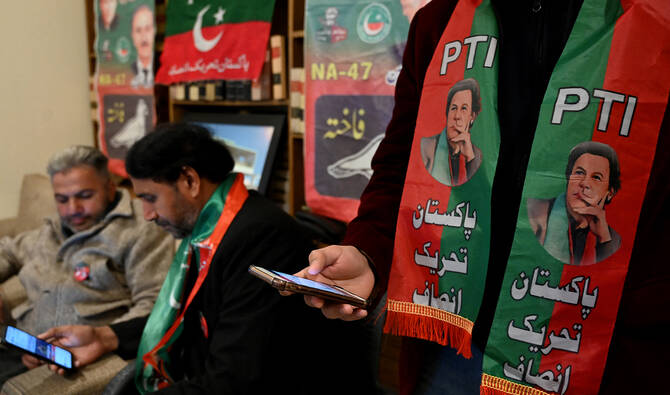

KARACHI: A number of Pakistani journalists said on Tuesday they received notifications from YouTube, citing a court order from Islamabad directing the blocking of their channels, along with those of jailed former Prime Minister Imran Khan and his Pakistan Tehreek-e-Insaf (PTI) party.
According to notices seen by Arab News, the US-based video-sharing platform said it had received a legal removal request referencing a court order dated June 24, 2025, in Enquiry No. 717/2025.
The list of affected channels includes those of senior journalists Matiullah Jan, Habib Akram, Sabir Shakir, Asad Ali Toor, Ahmed Noorani and at least 20 others, alongside Khan’s and PTI’s official YouTube channels.
Zulfi Bukhari, a close aide to Khan, told Arab News by phone that PTI’s channels had not yet received any formal notification. However, several journalists confirmed receiving takedown notices via YouTube and vowed to challenge the court’s directive.
“I am in contact with fellow journalists whose channels have been served with similar notices, and we intend to challenge this in court,” said Habib Akram, a Lahore-based anchor and political commentator, adding the order had been issued without any prior notice or summons from the Islamabad court.
“The decision appears to lack any clear legal basis and seems to be an apparent attempt to suppress independent journalism,” he added.
The order, issued by Judicial Magistrate Abbas Shah in Islamabad, instructed YouTube’s parent company, Google LLC, to block 27 channels for allegedly violating Pakistan’s Prevention of Electronic Crimes Act and other penal laws.
“You may choose to act on the said content in term of the aforesaid court order,” read a notice issued by YouTube. “If you fail to do so, as per our local law obligation, we may comply with the request without further notice to you.”
Asad Ali Toor, a journalist based in Islamabad whose name appears on the list, criticized both the court and the National Cyber Crime Investigation Agency (NCCIA) for acting without giving him a chance to be heard.
“For the past three months, NCCIA has also frozen my and my family’s bank accounts without any hearing,” he said.
Toor attributed such actions to his “critical reporting” on sensitive issues like enforced disappearances and institutional overreach. He said he had previously received notices about specific videos, but this was the first time his entire channel had been targeted.
Matiullah Jan voiced concern about the broader implications of the move.
“I believe YouTube should not block any channel solely on the basis of an inquiry without a court order,” he said. “If this becomes a norm, it could set a dangerous precedent globally.”
Despite multiple requests, the Ministries of Interior and Information & Broadcasting did not respond to Arab News queries seeking clarification on the government’s role in the matter or the legal grounds for the request to YouTube.
The court order referenced by YouTube states that during an inquiry under Section 94 of the Criminal Procedure Code, “evidence regarding YouTube channels” was deemed necessary, and their content constituted offenses under Pakistan’s cybercrime laws.
Digital rights groups and press freedom watchdogs have frequently criticized the Pakistani government for using vague legal provisions to stifle dissent. In its 2024 report, Reporters Without Borders (RSF) ranked Pakistan 152nd out of 180 countries on the World Press
Freedom Index, citing growing censorship, legal harassment of journalists, and tightening control over digital platforms.
Journalists now fear the court-backed move could deepen digital censorship in the country.
“We are not only being silenced, but also criminalized for doing our job,” said Toor. “This is not just about YouTube. It’s about the future of press freedom in Pakistan.”