

Pakistan blocks ‘thousands’ of passports in crackdown on overseas begging in Gulf countries

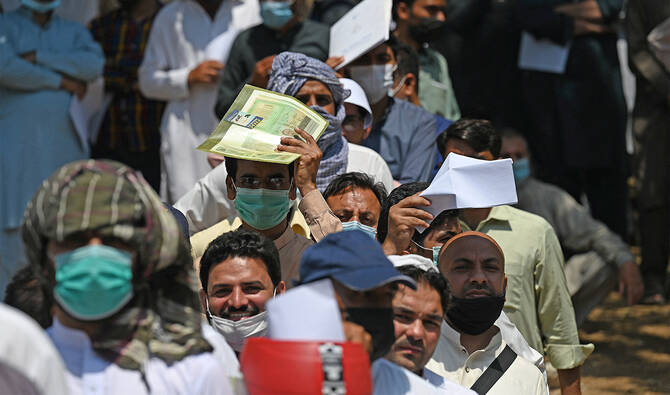
In this picture taken on May 19, 2021, Pakistani nationals wait in a queue to apply for a visa outside Afghanistan's embassy in Islamabad. (AFP/File)
Short Url
Updated 26 February 2026
Follow

Pakistan blocks ‘thousands’ of passports in crackdown on overseas begging in Gulf countries

  • Authorities impose five- to 10-year passport restrictions on deported offenders, report sharp decline in cases
  • Government links enforcement drive to broader push for skilled labor exports and record remittance inflows

ISLAMABAD: Pakistan has blocked “several thousand passports” and imposed long-term travel restrictions on citizens involved in begging abroad, the country’s overseas minister said on Wednesday, reporting a sharp decline in such cases following enforcement reforms.

Last August, the government announced a sweeping crackdown on what it described as a “beggar mafia” accused of exploiting visas to solicit money in Saudi Arabia and other Middle Eastern states. The practice had drawn complaints from Riyadh, prompting Islamabad to direct the Federal Investigation Agency (FIA) to curb the trend.

Federal Minister for Overseas Pakistanis Chaudhry Salik Hussain said authorities were targeting individuals who misuse Umrah and other visit visas to beg overseas, particularly in Gulf countries.

“We are not sending the beggars abroad,” he said at the Pakistan Governance Forum 2026 in the federal capital. “It is not written on the face of the beggar that he is a beggar. They go through the normal process of getting a visa for Umrah and then start this work on the side.”

Hussain said passports of deported individuals involved in begging or criminal activity were being blocked to prevent repeat travel.

“For that we can only do that if someone is involved in this work and he is caught and when he is deported, then at least we block his passport, which is happening,” he said. “Believe me, there has been a drastic drop in this.”

“There is no visa for begging. They go on a normal visa. Every document is 100 percent correct,” he added.

According to Hussain, the FIA is imposing passport restrictions of five to 10 years on offenders, preventing them from obtaining new travel documents.

He added that “several thousand passports” had so far been blocked.

Pakistan, which relies heavily on remittances from its overseas workforce, is also seeking to improve the quality of labor exports following meetings with labor ministers in Qatar, Bahrain, Saudi Arabia and the United Arab Emirates.

“We want our workforce to go there. The quantity is increasing but the quality element is very important,” he said, adding that the government plans to make soft skills training compulsory for Pakistanis going abroad “from the labor class to the undergraduates” so they better understand local norms and regulations.

The minister said exporting skilled labor helps ease unemployment pressures driven by Pakistan’s growing youth population while boosting remittances, which recently hit an all-time high.

“I think this is one of the reasons because our youth bulge is very high in Pakistan and local industries are not enough to cater to that. So we should at least find good jobs in foreign countries and send them there,” he said, adding that overseas workers “not only get employed but also send valuable remittances back home.”

Hussain said broader reforms were also under way to digitize overseas employment processes and reduce corruption.

“We are moving toward maximum digitization,” he said. “Problems and issues arise where humans interact with humans. We are moving toward digitization very quickly.”


Pakistan condemns Netanyahu’s ‘hexagon of alliances’ plan, says alert to growing India-Israel defense ties

Updated 26 February 2026
Follow

Pakistan condemns Netanyahu’s ‘hexagon of alliances’ plan, says alert to growing India-Israel defense ties

  • Israel’s Netanyahu last week proposed an alliance of countries in and around Middle East against its adversaries
  • Pakistan maintains “robust military preparedness” to deter any potential aggression, says foreign office spokesperson

ISLAMABAD: Pakistan’s foreign office spokesperson on Thursday condemned Israeli Prime Minister Benjamin Netanyahu’s recent statement about forming a “hexagon of alliances” within or around the Middle East, saying Islamabad was alert to growing defense ties between New Delhi and Tel Aviv. 

Netanyahu on Sunday outlined plans to form a new regional bloc, describing it as a “hexagon of alliances” that he said could include Israel, India, Greece and Cyprus, along with other unnamed Arab, African and Asian states. He said the grouping would collectively stand against what he described as “radical” adversaries.

His comments came days before Indian Prime Minister Narendra Modi arrived in Israel on Wednesday for a two-day trip to bolster ties. The two are expected to discuss cooperation in science and technology, innovation, agriculture, water management, technology, defense and security during the trip. 

The statement drew a sharp response from Pakistan’s Senate, which unanimously passed a resolution on Tuesday rejecting Netanyahu’s remarks.

“I would also like to draw your attention to the recent resolution adopted by the Senate of Pakistan that strongly condemned such remarks and attempts to undermine Muslim unity,” Foreign Office spokesperson Tahir Andrabi told reporters during a weekly press briefing.

“We continue to condemn these provocative steps and statements by the leadership of the occupying power that threaten regional peace and stability,” he added.

Netanyahu had also said Israel’s goal was to create an axis of nations that see eye to eye against what he described as the “radical Shia” and “radical Sunni” axis of nations. 

Andrabi said attempts to divide the Muslim world along sectarian lines were a “nefarious design” on Netanyahu’s part.

India is Israel’s largest arms buyer and second-largest trading partner in Asia, after China. In response to a question on India’s growing defense ties with Israel, Andrabi said Pakistan remained cognizant of the risks posed by such cooperation.

“Yes, we remain seized of the defense ties between Israel and India,” the spokesperson said, noting that certain “systems and platforms” may have been used by India against Pakistan in the past.

“We are alive to the threats they pose to our security, sovereignty and territorial integrity, as well as to regional peace and stability.”

Andrabi said Pakistan maintained “robust military preparedness” to deter any potential aggression from hostile forces.

‘UTMOST CAUTION EXERCISED’

Andrabi spoke about Pakistan’s recent strikes against alleged militant camps in Afghanistan, saying Islamabad had conducted them in self-defense and with extreme caution to avoid casualties. 

Pakistan said it carried out airstrikes in Afghanistan against militant camps and hideouts in three provinces on Saturday night, killing over 100 militants. Afghanistan accused Pakistan of violating its territorial sovereignty and killing dozens of civilians. Kabul has vowed to retaliate. 

Andrabi said the strikes were carried out to ensure protection for the lives of the people of Pakistan and to prevent “imminent terrorist attacks.”

“These actions were directed solely against identified terrorist camps and hideouts, and utmost caution was exercised to prevent harm to civilians,” he said. 

He warned Pakistan would take necessary measures under its right to self-defense against “terrorist threats” emanating from Afghan territory.

On the safety of Pakistani nationals in Afghanistan following the strikes, Andrabi said Islamabad had raised the issue with Afghan authorities, adding that Islamabad expected “foolproof security” for Pakistani diplomats and civilians.