

Pakistan blocks ‘thousands’ of passports in crackdown on overseas begging in Gulf countries

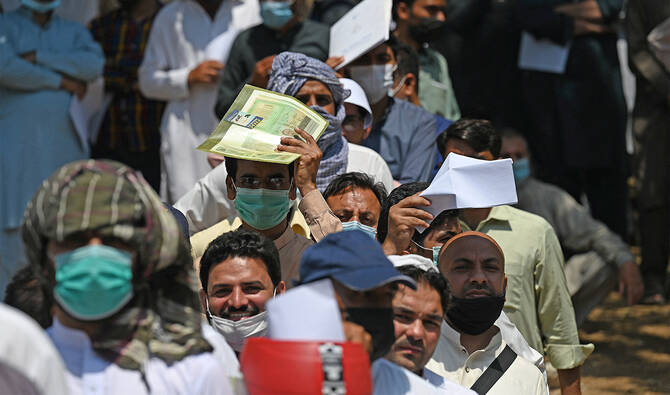
In this picture taken on May 19, 2021, Pakistani nationals wait in a queue to apply for a visa outside Afghanistan's embassy in Islamabad. (AFP/File)
Short Url
Updated 26 February 2026
Follow

Pakistan blocks ‘thousands’ of passports in crackdown on overseas begging in Gulf countries

  • Authorities impose five- to 10-year passport restrictions on deported offenders, report sharp decline in cases
  • Government links enforcement drive to broader push for skilled labor exports and record remittance inflows

ISLAMABAD: Pakistan has blocked “several thousand passports” and imposed long-term travel restrictions on citizens involved in begging abroad, the country’s overseas minister said on Wednesday, reporting a sharp decline in such cases following enforcement reforms.

Last August, the government announced a sweeping crackdown on what it described as a “beggar mafia” accused of exploiting visas to solicit money in Saudi Arabia and other Middle Eastern states. The practice had drawn complaints from Riyadh, prompting Islamabad to direct the Federal Investigation Agency (FIA) to curb the trend.

Federal Minister for Overseas Pakistanis Chaudhry Salik Hussain said authorities were targeting individuals who misuse Umrah and other visit visas to beg overseas, particularly in Gulf countries.

“We are not sending the beggars abroad,” he said at the Pakistan Governance Forum 2026 in the federal capital. “It is not written on the face of the beggar that he is a beggar. They go through the normal process of getting a visa for Umrah and then start this work on the side.”

Hussain said passports of deported individuals involved in begging or criminal activity were being blocked to prevent repeat travel.

“For that we can only do that if someone is involved in this work and he is caught and when he is deported, then at least we block his passport, which is happening,” he said. “Believe me, there has been a drastic drop in this.”

“There is no visa for begging. They go on a normal visa. Every document is 100 percent correct,” he added.

According to Hussain, the FIA is imposing passport restrictions of five to 10 years on offenders, preventing them from obtaining new travel documents.

He added that “several thousand passports” had so far been blocked.

Pakistan, which relies heavily on remittances from its overseas workforce, is also seeking to improve the quality of labor exports following meetings with labor ministers in Qatar, Bahrain, Saudi Arabia and the United Arab Emirates.

“We want our workforce to go there. The quantity is increasing but the quality element is very important,” he said, adding that the government plans to make soft skills training compulsory for Pakistanis going abroad “from the labor class to the undergraduates” so they better understand local norms and regulations.

The minister said exporting skilled labor helps ease unemployment pressures driven by Pakistan’s growing youth population while boosting remittances, which recently hit an all-time high.

“I think this is one of the reasons because our youth bulge is very high in Pakistan and local industries are not enough to cater to that. So we should at least find good jobs in foreign countries and send them there,” he said, adding that overseas workers “not only get employed but also send valuable remittances back home.”

Hussain said broader reforms were also under way to digitize overseas employment processes and reduce corruption.

“We are moving toward maximum digitization,” he said. “Problems and issues arise where humans interact with humans. We are moving toward digitization very quickly.”


Pakistan reviews austerity measures amid Middle East crisis, urges strict nationwide implementation

Updated 11 March 2026
Follow

Pakistan reviews austerity measures amid Middle East crisis, urges strict nationwide implementation

  • Deputy Prime Minister Ishaq Dar chairs review meeting of austerity steps
  • Officials briefed on salary cuts, school closures, four‑day week, petrol conservation

ISLAMABAD: Pakistan’s government on Wednesday assessed progress on a sweeping set of austerity measures introduced to mitigate the country’s economic strain from sharply rising global oil prices and supply disruptions linked to the ongoing war in the Middle East.

Prime Minister Shehbaz Sharif this week announced a series of austerity steps, including a four‑day work week for government offices, requiring 50  percent of staff to work from home, cutting fuel allowances for official vehicles by half, grounding up to 60  percent of the government fleet and closing all schools for two weeks to conserve fuel amid the global oil crisis.

The measures were unveiled in response to global oil market volatility triggered by the conflict involving the United States, Israel and Iran, which has disrupted supply routes such as the Strait of Hormuz and pushed crude prices sharply higher, straining Pakistan’s heavily import‑dependent energy sector.

“The meeting stressed the importance of strict and transparent adherence to the austerity measures, promoting fiscal responsibility and prudent use of public resources,” Deputy Prime Minister and Foreign Minister Senator Mohammad Ishaq Dar said in a statement.

He was chairing a meeting of the Committee for Monitoring and Implementation of Conservation and Additional Austerity Measures, constituted under the directions of the PM, bringing together federal and provincial officials to review execution of the broad cost‑cutting plan. 

Dar emphasized the government’s commitment to enforcing the PM’s austerity steps nationwide. The committee’s review also covered reductions in departmental expenditure, deductions from salaries of senior officials earning over Rs. 300,000 ($1,120), and coordination with provincial administrations to ensure uniform implementation of the plan.

Participants at the meeting reiterated that all ministries and divisions must continue strict monitoring and reporting, with transparent oversight mechanisms, as Pakistan navigates the economic pressures from the prolonged Middle East crisis and its fallout on global energy and trade markets.