

Pakistan expresses solidarity as 12 Turkish soldiers die in Iraq cave gas incident

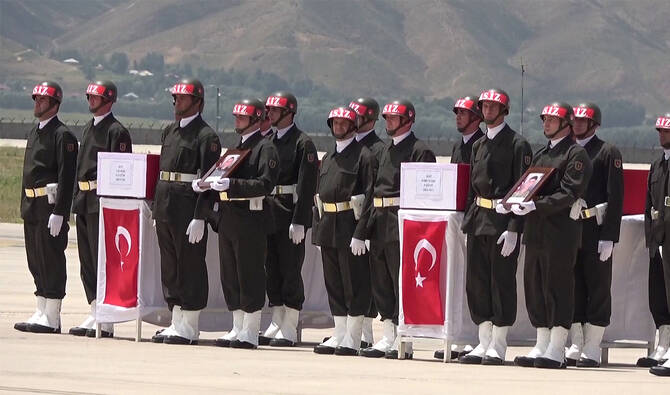
Officials pay tribute to the 12 soldiers killed in Iraq cave gas incident at a military ceremony in Yüksekova, Turkey, on July 7, 2025. (Turkish Defense Ministry/REUTERS/Screengrab)
Short Url
Updated 08 July 2025
Follow

Pakistan expresses solidarity as 12 Turkish soldiers die in Iraq cave gas incident

  • Incident occurred during a mission to locate the remains of a soldier killed earlier in operations against PKK group 
  • In past years, Turkish forces have reported discovering elaborate tunnel networks used by PKK fighters in northern Iraq

ISLAMABAD: Pakistan on Tuesday said it was saddened over the deaths of 12 Turkish soldiers who were killed after being exposed to methane gas during a military search operation in northern Iraq, offering condolences and reaffirming solidarity with Turkiye.

According to the Turkish defense ministry, the incident occurred on Sunday during a mission to locate the remains of a soldier killed earlier in operations against the Kurdistan Workers Party (PKK), which is designated a terrorist organization by Turkiye, the United States, and the European Union.

The soldiers were operating in the Claw-Lock Operation zone, part of a broader Turkish cross-border military campaign launched in April 2022 to root out PKK fighters from northern Iraq’s mountainous terrain. The ministry said several other soldiers exposed to methane gas in the same cave were hospitalized for treatment.

“We are deeply saddened to learn that 12 Turkish soldiers were martyred, after being exposed to methane gas during a search mission in the Claw-Lock Operation zone,” the Pakistani Ministry of Foreign Affairs said in a statement.

“We wish Allah’s mercy upon the martyrs and express deepest condolences to the bereaved families. Pakistan stands in firm solidarity with brotherly Turkiye in this moment of grief.”

While fatal gas exposure incidents in combat zones are relatively rare, the risk of methane buildup in enclosed or underground spaces such as caves or tunnels is well documented in both military and mining contexts. Methane is a colorless, odorless, and highly flammable gas that can displace oxygen, leading to suffocation in confined environments.

In past years, Turkish forces have reported discovering elaborate tunnel networks used by PKK fighters in northern Iraq, often rigged with explosives or hazardous substances. In 2021, three Turkish soldiers were killed in a suspected chemical exposure during clashes in a cave complex in the same region, though Turkish authorities did not publicly confirm the substance involved.

The latest incident underscores the continuing dangers faced by Turkish troops deployed in high-risk terrain as part of ongoing security operations. Turkiye has maintained a network of military bases in Iraq’s Kurdistan region for years, a policy that has drawn criticism from Baghdad but is defended by Ankara as necessary for national defense.

Pakistan and Turkiye share close defense and diplomatic ties, with regular high-level exchanges and joint military cooperation. Islamabad has consistently voiced support for Ankara’s security concerns, including its fight against the PKK.


Pakistani president arrives in Iraq to deepen trade, energy cooperation

Updated 20 December 2025
Follow

Pakistani president arrives in Iraq to deepen trade, energy cooperation

  • Visit follows recent high-level contacts as Islamabad seeks to expand limited commercial ties with Baghdad
  • Talks are expected to cover investment, manpower and facilitation of Pakistani pilgrims visiting holy sites in Iraq

ISLAMABAD: President Asif Ali Zardari arrived in Iraq on Saturday on an official visit aimed at expanding cooperation in trade, energy and investment, as Pakistan seeks to deepen ties with Baghdad after years of limited engagement.

Pakistan and Iraq established diplomatic relations in 1947 and have traditionally maintained cordial ties, though commercial links remain modest, with officials and business groups identifying scope for cooperation in construction services, pharmaceuticals, manpower and agricultural exports.

“President Asif Ali Zardari arrived in Baghdad on a four-day official visit to Iraq,” his office said in a post on X. “He was received by Culture Minister Dr. Ahmed Fakkak Al-Badrani. During the visit, meetings with senior Iraqi leadership are expected to advance cooperation and further strengthen Pakistan-Iraq relations.”

Zardari’s visit follows a series of recent high-level contacts between the two countries, reflecting efforts to broaden bilateral engagement beyond traditional diplomatic ties and explore collaboration across economic, political and people-to-people domains.

According to Pakistan’s foreign office, the president is expected to hold meetings with Iraq’s senior leadership to discuss cooperation in various areas such as trade and investment, energy, technology, education and manpower.

He is also expected to discuss regional and international issues with Iraqi officials.

Earlier this month, Pakistan’s Interior Minister Mohsin Naqvi met his Iraqi counterpart, Abdul Ameer Al-Shammari, on the sidelines of meetings in Brussels, where both sides agreed to enhance cooperation on security and facilitate travel for Pakistani Shia pilgrims to Najaf and Karbala.

The two officials discussed measures to ensure the smoother movement of these pilgrims and their compliance with visa regulations.