

Iran’s government says at least 1,060 people were killed in the war with Israel

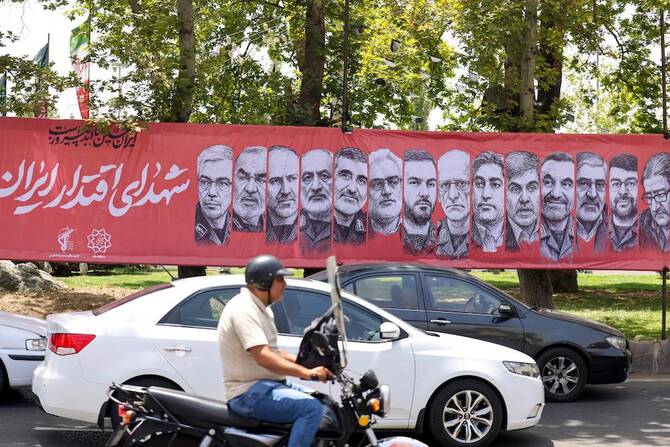
A large banner depicting Iranian commanders and scientists killed during the 12-day war between Iran and Israel is displayed at Tajrish Square in Tehran on June 30, 2025. (AFP)
Short Url
Updated 08 July 2025
Follow

Iran’s government says at least 1,060 people were killed in the war with Israel

  • Iranian official warns the death toll may reach 1,100 given how severely some people were wounded

DUBAI, United Arab Emirates: Iran’s government has issued a new death toll for its war with Israel, saying at least 1,060 people were killed and warning that the figure could rise.

Saeed Ohadi, the head of Iran’s Foundation of Martyrs and Veterans Affairs, gave the figure in an interview aired by Iranian state television late Monday.

Ohadi warned the death toll may reach 1,100 given how severely some people were wounded.

During the war, Iran downplayed the effects of Israel’s 12-day bombardment of the country, which decimated its air defenses, destroyed military sites and damaged its nuclear facilities. Since a ceasefire took hold, Iran slowly has been acknowledging the breadth of the destruction, though it still has not said how much military materiel it lost.

The Washington-based Human Rights Activists group, which has provided detailed casualty figures from multiple rounds of unrest in Iran, has said 1,190 people were killed, including 436 civilians and 435 security force members. The attacks wounded another 4,475 people, the group said.


Jailed Kurdish militant boss says peace laws needed for democratic integration in Turkiye 

Updated 2 sec ago
Follow

Jailed Kurdish militant boss says peace laws needed for democratic integration in Turkiye 

  • That landmark ⁠call fueled ‌hopes ‌for an ​end ‌to a conflict that ‌has killed more than 40,000 people, sowed deep divisions and ‌stymied development in mainly Kurdish southeast ⁠Turkiye
ANKARA: Jailed militant leader Abdullah Ocalan said ​on Friday that peace-related laws were needed for a transition to democratic integration in Turkiye, ‌in a statement ‌read ​out ‌a ⁠year ​after he ⁠called on his Kurdistan Workers Party (PKK) to end its decades-old insurgency and disband.
That landmark ⁠call fueled ‌hopes ‌for an ​end ‌to a conflict that ‌has killed more than 40,000 people, sowed deep divisions and ‌stymied development in mainly Kurdish southeast ⁠Turkiye, ⁠but progress has been slow. Ocalan’s statement was read out at a press conference by the pro-Kurdish DEM Party.