


Turkiye’s youngest oil wrestlers keeping a 14th-century tradition alive

1 / 6
A wrestler is doused in oil by an ‘oiler, during the 664th annual Historic Kirkpinar Oil Wrestling championship, in Edirne, northwestern Turkiye on July 5, 2025. (AP)
2 / 6
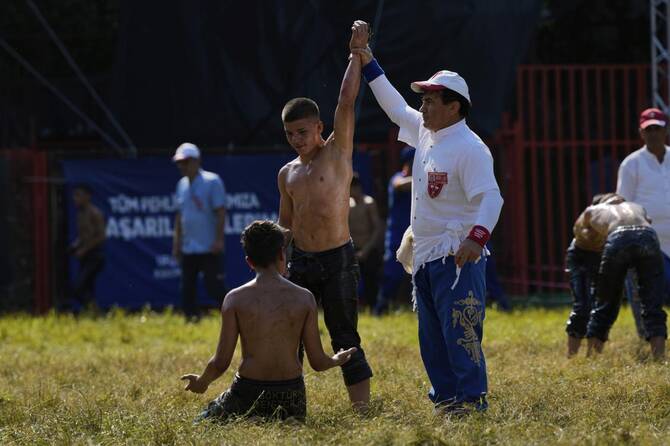
A referee announces the victory of a young wrestler in a round during the 664th annual Historic Kirkpinar Oil Wrestling championship, in Edirne, northwestern Turkiye on July 6, 2025.(AP)
3 / 6
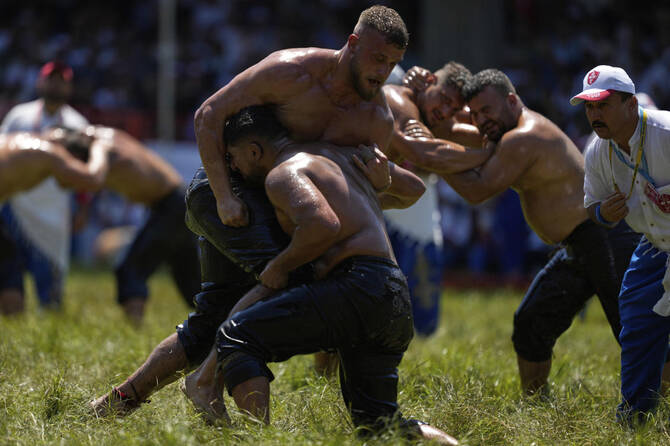
Wrestlers compete during the 664th annual Historic Kirkpinar Oil Wrestling championship, in Edirne, northwestern Turkiye on July 5, 2025. (AP)
4 / 6
Spectators watch wrestling rounds during the 664th annual Historic Kirkpinar Oil Wrestling championship, in Edirne, northwestern Turkiye on July 6, 2025. (AP)
5 / 6
Young wrestlers prepare as they wait for their turn to compete during the 664th annual Historic Kirkpinar Oil Wrestling Championship, in Edirne, northwestern Turkiye on July 6, 2025. (AP)
6 / 6
Wrestlers compete during the 664th annual Historic Kirkpinar Oil Wrestling championship, in Edirne, northwestern Turkey, Saturday, July 5, 2025. (AP Photo/Khalil Hamra)
Short Url
Updated 08 July 2025
Follow

Turkiye’s youngest oil wrestlers keeping a 14th-century tradition alive

  • The sport, which is on UNESCO’s intangible cultural heritage list, sees wrestlers cover themselves in olive oil and try to press their opponent’s back to the ground to win the bout

EDIRNE, Turkiye: On a grass field slick with olive oil and steeped in tradition, hundreds of boys as young as 11 joined the ranks of Turkiye’s most time-honored sporting event: the annual Kirkpinar Oil Wrestling Championship.

Held every summer in the northwestern city of Edirne, the event is said to date back to the 14th century as a way of keeping the Ottoman Empire’s fighting men fit and ready for battle.

The sport, which is on UNESCO’s intangible cultural heritage list, sees wrestlers cover themselves in olive oil and try to press their opponent’s back to the ground to win the bout.

Alongside the men contesting, youngsters also don the iconic “kispet” leather trousers to embark on a slippery test of strength, skill and stamina under the scorching sun.

The boys are ranked in divisions based on age, height and build, with the youngest generally placed in the “minik,” or tiny, category. Under strict safety regulations, their matches are shorter and closely supervised.

Most young wrestlers train year-round at local clubs, often in towns where oil wrestling is passed down through generations.

While the youngest competitors aren’t wrestling for titles like “baspehlivan,” the grand champion of the men’s matches, their participation is no less significant as it is key to the continuity of a sport that holds deep cultural importance across Turkiye.

This year’s contest – the 664th in its history – saw 36-year-old Orhan Okulu win his third men’s title.

“My goal was the golden belt in Kirkpinar and thanks to my God, I succeeded,” Okulu said of the coveted prize.


Egypt’s grand museum begins live restoration of King Khufu’s ancient boat

Visitors view the first solar boat of King Khufu, at the Grand Egyptian Museum in Giza, Egypt, Tuesday, Dec. 23, 2025. (AP)
Updated 23 December 2025
Follow

Egypt’s grand museum begins live restoration of King Khufu’s ancient boat

  • The 4,600-year-old boat was built during the reign of King Khufu, the pharaoh who also commissioned the Great Pyramid of Giza

CAIRO: Egypt began a public live restoration of King Khufu’s ancient solar boat at the newly opened Grand Egyptian Museum on Tuesday, more than 4,000 years after the vessel was first built.
Egyptian conservators used a small crane to carefully lift a fragile, decayed plank into the Solar Boats Museum hall — the first of 1,650 wooden pieces that make up the ceremonial boat of the Old Kingdom pharaoh.
The 4,600-year-old boat was built during the reign of King Khufu, the pharaoh who also commissioned the Great Pyramid of Giza. The vessel was discovered in 1954 in a sealed pit near the pyramids, but its excavation did not begin until 2011 due to the fragile condition of the wood.
“You are witnessing today one of the most important restoration projects in the 21st century,” Egyptian Tourism Minister Sherif Fathy said.
“It is important for the museum, and it is important for humanity and the history and the heritage.”
The restoration will take place in full view of visitors to the Grand Egyptian Museum over the coming four years.